Stop Overthinking User Test Selection: It’s Just a Geometric Waiting Time
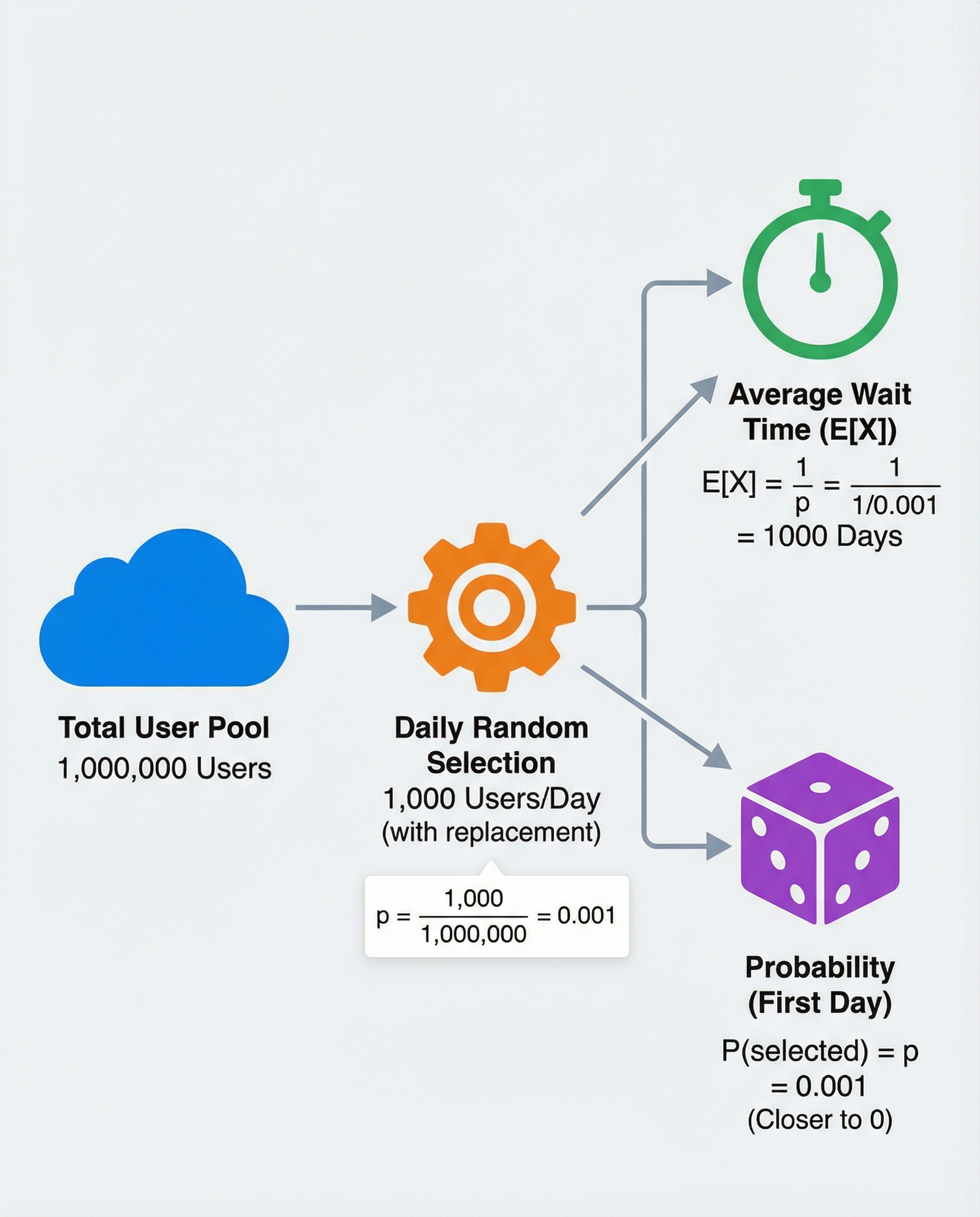
TL;DR: If each day a user has the same chance p of being picked, the number of days until that user is first selected follows a geometric distribution. Memorize the key rule: E[wait] = 1/p. For p = 1000/1,000,000 = 0.001, the average wait is 1/0.001 = 1000 days (~2.7 years).
Problem setup
Imagine an interviewer asks: "A service randomly chooses 1,000 users each day from a population of 1,000,000. How long until a given user is selected?"
Assumptions implicit in the simplest model:
- Each day is an independent trial.
- The per-day selection probability for that user is constant (p = 1000 / 1,000,000 = 0.001).
- Sampling is effectively with replacement relative to an individual user (the population is large and daily draws don't materially change p).
When those hold, the waiting time (measured in days) until the first selection is geometric.
The geometric solution (the piece you should say in an interview)
- PMF: P(T = k) = (1 - p)^(k-1) * p
- Mean: E[T] = 1 / p
- Memoryless property: P(T > n + k | T > n) = P(T > k)
Plugging numbers: p = 0.001
- Expected wait: E[T] = 1 / 0.001 = 1000 days (~2.7 years).
- Probability selected on day 1: p = 0.001 (0.1%).
- Probability selected within 365 days: 1 - (1 - p)^365 ≈ 30.6%.
- Probability selected within 1000 days: 1 - (1 - p)^1000 ≈ 1 - e^{-1} ≈ 63.2%.
Quick intuition: constant, independent daily chance ⇒ "each day is a fresh coin flip" until the first success. That is exactly the geometric scenario.
When this model breaks
The geometric model is the right first answer for interview-level reasoning, but note possible caveats in real systems:
- If draws are strictly without replacement at the population level and the population is small, you'd use a negative-hypergeometric or something similar. For very large populations and small daily samples, the geometric approximation is excellent.
- If p changes over time (e.g., the user is more/less likely on certain days), the simple geometric model no longer applies.
Interview tip
Say: "Since each day is an independent trial with constant p, the days-until-first-selection is geometric. So E[wait] = 1/p, which here gives 1000 days." Saying the constant-p ⇒ geometric connection quickly demonstrates you know the right model.
Takeaway
Stop overcomplicating it: when you can justify constant per-trial success probability, use the geometric distribution. Memorize E[T] = 1/p and the PMF; that combination solves many quick interview questions.
#DataScience #Statistics #InterviewPrep
About the author
bugfree.ai is an advanced AI-powered platform designed to help software engineers master system design and behavioral interviews. Whether you’re preparing for your first interview or aiming to elevate your skills, bugfree.ai provides a robust toolkit tailored to your needs. Key Features:
150+ system design questions: Master challenges across all difficulty levels and problem types, including 30+ object-oriented design and 20+ machine learning design problems. Targeted practice: Sharpen your skills with focused exercises tailored to real-world interview scenarios. In-depth feedback: Get instant, detailed evaluations to refine your approach and level up your solutions. Expert guidance: Dive deep into walkthroughs of all system design solutions like design Twitter, TinyURL, and task schedulers. Learning materials: Access comprehensive guides, cheat sheets, and tutorials to deepen your understanding of system design concepts, from beginner to advanced. AI-powered mock interview: Practice in a realistic interview setting with AI-driven feedback to identify your strengths and areas for improvement.
bugfree.ai goes beyond traditional interview prep tools by combining a vast question library, detailed feedback, and interactive AI simulations. It’s the perfect platform to build confidence, hone your skills, and stand out in today’s competitive job market. Suitable for:
New graduates looking to crack their first system design interview. Experienced engineers seeking advanced practice and fine-tuning of skills. Career changers transitioning into technical roles with a need for structured learning and preparation.
Comments
Join the discussionNo comments yet. Be the first to comment.