Stop Guessing in Interviews: Define the Right Metrics Like a Pro
In data and engineering interviews, metrics are not decoration — they are how you demonstrate impact. When an interviewer asks about success, don’t guess. Be deliberate: state the purpose, choose measurable KPIs, balance trade-offs, and explain how you'll track and evolve those metrics.
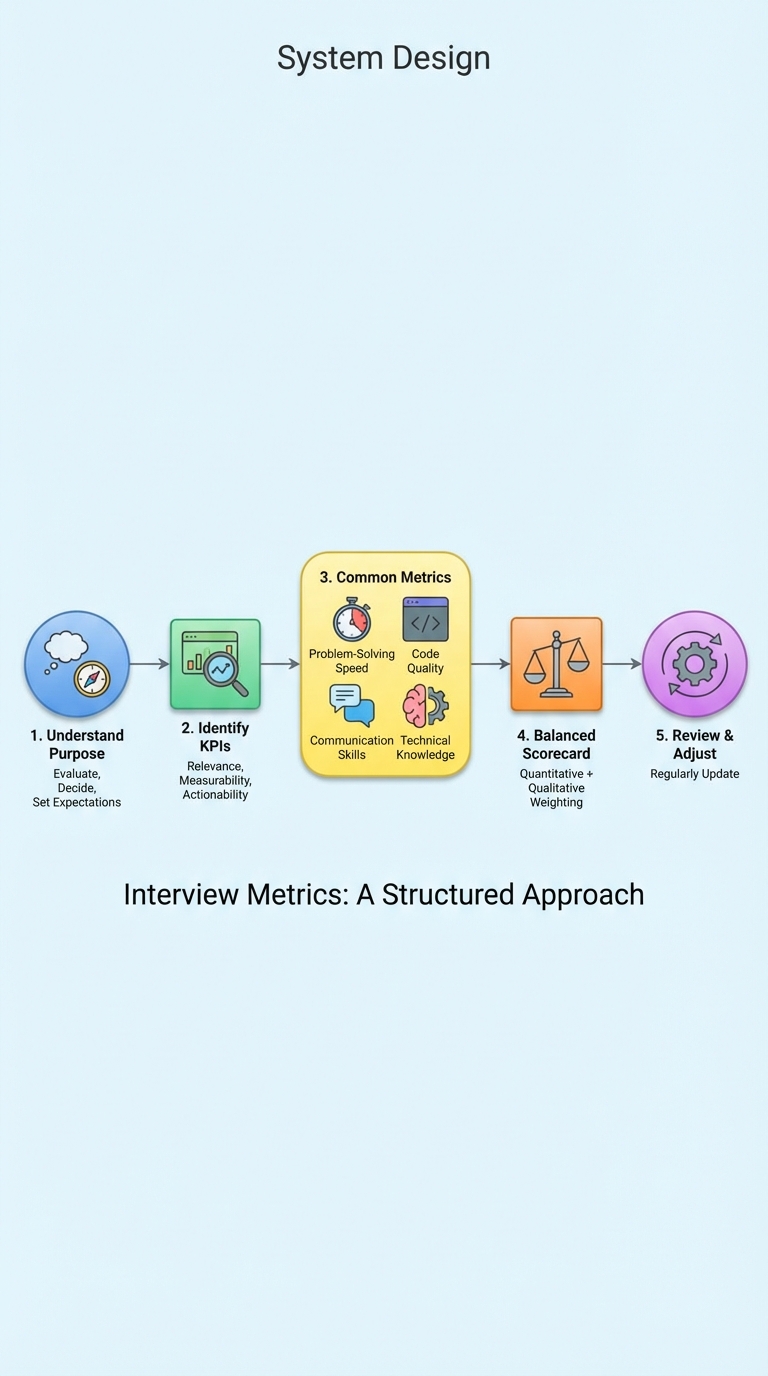
1) Start with the purpose
Always begin by saying why you’re measuring something. Common purposes:
- Evaluate model or feature performance (accuracy, fairness, latency)
- Guide product or technical decisions (adoption, cost/benefit)
- Set an objective bar for hiring or handoff
Example phrasing: “The goal is to evaluate if the recommendation model improves click-through while keeping latency under 100ms.”
2) Pick KPIs that matter: relevant, measurable, actionable
Choose indicators that map to the role and the purpose. A simple rule: relevant + measurable + actionable.
Examples by role:
- Data Science: accuracy, precision/recall, F1, AUC, calibration, model drift rate, inference latency, training cost
- Machine Learning Engineering: inference latency, throughput, memory footprint, deployment frequency, rollback rate
- Software Engineering: throughput/PR cycle time, mean time to recovery (MTTR), test coverage, code review turnaround, defect rate
- Site Reliability/Platform: uptime, p95/p99 latency, error budget burn rate, incident count
- Product/Analytics: activation, retention, conversion, revenue uplift, DAU/MAU
When giving numbers, state how you'd measure them (source of truth, sampling, time window). E.g.: “Precision measured on a weekly holdout set; threshold target >= 0.85.”
3) Use a balanced scorecard — combine dimensions, then weight them
One metric rarely tells the whole story. Combine dimensions such as:
- Accuracy/Correctness (technical correctness)
- Speed/Performace (latency, throughput)
- Code Quality & Maintainability (tests, review feedback)
- Communication & Collaboration (clarity of design, docs)
Sample weightings (adjust by seniority/job focus):
- Junior engineer: correctness 40%, code quality 30%, speed 10%, communication 20%
- Senior engineer: correctness 30%, code quality 25%, speed 15%, communication 30%
- ML engineer: model performance 40%, inference latency 20%, cost 20%, reproducibility 20%
Scoring example: weighted_score = sum(kpi_score * weight). Discuss trade-offs explicitly: increasing accuracy might increase latency or cost.
4) Be prepared to justify thresholds and trade-offs
Interviewers want to hear your reasoning, not just a checklist. Explain:
- Why a particular metric matters for the role/product
- How you chose thresholds (benchmarks, user impact, business goals)
- What trade-offs you’d accept (e.g., slight drop in precision for big latency improvements)
- How you’d monitor and alert (dashboards, alerting rules, periodic evaluation)
Example response: “I’d prioritize F1 because false positives are costly for users; target F1 >= 0.75. If latency exceeds 200ms, we’d prefer a simpler model to protect UX.”
5) Revisit metrics regularly
Roles, products, and constraints change. Commit to a cadence and triggers:
- Quarterly metric review with stakeholders
- Reassess after major product launches or infra changes
- Watch for drift or stale targets (seasonality, user behavior shifts)
When you change metrics, explain why: new business goals, maturity shifts, or measurement improvements.
Quick interview checklist
- State the measurement purpose first
- Pick 2–4 KPIs (relevant, measurable, actionable)
- Say how you’ll measure and the data source
- Offer thresholds and explain trade-offs
- Show a balanced scorecard and weightings if asked
- Describe monitoring and review cadence
Conclusion
In interviews, metrics turn opinions into evidence. Define why you measure, choose the right KPIs, balance trade-offs, and explain how you’ll monitor and evolve them. That clarity proves impact — and avoids guessing.
About the author
bugfree.ai is an advanced AI-powered platform designed to help software engineers master system design and behavioral interviews. Whether you’re preparing for your first interview or aiming to elevate your skills, bugfree.ai provides a robust toolkit tailored to your needs. Key Features:
150+ system design questions: Master challenges across all difficulty levels and problem types, including 30+ object-oriented design and 20+ machine learning design problems. Targeted practice: Sharpen your skills with focused exercises tailored to real-world interview scenarios. In-depth feedback: Get instant, detailed evaluations to refine your approach and level up your solutions. Expert guidance: Dive deep into walkthroughs of all system design solutions like design Twitter, TinyURL, and task schedulers. Learning materials: Access comprehensive guides, cheat sheets, and tutorials to deepen your understanding of system design concepts, from beginner to advanced. AI-powered mock interview: Practice in a realistic interview setting with AI-driven feedback to identify your strengths and areas for improvement.
bugfree.ai goes beyond traditional interview prep tools by combining a vast question library, detailed feedback, and interactive AI simulations. It’s the perfect platform to build confidence, hone your skills, and stand out in today’s competitive job market. Suitable for:
New graduates looking to crack their first system design interview. Experienced engineers seeking advanced practice and fine-tuning of skills. Career changers transitioning into technical roles with a need for structured learning and preparation.
Comments
Join the discussionNo comments yet. Be the first to comment.