The interview detail most people miss: treat stale data as a feature
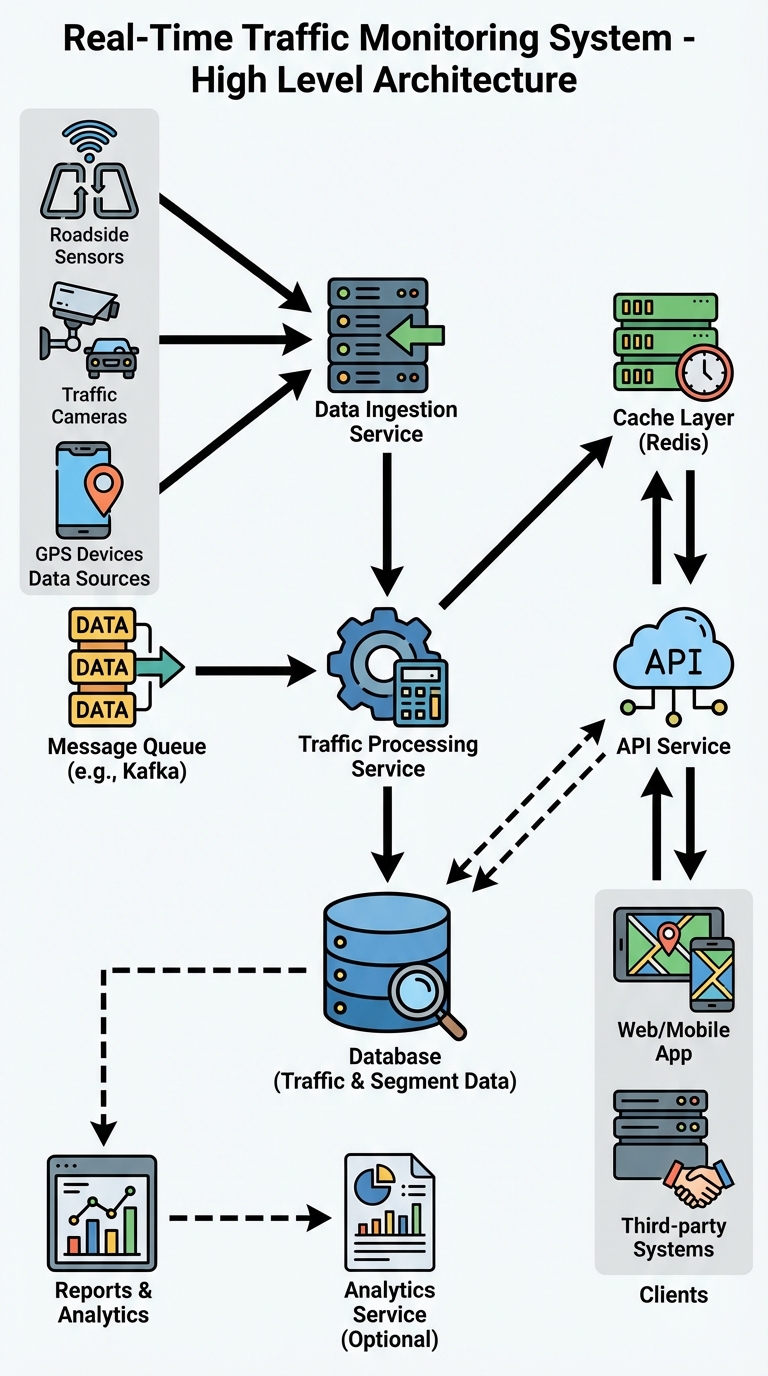
In a real-time traffic system the single biggest danger isn’t slow code — it’s old data that looks fresh. When clients assume every reading is up-to-date, they make brittle decisions (bad routing, misleading UI). The robust approach is the opposite: make freshness explicit and part of your API contract.
Design pattern: expose freshness per item
- Store a timestamp with every update (per road segment, sensor, etc.).
- Compute a freshness metric, e.g.
data_freshness_seconds = now - update_timestamp. - Mark results stale after a threshold (for example, 120s).
This converts uncertainty into a predictable contract: clients know whether a value is fresh enough for routing decisions, or should be treated conservatively.
Why this matters
- Predictable behavior: clients can implement deterministic fallbacks instead of guessing whether data is valid.
- Better UX: show "last updated" or "stale" indicators so users understand confidence.
- Safer automation: route calculations or control logic can avoid acting on stale inputs.
Implementation checklist
- Persist per-entity timestamps (not just a global last-updated). Fine-grained freshness matters.
- Compute and expose
data_freshness_seconds(or a status enum: FRESH / SOFT_STALE / STALE). - Choose sensible thresholds (e.g., 120s) but make them configurable per use-case.
- Surface freshness in your API (response fields, headers, or metadata).
- Consider push vs poll: whichever you use, still include timestamps.
- For caching layers, propagate and respect timestamps instead of hiding them.
Example (pseudo):
# When storing an update
record = { 'speed': 42, 'updated_at': now() }

# When serving results
data_freshness_seconds = now() - record['updated_at']
if data_freshness_seconds > 120:
    status = 'STALE'
else:
    status = 'FRESH'
What clients can do with freshness
- Degrade UI: show a warning, gray out data, or display "last seen 3m ago".
- Avoid risky actions: skip aggressive rerouting or other time-sensitive operations when data is stale.
- Use fallback strategies: historical averages, longer-window aggregates, or slower but more reliable data sources.
- Queue user actions until fresher data is available or request manual confirmation.
Interview talking points (what to say)
When asked about real-time design, be explicit and concise:
- "Freshness is part of the API, not an internal detail. Every update carries a timestamp and we expose a freshness measure to clients."
- "We classify data into freshness buckets (e.g., FRESH/STALE) and let client logic degrade or switch to fallbacks deterministically."
- "This prevents silent failures where stale data drives incorrect behavior — it converts uncertainty into a documented contract."
You can follow up with a quick implementation sketch (per-entity timestamps, data_freshness_seconds, configurable threshold) and examples of client-side behaviors.
Bottom line
Designs that hide staleness force consumers to guess about data quality. Instead, make freshness explicit, documented, and actionable. In interviews, framing this detail clearly shows system-level thinking: stale data isn't a bug to hide — it's a signal to manage.
#SystemDesign #DataEngineering #BackendEngineering
About the author
bugfree.ai is an advanced AI-powered platform designed to help software engineers master system design and behavioral interviews. Whether you’re preparing for your first interview or aiming to elevate your skills, bugfree.ai provides a robust toolkit tailored to your needs. Key Features:
150+ system design questions: Master challenges across all difficulty levels and problem types, including 30+ object-oriented design and 20+ machine learning design problems. Targeted practice: Sharpen your skills with focused exercises tailored to real-world interview scenarios. In-depth feedback: Get instant, detailed evaluations to refine your approach and level up your solutions. Expert guidance: Dive deep into walkthroughs of all system design solutions like design Twitter, TinyURL, and task schedulers. Learning materials: Access comprehensive guides, cheat sheets, and tutorials to deepen your understanding of system design concepts, from beginner to advanced. AI-powered mock interview: Practice in a realistic interview setting with AI-driven feedback to identify your strengths and areas for improvement.
bugfree.ai goes beyond traditional interview prep tools by combining a vast question library, detailed feedback, and interactive AI simulations. It’s the perfect platform to build confidence, hone your skills, and stand out in today’s competitive job market. Suitable for:
New graduates looking to crack their first system design interview. Experienced engineers seeking advanced practice and fine-tuning of skills. Career changers transitioning into technical roles with a need for structured learning and preparation.
Comments
Join the discussionNo comments yet. Be the first to comment.