SQL Interview Edge: Master Window Functions in 60 Seconds
bugfree.ai is an advanced AI-powered platform designed to help software engineers master system design and behavioral interviews. Whether you’re preparing for your first interview or aiming to elevate your skills, bugfree.ai provides a robust toolkit tailored to your needs. Key Features:
150+ system design questions: Master challenges across all difficulty levels and problem types, including 30+ object-oriented design and 20+ machine learning design problems. Targeted practice: Sharpen your skills with focused exercises tailored to real-world interview scenarios. In-depth feedback: Get instant, detailed evaluations to refine your approach and level up your solutions. Expert guidance: Dive deep into walkthroughs of all system design solutions like design Twitter, TinyURL, and task schedulers. Learning materials: Access comprehensive guides, cheat sheets, and tutorials to deepen your understanding of system design concepts, from beginner to advanced. AI-powered mock interview: Practice in a realistic interview setting with AI-driven feedback to identify your strengths and areas for improvement.
bugfree.ai goes beyond traditional interview prep tools by combining a vast question library, detailed feedback, and interactive AI simulations. It’s the perfect platform to build confidence, hone your skills, and stand out in today’s competitive job market. Suitable for:
New graduates looking to crack their first system design interview. Experienced engineers seeking advanced practice and fine-tuning of skills. Career changers transitioning into technical roles with a need for structured learning and preparation.
SQL Interview Edge: Master Window Functions in 60 Seconds
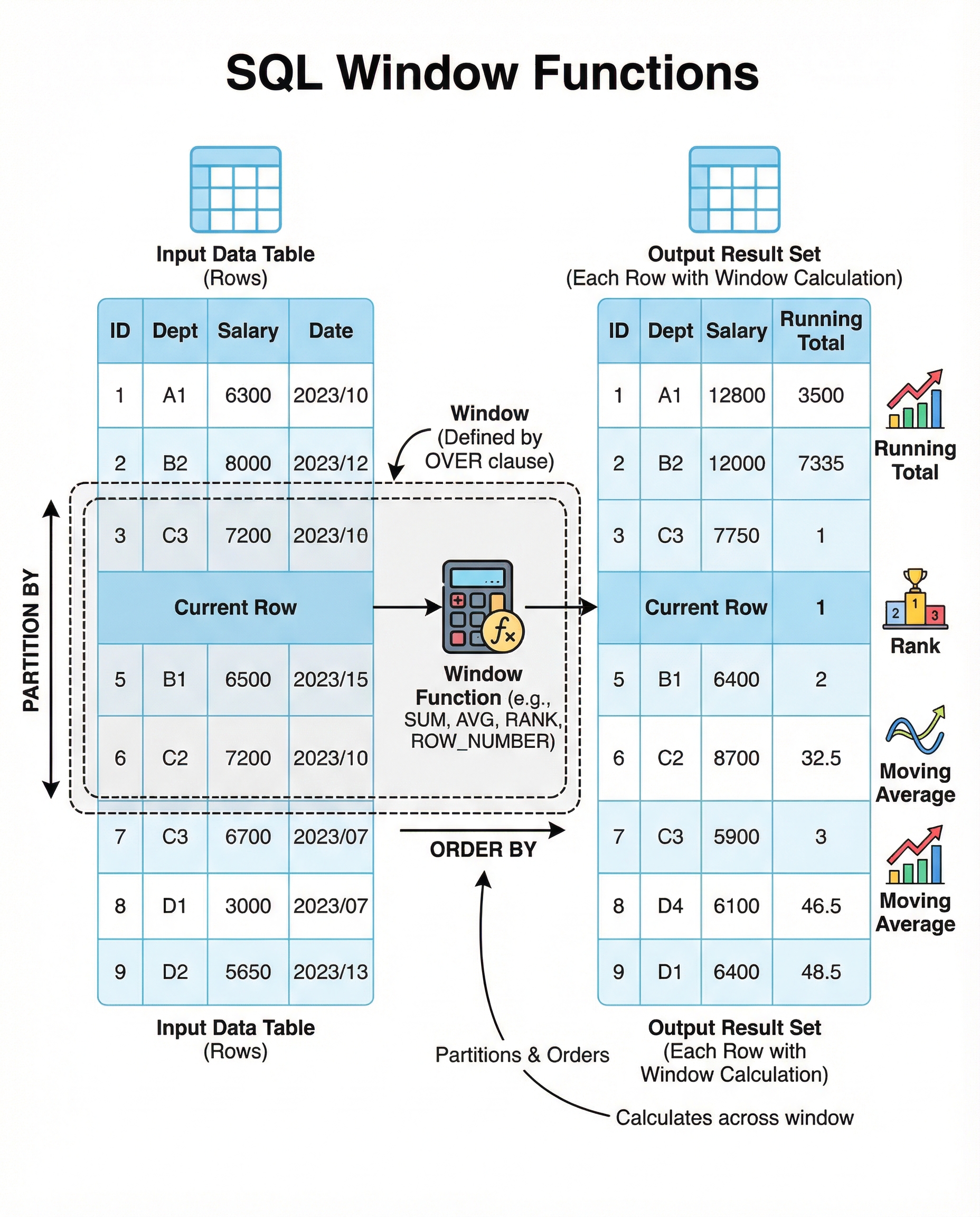
Window functions are an interview favorite because they compute per-row results without collapsing your data. The core pattern to remember:
<function>(...) OVER (
  PARTITION BY <cols>    -- optional: splits rows into groups
  ORDER BY <cols>        -- optional: defines ordering inside each partition
  ROWS|RANGE BETWEEN ...  -- optional: frame control for moving aggregates
)
Quick guide to the most-used functions:
- ROW_NUMBER(): gives a unique sequential number to rows in the window. Use when you need a deterministic, tie-breaking sequence.
- RANK(): assigns the same rank to ties but leaves gaps after ties (1, 2, 2, 4).
- DENSE_RANK(): like RANK() but without gaps (1, 2, 2, 3).
- SUM() OVER (ORDER BY ... ROWS UNBOUNDED PRECEDING): running total.
- AVG() OVER (... ROWS BETWEEN n PRECEDING AND CURRENT ROW): moving average.
Important tips:
- Window functions do NOT reduce the number of rows — they add per-row calculations.
- You must specify ORDER BY for running totals and moving aggregates to be deterministic.
- Use ROWS for a physical number of rows (e.g., last 3 rows), RANGE for value-based frames (can behave differently with ties).
- Window functions cannot be used in WHERE (use a subquery or CTE), but they can appear in SELECT and ORDER BY.
Examples you can memorize and adapt:
1) Running total by date
SELECT
  order_id,
  order_date,
  amount,
  SUM(amount) OVER (ORDER BY order_date
                    ROWS UNBOUNDED PRECEDING) AS running_total
FROM orders;
2) Salary rank within a department
SELECT
  employee_id,
  department,
  salary,
  RANK() OVER (PARTITION BY department
               ORDER BY salary DESC) AS dept_rank
FROM employees;
If you want no gaps in ranks, replace RANK() with DENSE_RANK().
3) 3-month moving average (per store)
SELECT
  store_id,
  month_date,
  sales,
  AVG(sales) OVER (PARTITION BY store_id
                    ORDER BY month_date
                    ROWS BETWEEN 2 PRECEDING AND CURRENT ROW) AS moving_avg_3m
FROM store_monthly_sales;
Practice these 3 exercises until you can write the queries from memory:
- Running total for orders (global or per-customer).
- Department salary rank (and switch between RANK/DENSE_RANK/ROW_NUMBER).
- 3-period moving average using ROWS BETWEEN n PRECEDING AND CURRENT ROW.
Mastering these patterns gives you immediate leverage in interviews — window functions are a fast way to show SQL fluency.