High-Score (Bugfree Users) Interview Experience: Snowflake Software Engineer — Process, Rounds & Key Takeaways
A candidate shared a high-scoring interview loop for a Software Engineer role at Snowflake. This write-up summarizes the process, each round, what mattered, and the biggest lessons you can apply to your own prep.
Interview loop (at a glance)
- Phone screen
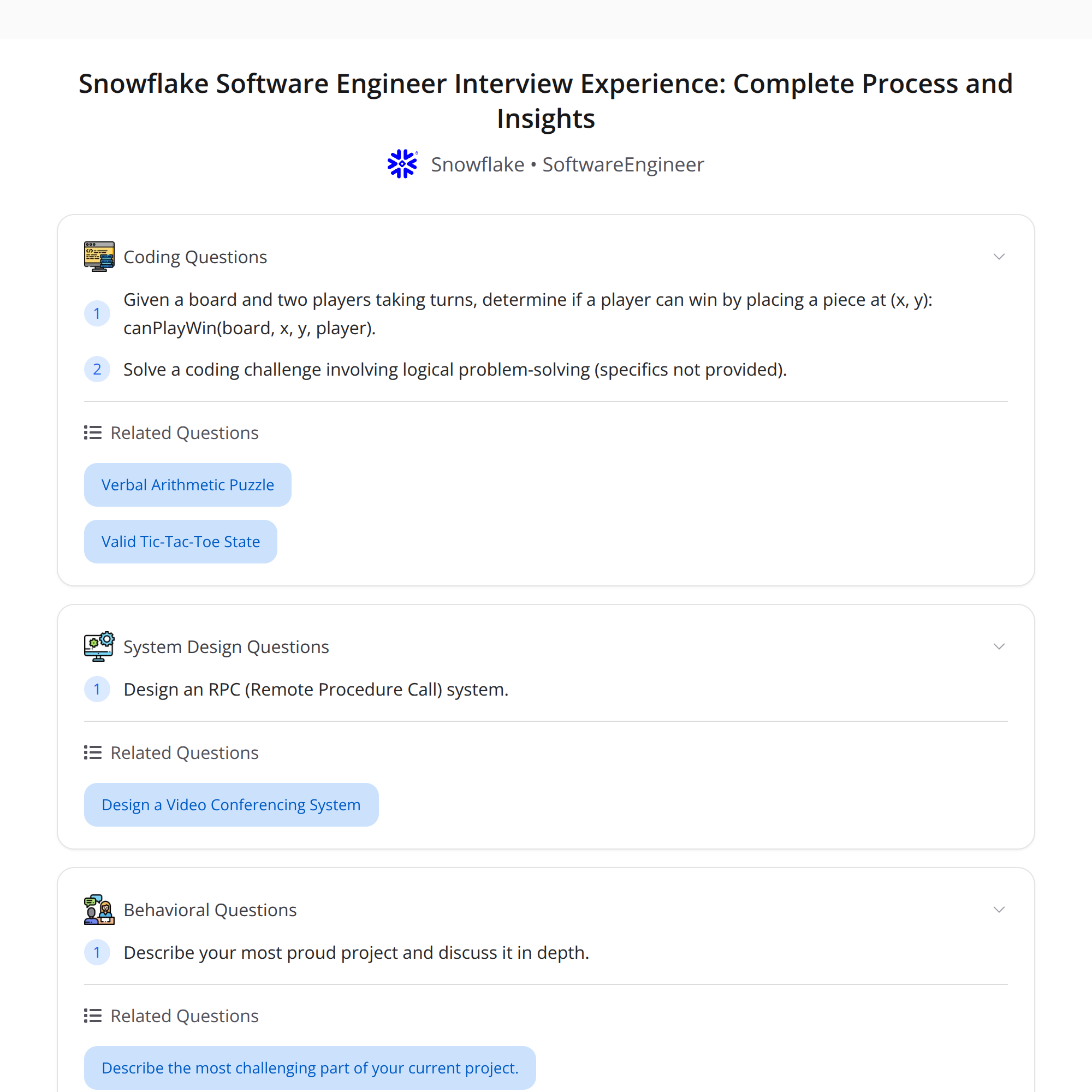
- Coding 1 — board-game "win check" (simplicity and clear reasoning mattered)
- System design — design an RPC system (unconventional, required on-the-fly decisions)
- Coding 2 — solid algorithmic problem-solving
- Behavioral — walk through a proud project and deep-dive questions
Round-by-round notes
Phone screen
- Typical initial screen to assess background, basics, and cultural fit.
- Be concise about past roles, impact, and why Snowflake.
Coding 1 — board-game win check
- Problem type: game-state evaluation (e.g., check if a board position is a win).
- What mattered most: clear, simple logic and communication, not overengineering.
- Tips: start with a straightforward brute-force or rule-based approach, explain correctness and complexity, then iterate to optimize if time allows.
System Design — RPC system
- Task: design an RPC-like system (unconventional prompt — required improvisation).
- Focus areas: API surface, request/response semantics, transport choices, failure modes, retries/timeouts, load balancing, and observability.
- Practical approach: sketch components, pick tradeoffs (e.g., HTTP/2 vs gRPC), address scaling and fault tolerance, and discuss monitoring and operational concerns.
- Tip: if the prompt is unusual, clarify scope early, state assumptions, and be explicit about what you'll leave out.
Coding 2 — algorithmic problem
- Standard evaluation of problem-solving ability and implementation correctness.
- Demonstrate systematic approach: clarify constraints, propose solution(s), analyze complexity, and test with edge cases.
Behavioral — proud project + deep dive
- Expect a deep dive into a project claimed as a highlight. Interviewers probe design choices, tradeoffs, metrics, failures, and ownership.
- Use STAR-style storytelling (Situation, Task, Action, Result). Provide numbers when possible and be honest about shortcomings.
Key takeaways
- Communication drives outcomes as much as correctness. Verbally explain thought processes, tradeoffs, and assumptions.
- Clarity > cleverness: simple, correct solutions with well-explained reasoning usually win over complex but opaque approaches.
- Be ready to improvise: nonstandard prompts (like an RPC design) require quick assumption-setting and focused scoping.
- Level calibration can shift mid-loop (e.g., IC3 → IC2) based on early signals. Stay adaptable — maintain momentum even if the perceived level changes.
- Behavioral depth matters: owning a project and being able to rigorously discuss design and impact is critical.
Practical prep checklist
- Practice concise verbalization: explain solutions step-by-step and call out complexities.
- Brush up on common algorithmic patterns (arrays, trees, graphs, DP) and whiteboard-style problems.
- Study system-design basics and RPC/distributed system fundamentals (gRPC, retries, idempotency, load balancing, observability).
- Prepare 2–3 strong project stories with metrics, tradeoffs, and lessons learned.
- Do mock interviews with a focus on both correctness and communication.
Final thoughts
This loop highlights a balanced evaluation: coding correctness, system-design thinking under constraints, and behavioral depth. Emphasize clear communication, be explicit about assumptions, and keep pace — those elements often make the difference.
Originally posted by Bugfree users — helpful as a high-score reference for Snowflake interview prep.
About the author
bugfree.ai is an advanced AI-powered platform designed to help software engineers master system design and behavioral interviews. Whether you’re preparing for your first interview or aiming to elevate your skills, bugfree.ai provides a robust toolkit tailored to your needs. Key Features:
150+ system design questions: Master challenges across all difficulty levels and problem types, including 30+ object-oriented design and 20+ machine learning design problems. Targeted practice: Sharpen your skills with focused exercises tailored to real-world interview scenarios. In-depth feedback: Get instant, detailed evaluations to refine your approach and level up your solutions. Expert guidance: Dive deep into walkthroughs of all system design solutions like design Twitter, TinyURL, and task schedulers. Learning materials: Access comprehensive guides, cheat sheets, and tutorials to deepen your understanding of system design concepts, from beginner to advanced. AI-powered mock interview: Practice in a realistic interview setting with AI-driven feedback to identify your strengths and areas for improvement.
bugfree.ai goes beyond traditional interview prep tools by combining a vast question library, detailed feedback, and interactive AI simulations. It’s the perfect platform to build confidence, hone your skills, and stand out in today’s competitive job market. Suitable for:
New graduates looking to crack their first system design interview. Experienced engineers seeking advanced practice and fine-tuning of skills. Career changers transitioning into technical roles with a need for structured learning and preparation.
Comments
Join the discussionNo comments yet. Be the first to comment.