ServiceNow Associate Machine Learning Engineer — Interview Experience (High-Score, Bugfree Users)
A Bugfree users post summarizing a successful interview for ServiceNow's Associate Machine Learning Engineer role. This write-up focuses on what was asked, how rounds were structured, and practical tips to prepare—especially if you expect a DSA/DP-heavy process.
Quick snapshot
- Total rounds: 3
- Focus: Data structures & algorithms (heavy), dynamic programming, plus a hiring-manager conversation on projects and ML design
- Overall advice: sharpen DSA/DP skills and practice clear communication
Round-by-round breakdown
Round 1 — Online coding (60 minutes)
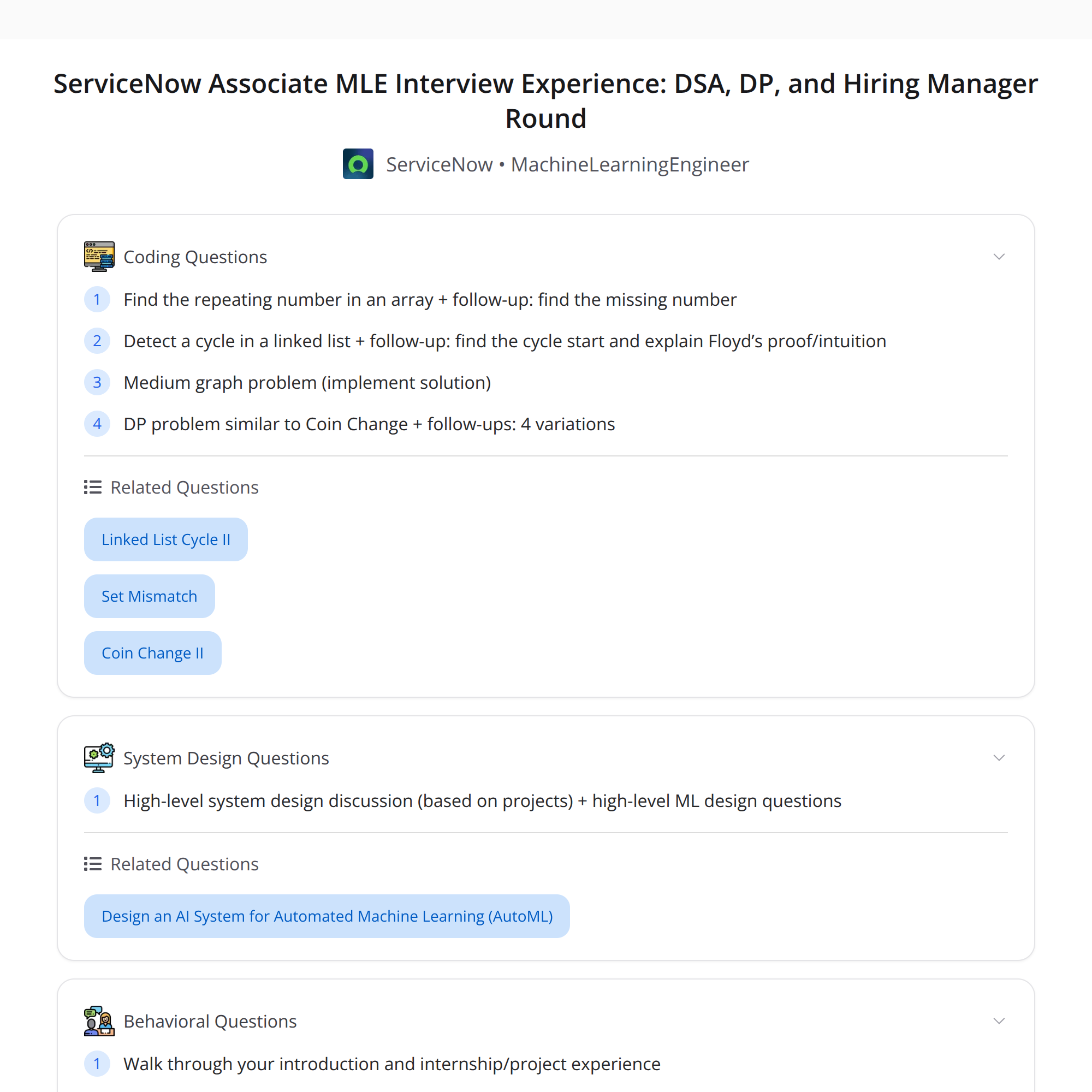
- Array problem involving a repeating element and a missing number (classic duplicate+missing pattern).
- Linked list cycle detection — implemented Floyd’s cycle-finding algorithm and discussed the proof/intuition behind it.
- A medium-level graph problem (expect typical graph techniques: BFS/DFS, shortest path insights or connectivity).
What to prepare:
- Array tricks: index mapping, XOR approaches, sum/formula checks, and handling edge cases.
- Linked lists: cycle detection (Floyd), reasoning about pointers and proof of meeting point.
- Graphs: be comfortable with BFS/DFS, adjacency lists, and time/space complexity trade-offs.
Round 2 — Coding + algorithm discussion (60 minutes)
- Dynamic programming focused: Coin Change style problem with four variations. The candidate coded one variant and verbally explained how to adapt the solution to the other three.
- Interviewers gave strong algorithmic feedback and paid attention to communication and clarity.
What to prepare:
- Classic DP templates: knapsack, coin change (min coins, combinations, permutations, bounded/unbounded variants).
- Practice writing one correct implementation and then explaining modifications for variants.
- Emphasize complexity analysis and explain trade-offs when moving between recursive/memoized and iterative tabulation approaches.
Round 3 — Hiring Manager (45 minutes)
- Deep dive into projects and internships — expect to explain decisions, trade-offs, evaluation metrics, and impact.
- Light ML questions and a high-level systems/design discussion (how you’d approach model-building, data pipeline, or a simple service design).
- Culture-fit and behavioral questions to assess team fit and communication style.
What to prepare:
- Project narratives: your role, technical choices, challenges, metrics, and outcomes.
- High-level ML thinking: problem framing, data requirements, model selection rationale, evaluation, and monitoring.
- Behavioral examples demonstrating collaboration, ownership, and learning from failure.
Key takeaways & interview tips
- Expect DSA-first interviews: heavy emphasis on arrays, linked lists, graphs, and DP.
- DP matters: be prepared to implement one variant and explain modifications for others.
- Prove your solutions: interviewers appreciated proofs/intuition (e.g., Floyd’s algorithm correctness).
- Communication counts: clearly explain your approach, assumptions, and edge-case handling.
- Projects still matter: the HM round probes deeper into your ML experience and design thinking.
Final checklist before the interview
- Revise Floyd’s cycle detection and be able to prove why it works.
- Practice coin change/knapsack problems and multiple variants of the same DP template.
- Solve medium graph problems and explain complexity.
- Prepare concise project stories with metrics and decisions.
- Practice clear step-by-step communication while coding.
Good luck—focus on DSA fundamentals, polish your DP templates, and be ready to communicate your thinking clearly.
#MachineLearning #InterviewPrep #DataStructuresAndAlgorithms
About the author
bugfree.ai is an advanced AI-powered platform designed to help software engineers master system design and behavioral interviews. Whether you’re preparing for your first interview or aiming to elevate your skills, bugfree.ai provides a robust toolkit tailored to your needs. Key Features:
150+ system design questions: Master challenges across all difficulty levels and problem types, including 30+ object-oriented design and 20+ machine learning design problems. Targeted practice: Sharpen your skills with focused exercises tailored to real-world interview scenarios. In-depth feedback: Get instant, detailed evaluations to refine your approach and level up your solutions. Expert guidance: Dive deep into walkthroughs of all system design solutions like design Twitter, TinyURL, and task schedulers. Learning materials: Access comprehensive guides, cheat sheets, and tutorials to deepen your understanding of system design concepts, from beginner to advanced. AI-powered mock interview: Practice in a realistic interview setting with AI-driven feedback to identify your strengths and areas for improvement.
bugfree.ai goes beyond traditional interview prep tools by combining a vast question library, detailed feedback, and interactive AI simulations. It’s the perfect platform to build confidence, hone your skills, and stand out in today’s competitive job market. Suitable for:
New graduates looking to crack their first system design interview. Experienced engineers seeking advanced practice and fine-tuning of skills. Career changers transitioning into technical roles with a need for structured learning and preparation.
Comments
Join the discussionNo comments yet. Be the first to comment.