High-Score Interview Experience: ServiceNow Associate Machine Learning Engineer (DSA/DP Heavy)
A Bugfree user shared a high-scoring interview walkthrough for ServiceNow’s Associate Machine Learning Engineer role. This account is concise but actionable — it highlights the focus areas, question types, and how each round was evaluated.
Quick Highlights
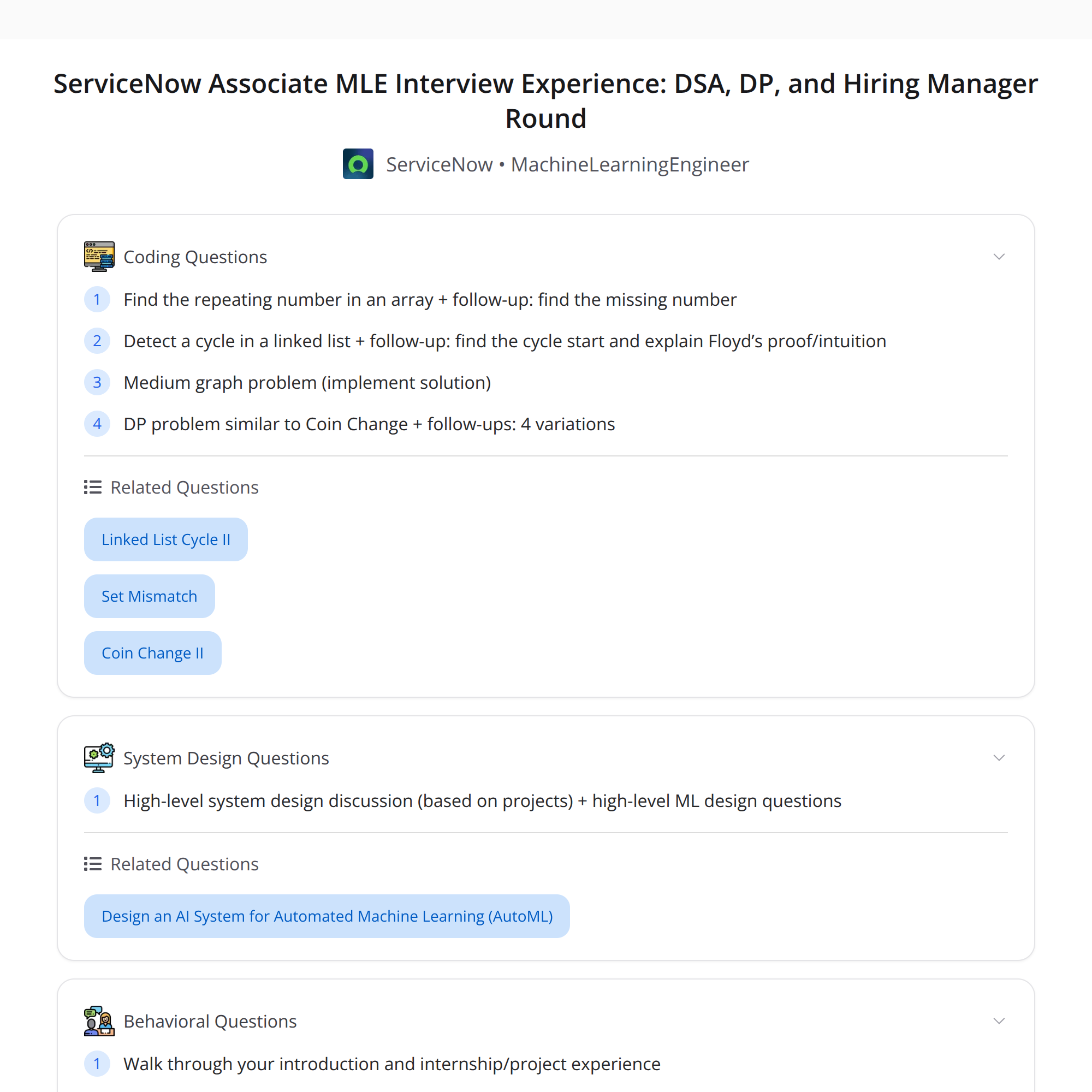
- Round 1 (60 min) — Data structures & algorithms heavy: array problem (repeating + missing number), linked list cycle detection (Floyd’s algorithm + proof), and a medium graph problem.
- Round 2 (60 min) — Dynamic programming focus: a coin-change style problem with 4 variations. Candidate coded one and explained solutions for the other variations. Interviewer gave strong algorithmic feedback; communication mattered.
- Round 3 (45 min) — Hiring Manager: deep dive into projects and internships, light ML discussion, high-level system/design questions, and culture-fit.
Takeaway: Expect a DSA-first interview for this role. Polish both algorithm skills (especially DP) and your communication/activity to explain choices.
Round-by-round breakdown & advice
Round 1 — DSA (60 minutes)
- Problems seen:
- Array: find repeating and missing numbers (common trick: XOR or math formulas; careful with overflow and constraints).
- Linked List: detect cycle using Floyd’s Tortoise and Hare (interviewer asked for the proof).
- Graph: a medium-level graph problem (likely BFS/DFS/topological order/shortest path style).
Tips:
- For the repeating + missing: be ready to discuss O(1) extra space approaches (XOR, sums) and trade-offs.
- For Floyd’s algorithm: be able to both code and give a short proof/intuition (why the two pointers meet). A concise proof: when a cycle exists, the fast pointer gains one step per move relative to the slow pointer; within k steps it will catch up inside the cycle.
- Practice medium graph patterns (connected components, shortest path variations, cycle detection in directed graphs).
Suggested practice: LeetCode arrays, linked list pattern problems, and common graph mid-level problems.
Round 2 — DP heavy (60 minutes)
- Problem style: Coin change with 4 variations. Candidate coded one variation and verbally explained the other three.
Common coin-change variations to prep for:
- Count number of ways to make amount (order-independent vs order-dependent).
- Minimum coins to make amount (classic unbounded knapsack min-coin problem).
- Return actual combination(s) (reconstruct path via parent pointers or DP backtracking).
- Bounded vs unbounded variants (each coin once vs infinite supply).
Tips:
- Be fluent with both top-down (memoization) and bottom-up approaches.
- Practice identifying state and recurrence quickly: e.g., dp[i] = min(dp[i], dp[i-coin] + 1) for min coins; dp[amount+1] base for impossible states.
- When asked to implement one and explain others, code cleanly and narrate the differences (state, iteration order, base cases).
- Interviewers appreciate algorithmic feedback: articulate time/space complexity and possible optimizations.
Suggested practice: DP patterns collection (coin change, knapsack, LIS variants, partition problems). Striver/NeetCode playlists are good for pattern recognition.
Round 3 — Hiring Manager (45 minutes)
- Focus: Projects and internships, ML basics at a high level, design questions, and culture fit.
Tips:
- Prepare concise project stories: problem, approach, your role, metrics/impact, challenges, and what you'd do differently.
- Expect high-level ML discussion — model choices, evaluation metrics, data pipelines — but not necessarily deep math proofs.
- Be ready to discuss system or feature design (trade-offs, scalability, monitoring) at a high level.
- Demonstrate curiosity and culture fit: teamwork, learning, and ownership examples.
Practical preparation plan (2–4 weeks roadmap)
- Week 1: Warm up DSA — arrays, linked lists, two-pointer, basic graphs. 30–40 focused problems.
- Week 2: Graphs + medium problems. Practice one medium graph each day and revisit tricky patterns.
- Week 3: DP deep dive — coin-change family, knapsack, partition. Implement variants and explain differences.
- Week 4: Projects & system design prep — prepare 3–4 project stories and mock HM Q&A.
During practice: time-box problems, explain solutions out loud, and practice writing clean code with edge cases.
Quick interview-day tips
- Communicate the plan before coding: explain approach, complexity, and edge cases.
- If stuck, mention trade-offs and ask clarifying questions — interviewers value thought process.
- For DP problems, if pressed for time, briefly outline the memoization approach and complexity before coding.
Resources
- LeetCode (Arrays, Linked List, Graphs, DP)
- Striver/NeetCode playlists for patterns and curated lists
- GeeksforGeeks for proofs and explanation (e.g., Floyd’s cycle detection proof)
- Competitive programming practice for quick pattern recognition
Final takeaway
ServiceNow’s Associate MLE interview described here is DSA-first with a strong emphasis on dynamic programming. Technical correctness matters, but so does clear communication and the ability to explain variations and trade-offs. Prepare with targeted DSA + DP practice and polish your project stories for the HM round.
About the author
bugfree.ai is an advanced AI-powered platform designed to help software engineers master system design and behavioral interviews. Whether you’re preparing for your first interview or aiming to elevate your skills, bugfree.ai provides a robust toolkit tailored to your needs. Key Features:
150+ system design questions: Master challenges across all difficulty levels and problem types, including 30+ object-oriented design and 20+ machine learning design problems. Targeted practice: Sharpen your skills with focused exercises tailored to real-world interview scenarios. In-depth feedback: Get instant, detailed evaluations to refine your approach and level up your solutions. Expert guidance: Dive deep into walkthroughs of all system design solutions like design Twitter, TinyURL, and task schedulers. Learning materials: Access comprehensive guides, cheat sheets, and tutorials to deepen your understanding of system design concepts, from beginner to advanced. AI-powered mock interview: Practice in a realistic interview setting with AI-driven feedback to identify your strengths and areas for improvement.
bugfree.ai goes beyond traditional interview prep tools by combining a vast question library, detailed feedback, and interactive AI simulations. It’s the perfect platform to build confidence, hone your skills, and stand out in today’s competitive job market. Suitable for:
New graduates looking to crack their first system design interview. Experienced engineers seeking advanced practice and fine-tuning of skills. Career changers transitioning into technical roles with a need for structured learning and preparation.
Comments
Join the discussionNo comments yet. Be the first to comment.