The single rule for RTB systems: protect latency
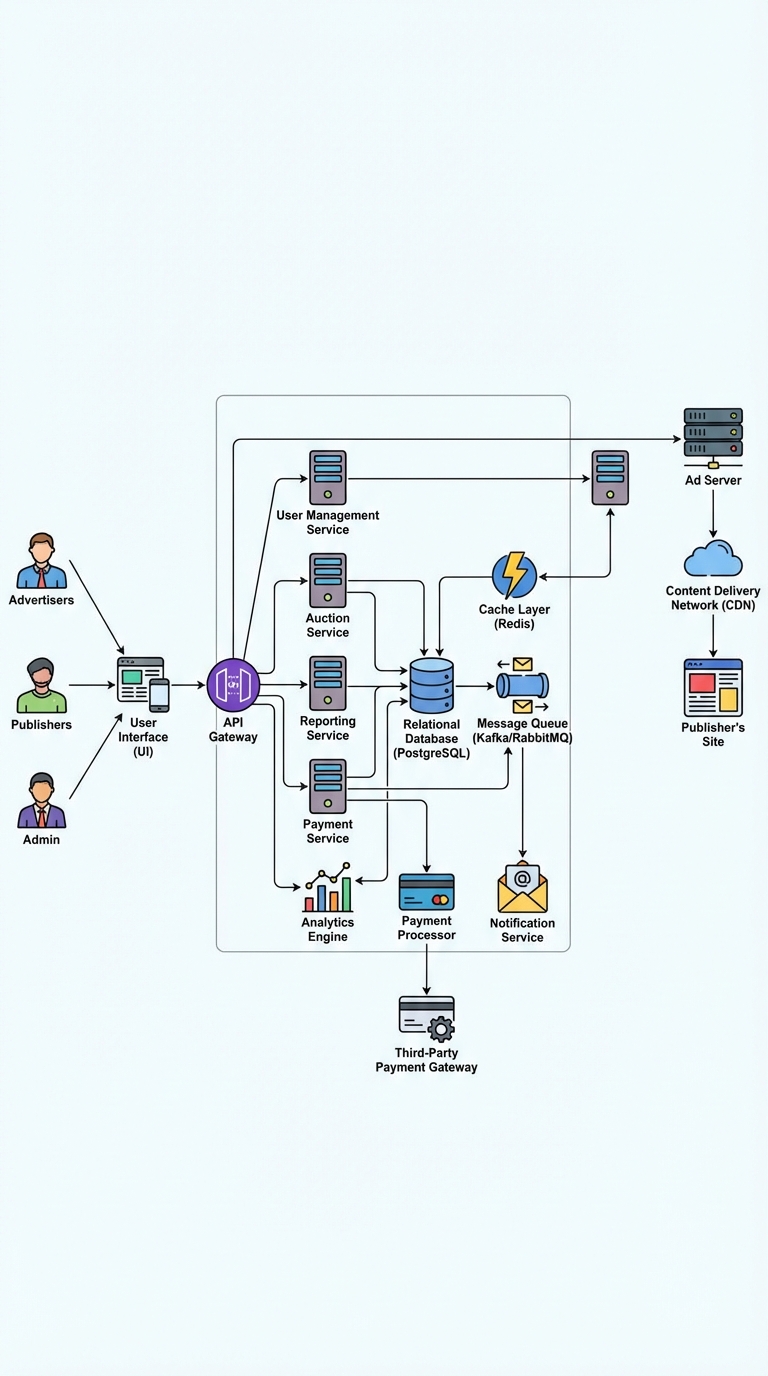
In a real-time bidding (RTB) system, never evaluate bids synchronously on the request path. The primary goal of your bidding API is to accept bids quickly and protect end-to-end latency for bidders and the auctioneer.
If your request path tries to do heavy evaluation, persist state, or run business rules inline, you'll introduce latency, increase timeouts during traffic spikes, and make retries risky. Instead, embrace an asynchronous, event-driven flow.
Correct approach (high-level)
- Accept the incoming bid fast (respond to the client).
- Persist the raw bid record to durable storage (database or write-ahead store).
- Publish a bid event to a message queue or streaming system.
- A separate Bid Evaluator service consumes events, compares bids, and updates the current best bid for that auction.
- An Auction Manager (or scheduler) closes the auction at its configured end_time and finalizes the winner.
This decoupling keeps your API fast, increases throughput, and makes retries safe when combined with idempotency and deduplication.
Why this pattern works
- Latency protection: The request path only does a quick accept + persist. Heavy evaluation happens off the critical path.
- Higher throughput: Consumers can be scaled independently of the API layer. You can tune partitioning and parallelism for the evaluator.
- Resilience to spikes: Message queues buffer bursts and smooth processing.
- Safe retries: With idempotency keys and dedup, at-least-once delivery from the queue won't corrupt auction state.
Implementation details and best practices
Persist immediately: Write the raw bid (auction_id, bidder_id, bid_amount, timestamp, idempotency_key) to durable storage before returning success.
Use an event stream: Publish a compact event (e.g., bid_id, auction_id) to Kafka, Kinesis, Pub/Sub, or SQS for the evaluator to consume.
Partition by auction_id: Ensure events for the same auction go to the same consumer partition to maintain ordering and avoid cross-consumer conflicts.
Idempotency & dedup:
- Use a unique idempotency_key per bid submission.
- Keep a deduplication store keyed by idempotency_key (or persist uniqueness constraints in the DB) so retries don't create duplicate effects.
- Consumers should handle at-least-once semantics by checking whether a bid has already been applied.
Best-bid updates:
- The Bid Evaluator should read the current best bid and apply a compare-and-set (or DB transaction) to update only if the incoming bid is better.
- Define "better" explicitly (price, timestamp tie-breaker, bidder priority).
- Use optimistic concurrency control or database transactions to avoid lost updates.
Auction closing:
- Auction Manager monitors auction end_time and finalizes the winner.
- It should consider late-arriving bids according to your lateness policy (reject, accept within a grace window, or extend auction).
Monitoring & observability:
- Track queue lag, consumer throughput, persistence latencies, and discarded/duplicate events.
- Create alerts for increasing queue lag or persistent consumer errors.
Common pitfalls
- Evaluating on the request path: Causes timeouts and cascading failures during spikes.
- Not partitioning properly: If events for the same auction can be processed concurrently on different consumers, you’ll introduce race conditions.
- Ignoring idempotency: Without dedup, retries and at-least-once delivery can double-apply bids.
- Overly strict ordering assumptions: Don’t assume perfect ordering from distributed queues; design with at-least-once and potential reordering in mind.
Minimal pseudocode
Request handler:
onBidRequest(bid):
  persistBid(bid)                # durable write
  publishEvent({ bid_id })       # lightweight event
  return 200 OK                   # respond fast
Consumer (Bid Evaluator):
onBidEvent(event):
  bid = fetchBid(event.bid_id)
  if alreadyProcessed(bid.idempotency_key):
    return
  currentBest = readBestBid(bid.auction_id)
  if isBetter(bid, currentBest):
    updateBestBid(bid.auction_id, bid)  # CAS/transactional update
  markProcessed(bid.idempotency_key)
Auction finalization:
onAuctionClose(auction_id):
  winner = readBestBid(auction_id)
  finalizeWinner(winner)
TL;DR
Do not process bid evaluation synchronously on the request path. Accept and persist quickly, publish an event, and evaluate bids asynchronously with idempotency and proper partitioning. This pattern protects latency, increases throughput, and makes your RTB system robust to spikes and retries.
#SystemDesign #DistributedSystems #AdTech
About the author
bugfree.ai is an advanced AI-powered platform designed to help software engineers master system design and behavioral interviews. Whether you’re preparing for your first interview or aiming to elevate your skills, bugfree.ai provides a robust toolkit tailored to your needs. Key Features:
150+ system design questions: Master challenges across all difficulty levels and problem types, including 30+ object-oriented design and 20+ machine learning design problems. Targeted practice: Sharpen your skills with focused exercises tailored to real-world interview scenarios. In-depth feedback: Get instant, detailed evaluations to refine your approach and level up your solutions. Expert guidance: Dive deep into walkthroughs of all system design solutions like design Twitter, TinyURL, and task schedulers. Learning materials: Access comprehensive guides, cheat sheets, and tutorials to deepen your understanding of system design concepts, from beginner to advanced. AI-powered mock interview: Practice in a realistic interview setting with AI-driven feedback to identify your strengths and areas for improvement.
bugfree.ai goes beyond traditional interview prep tools by combining a vast question library, detailed feedback, and interactive AI simulations. It’s the perfect platform to build confidence, hone your skills, and stand out in today’s competitive job market. Suitable for:
New graduates looking to crack their first system design interview. Experienced engineers seeking advanced practice and fine-tuning of skills. Career changers transitioning into technical roles with a need for structured learning and preparation.
Comments
Join the discussionNo comments yet. Be the first to comment.