High-Score (Bugfree) Interview Experience: Roblox Recruiter Initial Screening — What Actually Matters
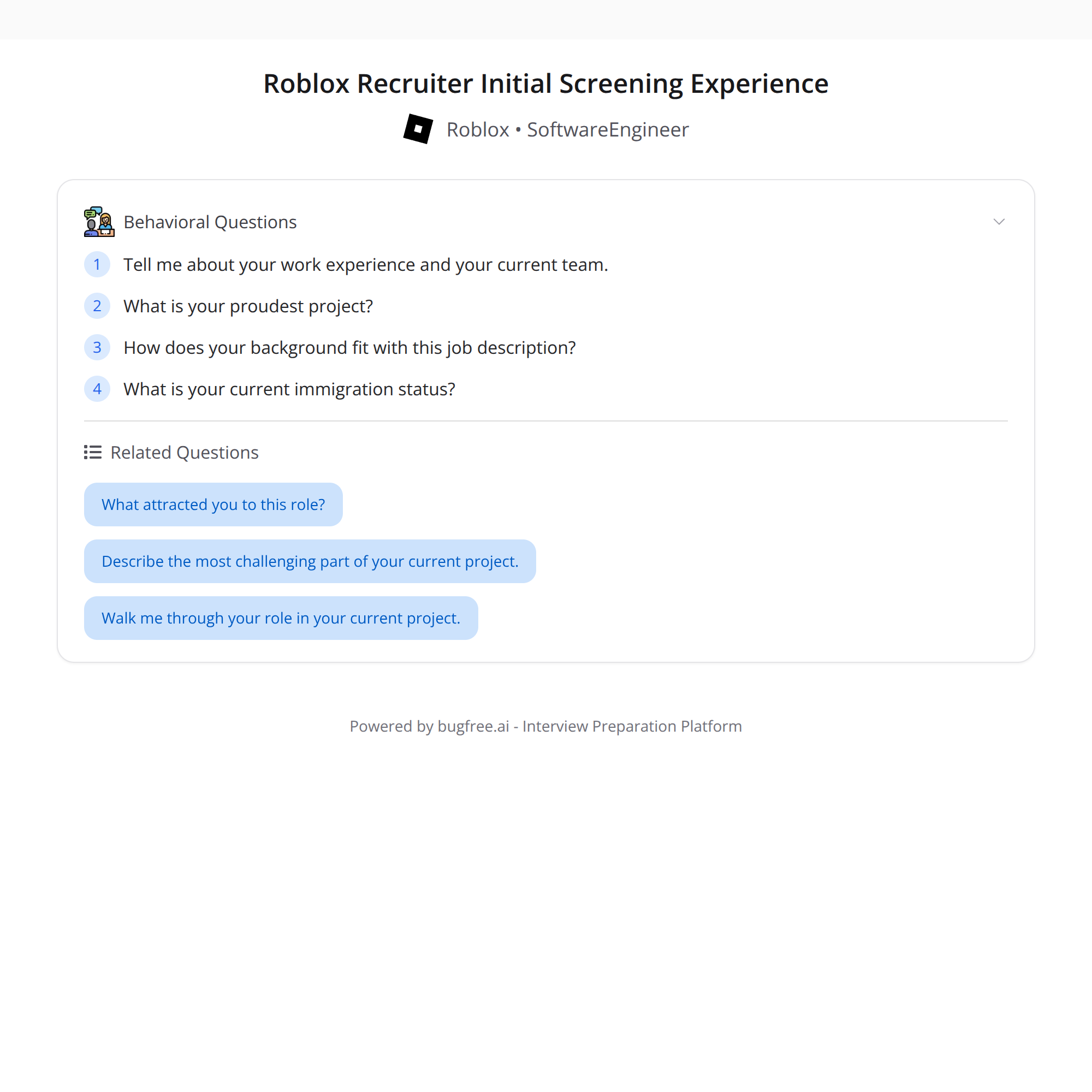
TL;DR: The Roblox recruiter screen is short and behavioral — focus on a tight intro, a single “proudest project” story that shows impact, and be upfront about immigration status and timelines. Be proactive: updates can be slow and recruiters may change mid-process.
What the recruiter screen actually looks for
- Behavioral fit and clear communication. Recruiters want to understand who you are, not deep technical details.
- Signal of impact: what you shipped, your role, and measurable outcomes.
- Alignment with the job description — both skills and seniority/expectations.
- Practical constraints like visa status and availability, which affect scheduling and offer timelines.
How to prepare (quick and actionable)
Craft a tight intro (30–60 seconds)
- Who you are, what you do today, and what you want next.
- Example: "I'm a backend engineer with 5 years building scalable services at X, currently focused on latency optimizations in payments. I'm looking to join a product-driven team where I can scale systems and mentor junior engineers."
Prepare one strong “proudest project” story (use STAR + metrics)
- Situation: One-sentence context.
- Task: Your responsibility.
- Action: Key technical and collaboration choices.
- Result: Concrete impact (numbers, user experience, time saved).
- Example structure: "At Company X I led a migration to a new caching layer (S). I owned design and rollout (T). I implemented batched warming and feature flags to reduce risk (A). That cut tail latency by 40% and reduced incident volume by 30% (R)."
Align answers to the job description
- Mirror keywords (e.g., "distributed systems," "telemetry," "cross-functional leadership") and give short examples that demonstrate those skills.
Be ready to discuss immigration and logistics
- Expect questions about visa type (H-1B), petition stage (I-140), work authorization, and notice periods.
- Be honest about constraints; this helps recruiters assess timeline feasibility rather than being used against you.
Timeline realities and communication
- The process can feel slow — expect status updates to land on business days and potentially take several days.
- Recruiters can change midstream. If you notice a new recruiter, reintroduce yourself briefly and reiterate interest.
- Stay proactive: send concise follow-ups (e.g., "Just checking in — still very interested and available for next steps") every 4–7 business days if you haven't heard back.
Sample lines and micro-scripts
- Tight intro: "I'm [Name], a [seniority] software engineer focused on [area]. At [current company] I led [brief project], and I'm exploring roles where I can [impact you want]."
- Proudest project opener: "My proudest project was... — I led X, we achieved Y (metric), and it mattered because Z." Keep it under 90 seconds.
- Visa/status line: "I currently work on an H‑1B and have an approved I‑140" or "I need employer sponsorship — happy to discuss timelines." (Be truthful.)
- Follow-up: "Thanks again for your time. I'm still excited about this role and available for next steps — let me know if you'd like any additional details."
Final tips (short)
- Keep answers concise but specific — recruiters screen for fit and red flags, not detailed technical explanations.
- Have your resume highlights and a portfolio link ready to paste into chat.
- Practice your "proudest project" out loud until it fits naturally into ~1–2 minutes.
- If a recruiter asks for clarification, use it as an opportunity to tie your experience back to the job.
Key takeaways
- Nail a 30–60s intro and one STAR story with metrics.
- Be transparent about immigration and timelines.
- Expect slow updates and occasional recruiter handoffs — follow up politely and proactively.
Tags: #SoftwareEngineering #InterviewTips #CareerGrowth
About the author
bugfree.ai is an advanced AI-powered platform designed to help software engineers master system design and behavioral interviews. Whether you’re preparing for your first interview or aiming to elevate your skills, bugfree.ai provides a robust toolkit tailored to your needs. Key Features:
150+ system design questions: Master challenges across all difficulty levels and problem types, including 30+ object-oriented design and 20+ machine learning design problems. Targeted practice: Sharpen your skills with focused exercises tailored to real-world interview scenarios. In-depth feedback: Get instant, detailed evaluations to refine your approach and level up your solutions. Expert guidance: Dive deep into walkthroughs of all system design solutions like design Twitter, TinyURL, and task schedulers. Learning materials: Access comprehensive guides, cheat sheets, and tutorials to deepen your understanding of system design concepts, from beginner to advanced. AI-powered mock interview: Practice in a realistic interview setting with AI-driven feedback to identify your strengths and areas for improvement.
bugfree.ai goes beyond traditional interview prep tools by combining a vast question library, detailed feedback, and interactive AI simulations. It’s the perfect platform to build confidence, hone your skills, and stand out in today’s competitive job market. Suitable for:
New graduates looking to crack their first system design interview. Experienced engineers seeking advanced practice and fine-tuning of skills. Career changers transitioning into technical roles with a need for structured learning and preparation.
Comments
Join the discussionNo comments yet. Be the first to comment.