High-Score Rippling Interview Experience — What the Hiring Manager Really Tests
A Bugfree user shared a concise, high-quality Rippling interview experience that highlights what matters most in the hiring-manager round. After a referral, the process moved quickly: a clear, professional phone screen followed by a deep-dive hiring-manager conversation. Even when the candidate didn't advance, structured feedback made the loop a great learning opportunity.
At-a-glance: timeline & format
- Referral → fast-moving recruiter contact
- Phone screen: candidate-friendly, professional, focused
- Hiring Manager round: a deep dive into one past project, best presented with a ~5-slide deck
- Feedback: specific and actionable, regardless of outcome
The Hiring Manager round — what to expect
This round is not a surface-level recap. Expect granular questions about:
- Your exact role and responsibilities on the project
- Concrete design/implementation choices and trade-offs
- Challenges you faced and how you mitigated them
- Technical and non-technical impact (metrics, adoption, downstream effects)
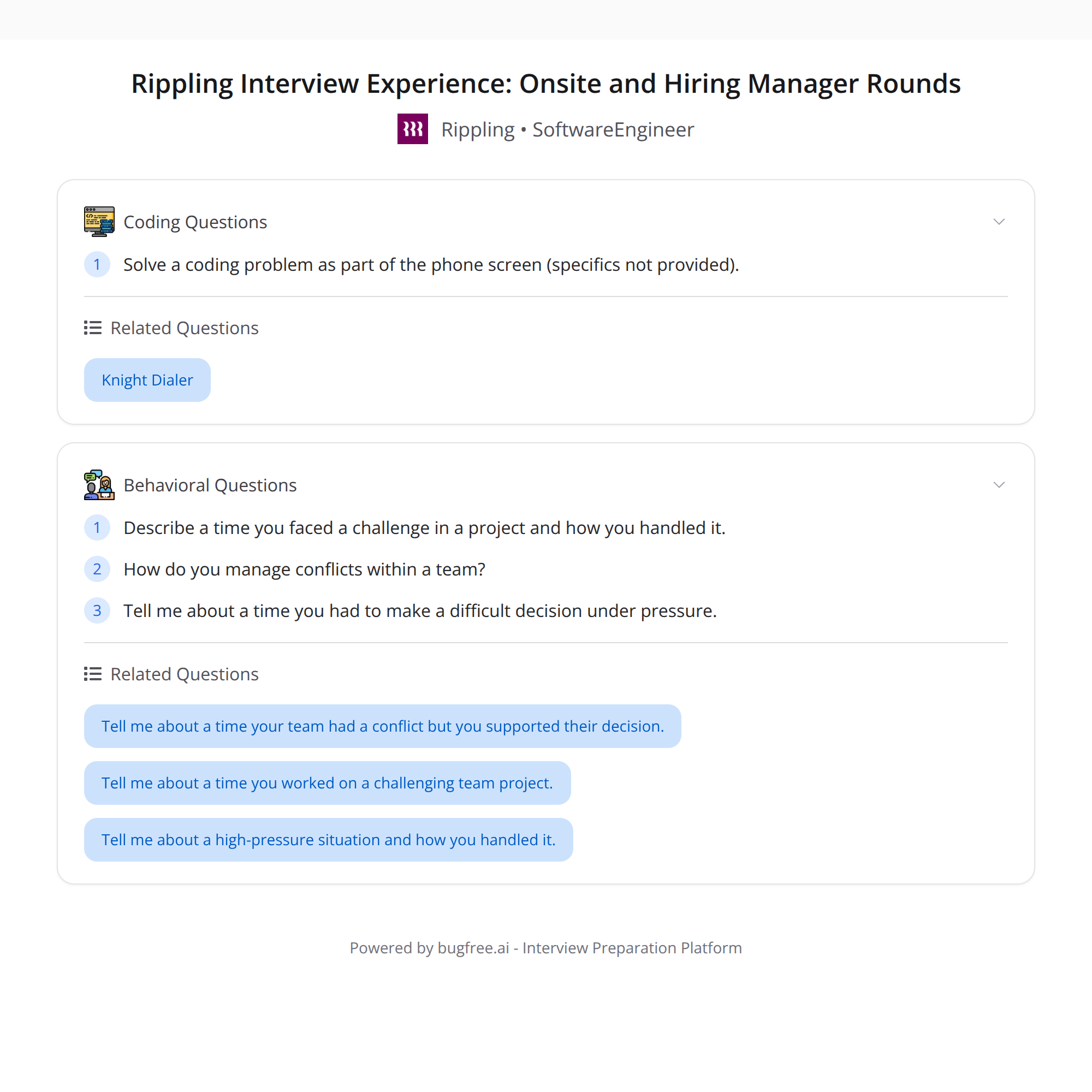
- Behavioral scenarios: teamwork, conflict, trade-offs under pressure, and decision-making
Bring a short, focused slide deck (roughly five slides) to guide the conversation and anchor evidence.
How to build an effective 5-slide project deck
- Problem & context — What was the user or business problem? Why did it matter?
- Your role — Be explicit: what did you own vs. what others owned?
- Solution overview — Key design and architecture choices, with diagrams if helpful
- Trade-offs & challenges — What options did you consider, why did you choose X, how did you mitigate risks?
- Impact & lessons — Quantified outcomes if possible, plus what you’d do differently now
Keep visuals simple, text minimal, and use one clear example per slide.
Example questions you might receive
- "What part of this project was specifically your responsibility?"
- "Walk me through the decision to choose X over Y — what were the trade-offs?"
- "How did you measure success and what metrics moved?"
- "Tell me about a conflict on the team and how it was resolved."
- "If you were to revisit this project today, what would you change?"
What the hiring manager is testing
- Depth of ownership and clarity about your contributions
- Ability to articulate trade-offs and reason under uncertainty
- Technical judgment: architecture, scalability, reliability considerations
- Communication: can you explain complex work clearly and concisely?
- Collaboration and behavioral fit: navigating conflict, cross-functional trade-offs
Why structured feedback matters
Even if you don’t move forward, the specific feedback from the hiring manager provides a clear roadmap for improvement — whether that’s showing deeper ownership, providing more metrics, or refining how you explain trade-offs.
Practical tips (quick wins)
- Prepare a 5-slide deck and rehearse a 10–15 minute walkthrough
- Be explicit about your role and contributions
- Bring concrete numbers or qualitative outcomes when metrics aren’t available
- Practice concise trade-off explanations (pros, cons, mitigations)
- Be ready for behavioral follow-ups that probe teamwork and pressure decisions
Takeaway
Rippling’s hiring-manager interview prioritizes depth and clarity. A focused project deck, precise ownership statements, and thoughtful trade-off explanations will serve you well. The structured feedback you get — win or lose — is valuable for sharpening future interviews.
#SoftwareEngineering #InterviewTips #CareerGrowth
About the author
bugfree.ai is an advanced AI-powered platform designed to help software engineers master system design and behavioral interviews. Whether you’re preparing for your first interview or aiming to elevate your skills, bugfree.ai provides a robust toolkit tailored to your needs. Key Features:
150+ system design questions: Master challenges across all difficulty levels and problem types, including 30+ object-oriented design and 20+ machine learning design problems. Targeted practice: Sharpen your skills with focused exercises tailored to real-world interview scenarios. In-depth feedback: Get instant, detailed evaluations to refine your approach and level up your solutions. Expert guidance: Dive deep into walkthroughs of all system design solutions like design Twitter, TinyURL, and task schedulers. Learning materials: Access comprehensive guides, cheat sheets, and tutorials to deepen your understanding of system design concepts, from beginner to advanced. AI-powered mock interview: Practice in a realistic interview setting with AI-driven feedback to identify your strengths and areas for improvement.
bugfree.ai goes beyond traditional interview prep tools by combining a vast question library, detailed feedback, and interactive AI simulations. It’s the perfect platform to build confidence, hone your skills, and stand out in today’s competitive job market. Suitable for:
New graduates looking to crack their first system design interview. Experienced engineers seeking advanced practice and fine-tuning of skills. Career changers transitioning into technical roles with a need for structured learning and preparation.
Comments
Join the discussionNo comments yet. Be the first to comment.