High-Score (Bugfree Users) Reddit MLE Interview: From Recs System Design to Ad Click Modeling
A concise, high-score interview playbook based on Bugfree users' experience with Reddit's Machine Learning Engineer (MLE) loop. The loop was structured, practical, and notably supportive — interviewers were friendly and the process was remote-friendly. Below is a breakdown of each round, what interviewers are looking for, and actionable tips to prepare.
Interview rounds (what to expect)
Hiring Manager (HM) screen
- Focus: resume review, leadership, career fit, and reverse questions (your questions for the team).
- What they assess: clarity of past impact, communication, priorities, leadership behaviors, and alignment with team mission.
- Tip: have 2–3 concise stories (STAR format) showing technical impact, trade-offs you made, and cross-team collaboration. Prepare meaningful questions about team metrics, product goals, and org structure.
PM cross-functional deep dive
- Focus: stakeholder alignment, product thinking, and conflict resolution.
- What they assess: ability to translate ML work into product value, negotiate trade-offs with PMs, and resolve conflicting priorities.
- Tip: practice framing model trade-offs in product terms (latency, relevance, fairness, cost). Use examples where you influenced product decisions with data.
Engineering domain deep dive
- Focus: defend design choices, alternatives, and engineering trade-offs.
- What they assess: depth of system-level thinking, pragmatic trade-offs, and clarity when explaining technical decisions.
- Tip: be ready to walk through architecture diagrams, cite alternatives you considered, and explain why you chose one approach over another (scalability, reliability, simplicity, cost).
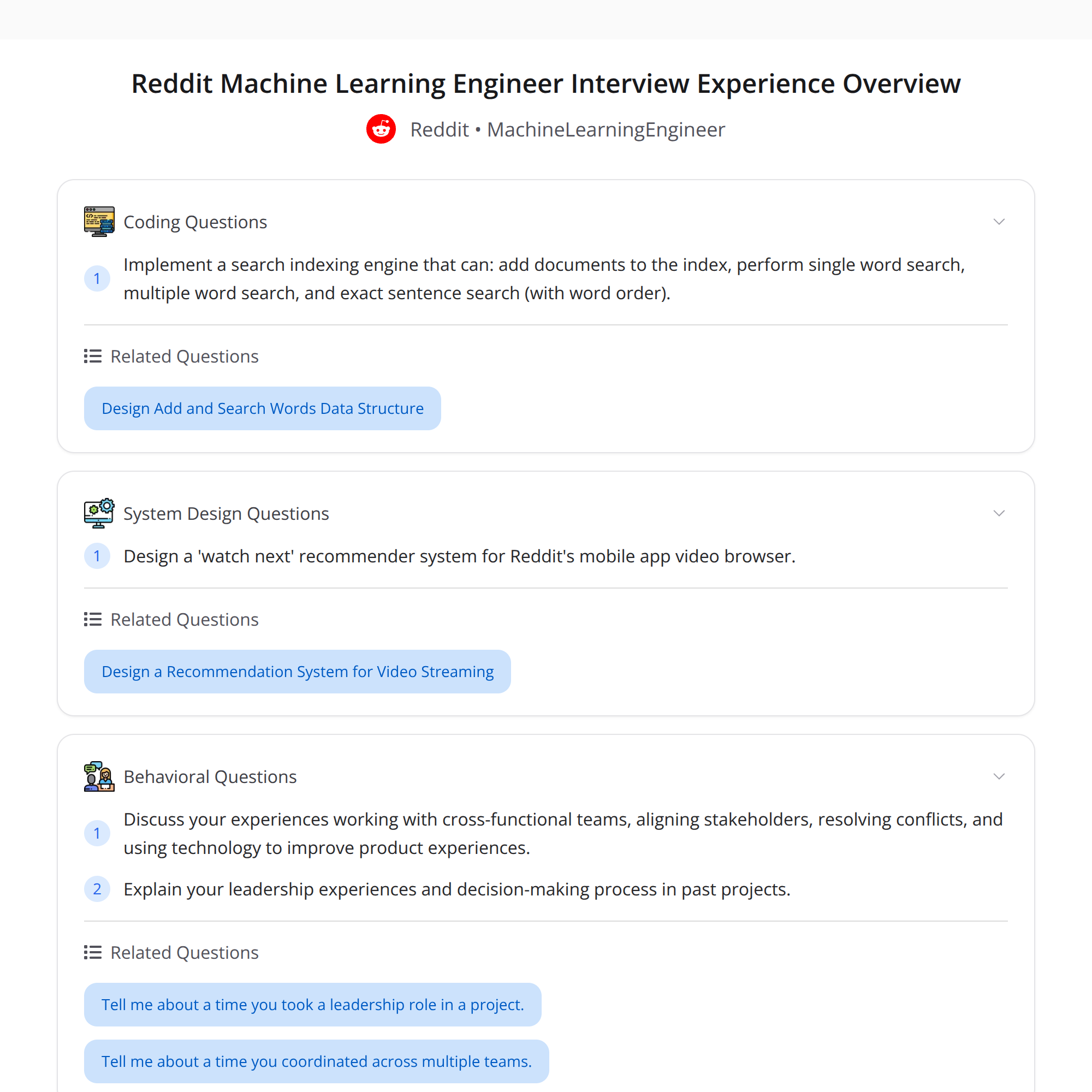
System design: “Watch next” recommender on mobile video
- Focus: end-to-end recommender architecture for mobile video (watch-next), including data flow, feature engineering, online serving, and feedback loops.
- What they assess: product scoping, ranking vs. candidate generation, offline vs. online evaluation, A/B testing, cold-start handling, and system constraints on mobile (latency, bandwidth, on-device models).
- Tip:
- Start by clarifying product goals and key metrics (watch time, engagement, retention, revenue).
- Sketch candidate generation and ranking pipelines, including approximate nearest neighbors, content-based signals, collaborative signals, and business filters.
- Discuss feature freshness, training cadence, online feature stores, and ways to reduce latency (feature caching, model distillation, on-device inference).
- Cover evaluation: offline metrics, online experimentation, guardrails for degenerate behavior (filtering, fairness).
Non-LeetCode coding task: search indexing engine
- Focus: build a simple search index supporting: adding documents, single-word and multi-word queries, and exact-sentence search.
- What they assess: engineering clarity, algorithmic thinking for indexing and search (inverted indexes, tokenization, phrase queries), handling updates, and pragmatic testing.
- Tip:
- Explain data structures (inverted index, posting lists) and how you handle phrase queries (positional indices).
- Consider edge cases (punctuation, case normalization, stop words) and simple performance considerations (memory vs. disk, batching updates).
- Write clear, testable code and show example queries and outputs.
ML case study: ad click prediction (modeling-focused)
- Focus: building and evaluating an ad click prediction model — features, objective, evaluation, and productionization considerations.
- What they assess: feature design (user, ad, context), choice of loss/objective, calibration, handling class imbalance, online metrics, and serving constraints.
- Tip:
- Discuss feature families (user signals, ad metadata, context/time/device), feature crosses, embeddings, and categorical handling.
- Talk about evaluation: AUC/ROC for ranking, calibration metrics, precision/recall for business thresholds, and offline vs. online metrics (CTR lift, revenue).
- Consider pragmatic items: model latency, incremental training, feature drift, instrumented experiments, and safety checks for biased predictions.
Overall impressions and standout points
- Structured but practical: interviews focused on real-world trade-offs rather than contrived puzzles.
- Supportive environment: interviewers were friendly and the loop felt remote-friendly.
- Breadth + depth: expect a mix of product thinking, system design, engineering rigor, and ML modeling.
Quick prep checklist
- Prepare 3 concise impact stories (technical, cross-functional, leadership).
- Refresh recommender system design patterns (candidate generation, ranking, evaluation).
- Review inverted indexes, positional indices, and simple search implementations.
- Brush up on ad click modeling topics: feature engineering, calibration, and evaluation.
- Practice system trade-off conversations (latency, freshness, cost, fairness).
Final takeaway
If you’re interviewing for an MLE role at Reddit (or similar companies), focus equally on product impact and engineering practicality. Demonstrate how your models and systems drive measurable product outcomes, and be ready to defend trade-offs with clarity and humility.
#MachineLearning #SystemDesign #InterviewPrep
About the author
bugfree.ai is an advanced AI-powered platform designed to help software engineers master system design and behavioral interviews. Whether you’re preparing for your first interview or aiming to elevate your skills, bugfree.ai provides a robust toolkit tailored to your needs. Key Features:
150+ system design questions: Master challenges across all difficulty levels and problem types, including 30+ object-oriented design and 20+ machine learning design problems. Targeted practice: Sharpen your skills with focused exercises tailored to real-world interview scenarios. In-depth feedback: Get instant, detailed evaluations to refine your approach and level up your solutions. Expert guidance: Dive deep into walkthroughs of all system design solutions like design Twitter, TinyURL, and task schedulers. Learning materials: Access comprehensive guides, cheat sheets, and tutorials to deepen your understanding of system design concepts, from beginner to advanced. AI-powered mock interview: Practice in a realistic interview setting with AI-driven feedback to identify your strengths and areas for improvement.
bugfree.ai goes beyond traditional interview prep tools by combining a vast question library, detailed feedback, and interactive AI simulations. It’s the perfect platform to build confidence, hone your skills, and stand out in today’s competitive job market. Suitable for:
New graduates looking to crack their first system design interview. Experienced engineers seeking advanced practice and fine-tuning of skills. Career changers transitioning into technical roles with a need for structured learning and preparation.
Comments
Join the discussionNo comments yet. Be the first to comment.