High-score Reddit MLE interview — summary from Bugfree users
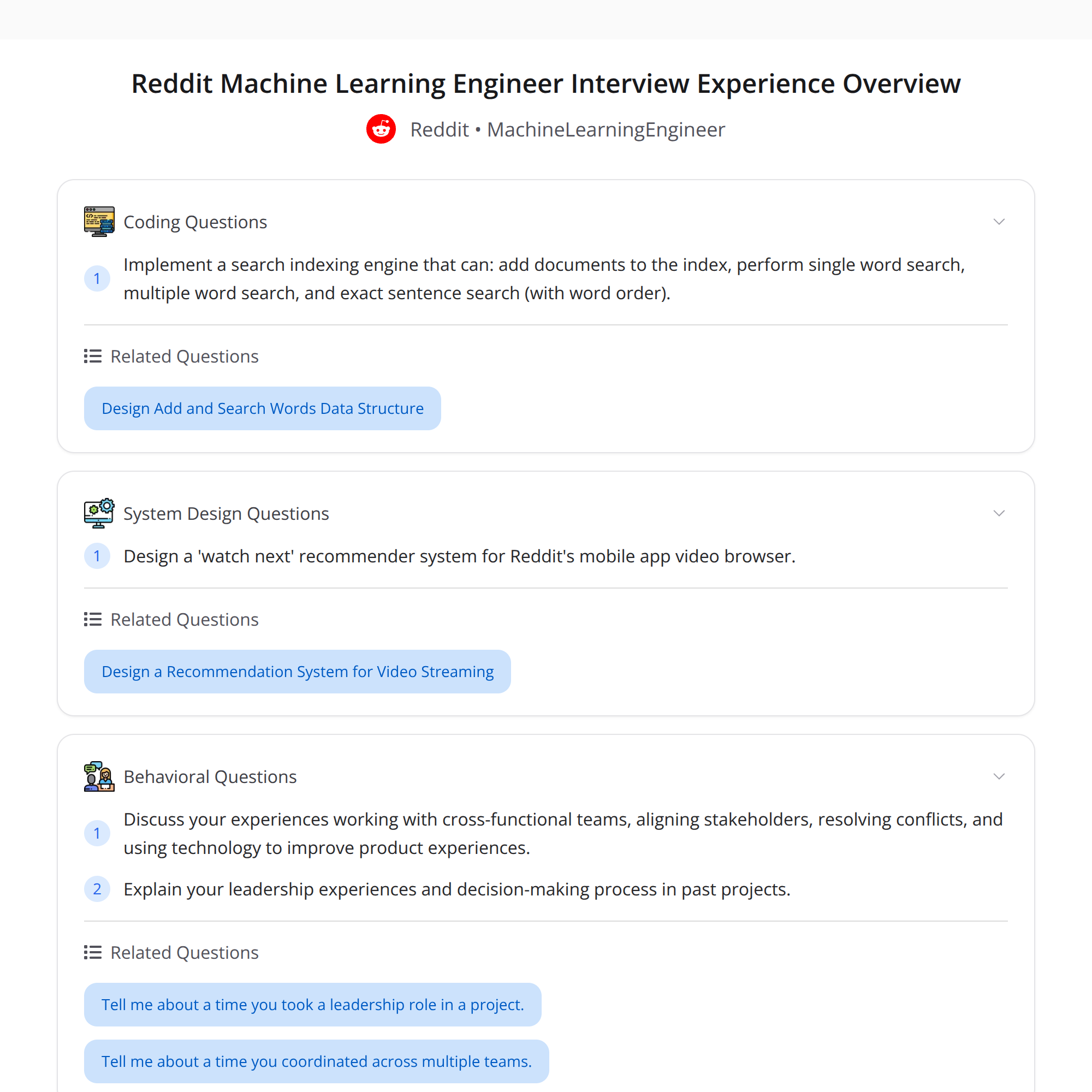
Reddit’s Machine Learning Engineer (MLE) loop was structured, practical, and supportive. Interviewers were friendly and the process felt remote-friendly. The loop covered leadership, cross-functional product thinking, domain-specific engineering, system design for a mobile “watch next” recommender, a non-LeetCode coding task, and an ML case study focused on ad click prediction.
Below is a concise breakdown of each round, what was evaluated, and practical tips to prepare.
1) Hiring Manager (HM) screen
- Focus: resume walkthrough, leadership examples, and reverse questions.
- What to show: clear impact metrics, examples of cross-team influence, trade-offs you led, and measurable outcomes.
- Tip: Prepare one or two concise STAR stories (Situation, Task, Action, Result) demonstrating technical leadership and stakeholder management. Have thoughtful questions ready about team priorities, metrics, and onboarding.
2) PM cross-functional deep dive
- Focus: stakeholder alignment, product trade-offs, and conflict resolution.
- What to demonstrate: ability to translate model trade-offs into product impact, negotiate priorities with PMs/Eng, and propose concrete evaluation plans (A/B tests or feature flags).
- Tip: Frame discussions around user/business metrics, propose measurable success criteria, and show how you’d communicate results to non-technical stakeholders.
3) Engineering domain deep dive
- Focus: defend design choices, alternatives, and technical trade-offs.
- What to show: clarity on system constraints (latency, throughput, cost), testing/CI practices, monitoring, and rollback strategies.
- Tip: Always explain the alternatives you considered, why you rejected them, and which metrics would change your decision.
4) System design — “watch next” recommender on mobile video
- Focus areas to cover:
- Goals & metrics: engagement, watch time, CTR, retention, diversity, freshness, and fairness.
- Candidate generation: collaborative filtering, embeddings, heuristics, and feed-level signals.
- Ranking: lightweight on-device models vs server-side ranking, latency and model-size trade-offs.
- Serving & infra: caching, prefetching, offline vs online features, feature freshness, scalable feature stores.
- Evaluation: offline metrics (NDCG, recall), online A/B testing, simulation for cold-start.
- Mobile-specific considerations: bandwidth/latency constraints, offline behavior, battery & model size, privacy and on-device inference.
- Tip: Start with a clear objective, list constraints, sketch both offline pipeline and online serving, and justify choices with trade-offs.
5) Non-LeetCode coding task — search indexing engine
- Requirements: support adding documents, single-word/multi-word search, and exact-sentence (phrase) search.
- Suggested approach:
- Use an inverted index mapping tokens -> posting lists (docIDs + positions).
- For phrase search, use positional indexes and intersect postings while checking token positions for adjacency.
- Tokenization, stop-word handling, and optional normalization (lowercasing, stemming) are critical.
- Consider compression for posting lists (delta/gap encoding) for scale; use hashing or tries for fast dictionary lookup.
- Tip: Clarify assumptions (memory limits, concurrency, persistence) and write a clear, testable implementation for the core ops (addDoc, searchSingle, searchMulti, searchPhrase).
6) ML case study — ad click prediction
- Key modeling topics to cover:
- Features: user history, context (time, location, page), ad metadata, device, session signals.
- Models: logistic regression for baseline, gradient-boosted trees, factorization machines, embeddings + shallow neural nets, or hybrid ranking models.
- Metrics: AUC, log loss, calibration, CTR, revenue impact, and business KPIs; also consider offline/online correlation.
- Training: handle class imbalance (sampling, weighting), feature engineering (ID embeddings, feature crosses), and regularization.
- Serving: latency budget, feature freshness, feature stores, online/nearline updates, and model validation in production.
- Safety & fairness: address bias, feedback loops, and privacy constraints.
- Tip: Present end-to-end thinking: feature pipeline → model choice → evaluation plan → deployment & monitoring, and highlight trade-offs between interpretability and performance.
Overall impressions & preparation checklist
- Interviewers were supportive and the loop felt designed to assess real-world product- and infra-oriented ML skills rather than contrived algorithm puzzles.
- Prep checklist:
- Prepare leadership stories and resume-impact bullets.
- Review recommender system patterns and mobile constraints.
- Practice inverted-index/phrase-search coding problems.
- Brush up on ad CTR modeling: features, common models, metrics, and deployment concerns.
- Be ready to defend design choices and discuss fallbacks/alternatives.
Good luck—focus on clear trade-offs, measurable success criteria, and pragmatic deployment considerations.
#MachineLearning #SystemDesign #InterviewPrep
About the author
bugfree.ai is an advanced AI-powered platform designed to help software engineers master system design and behavioral interviews. Whether you’re preparing for your first interview or aiming to elevate your skills, bugfree.ai provides a robust toolkit tailored to your needs. Key Features:
150+ system design questions: Master challenges across all difficulty levels and problem types, including 30+ object-oriented design and 20+ machine learning design problems. Targeted practice: Sharpen your skills with focused exercises tailored to real-world interview scenarios. In-depth feedback: Get instant, detailed evaluations to refine your approach and level up your solutions. Expert guidance: Dive deep into walkthroughs of all system design solutions like design Twitter, TinyURL, and task schedulers. Learning materials: Access comprehensive guides, cheat sheets, and tutorials to deepen your understanding of system design concepts, from beginner to advanced. AI-powered mock interview: Practice in a realistic interview setting with AI-driven feedback to identify your strengths and areas for improvement.
bugfree.ai goes beyond traditional interview prep tools by combining a vast question library, detailed feedback, and interactive AI simulations. It’s the perfect platform to build confidence, hone your skills, and stand out in today’s competitive job market. Suitable for:
New graduates looking to crack their first system design interview. Experienced engineers seeking advanced practice and fine-tuning of skills. Career changers transitioning into technical roles with a need for structured learning and preparation.
Comments
Join the discussionNo comments yet. Be the first to comment.