Rate Limiting vs Throttling: Stop Confusing Them in System Design Interviews
If you can’t explain the difference between rate limiting and throttling, you’ll often lose easy points in API/system design interviews. They sound similar but solve different problems. Here’s a concise, interview-ready guide you can use.
Elevator pitch (one-liner)
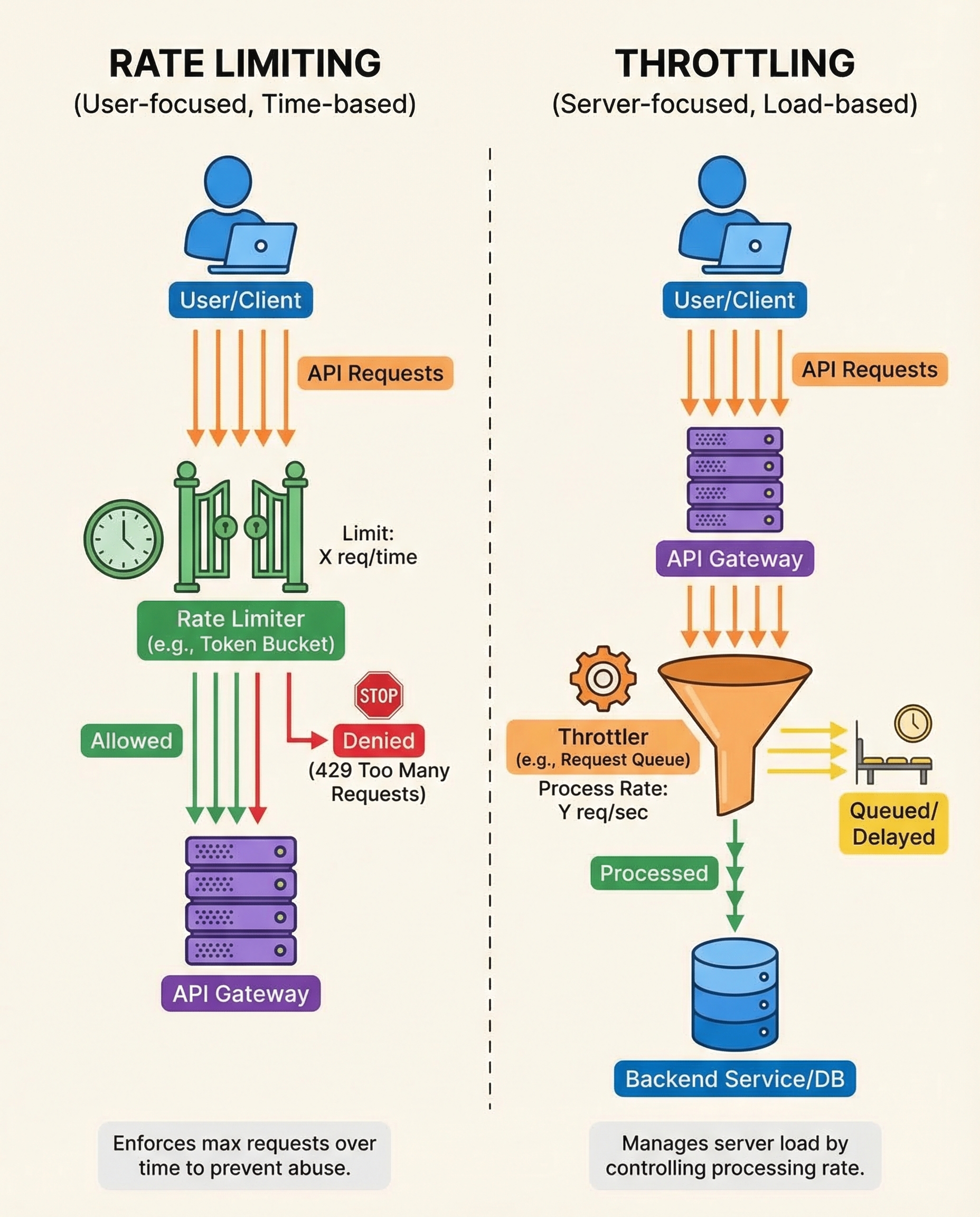
- Rate limiting answers: "How many requests over time is a user allowed?"
- Throttling answers: "How much load can the system accept at once?"
Rate limiting — what and why
Rate limiting caps the number of requests a client (or client class) can make in a time window. It protects against abuse, enforces fair usage, and prevents a single consumer from consuming disproportionate resources.
Common algorithms:
- Fixed window: count requests in fixed intervals (simple but has boundary spikes).
- Sliding window (counter or log): smoother and more accurate across boundaries.
- Token bucket: tokens are added at a steady rate; requests consume tokens — allows controlled bursts.
- Leaky bucket: queue that leaks at a fixed rate — smooths bursts into a steady output.
Practical notes:
- Typical response on limit hit: HTTP 429 Too Many Requests + Retry-After header.
- Headers to expose to clients: X-RateLimit-Limit, X-RateLimit-Remaining, X-RateLimit-Reset (or standardized equivalents).
- Implementation: single-node (in-memory) for simple services; Redis or a distributed counter for API gateways across multiple nodes.
- Tradeoffs: strictness vs user experience; token bucket allows bursts but enforces long-term average, fixed window is cheap but less accurate.
Throttling — what and why
Throttling controls how much the service processes at once. It protects system responsiveness under load by limiting concurrency, queueing requests, or applying backpressure.
Common techniques:
- Concurrency limits: max number of simultaneous requests/threads/workers per service or per user.
- Queueing with a bounded queue: accept some requests and enqueue them; reject once queue is full.
- Backpressure: signal clients to slow down (or fail quickly) so the system can recover.
- Graceful degradation / circuit breakers: temporarily reduce or block functionality when a downstream is overloaded.
- Client-side exponential backoff: when the server signals overload, clients retry with increasing delays.
Practical notes:
- Throttling may respond with 503 Service Unavailable or 429, depending on semantics and API design.
- Throttling targets system health and latency, not just request counts.
- It’s about "how many in flight right now" and keeping resource usage within safe limits.
Quick comparison (interview-ready)
- Focus: Rate limiting = long-term fairness and abuse prevention; Throttling = short-term load control and stability.
- Metric: Rate limiting measures requests per time; throttling measures concurrent work or queue depth.
- Algorithms: Rate limiting uses windows/tokens; throttling uses concurrency limits, bounded queues, backpressure.
- Response behavior: Rate limits are often enforced per client identity/plan; throttling is often enforced to protect service internals.
How to answer this in an interview (structure)
- Define both in one sentence each.
- Give a short example: e.g., "API key X limited to 1000 req/min (rate limiting); the service only processes 50 concurrent requests to keep latency acceptable (throttling)."
- Mention common algorithms (token bucket, leaky bucket, fixed/sliding window for rate limiting; worker pools, queues, backpressure for throttling).
- Discuss implementation concerns: distributed counters (Redis), fairness, headers, telemetry, and failure modes.
- Conclude when to use each and when to combine them.
Example answer you can speak aloud: "Rate limiting caps how many requests a client can make over time (use token bucket or sliding window). Throttling controls how many requests the system processes at once to keep latency and resource usage stable (use concurrency limits, bounded queues, and backpressure). In production you usually use both: rate limits to prevent abuse and throttles to protect servers under sudden load."
When to combine them
Use rate limiting for long-term fairness and abuse prevention (e.g., API tiers). Use throttling to defend against sudden spikes and protect latency-sensitive components. Put rate limits at the API gateway and throttling closer to the service/worker level.
Real-world examples
- Public API: Rate limit per API key (e.g., 1,000 requests/min). Gateway returns 429 with Retry-After.
- Worker service: Limit to 100 concurrent jobs; extra jobs are queued (bounded) or rejected.
- Streaming or upload endpoints: Token bucket to allow short bursts, plus concurrency limits to control memory/CPU.
Quick checklist before you speak in an interview
- Say the one-line definitions clearly.
- Mention at least one algorithm per concept.
- Explain a client-visible signal (status code/headers).
- Discuss tradeoffs and operational concerns (distribution, accuracy, UX).
- Close with when to combine both.
Answering this cleanly shows you understand both API-level policies and system-level protection. Keep these distinctions ready — they’re easy points to earn in system design interviews.
About the author
bugfree.ai is an advanced AI-powered platform designed to help software engineers master system design and behavioral interviews. Whether you’re preparing for your first interview or aiming to elevate your skills, bugfree.ai provides a robust toolkit tailored to your needs. Key Features:
150+ system design questions: Master challenges across all difficulty levels and problem types, including 30+ object-oriented design and 20+ machine learning design problems. Targeted practice: Sharpen your skills with focused exercises tailored to real-world interview scenarios. In-depth feedback: Get instant, detailed evaluations to refine your approach and level up your solutions. Expert guidance: Dive deep into walkthroughs of all system design solutions like design Twitter, TinyURL, and task schedulers. Learning materials: Access comprehensive guides, cheat sheets, and tutorials to deepen your understanding of system design concepts, from beginner to advanced. AI-powered mock interview: Practice in a realistic interview setting with AI-driven feedback to identify your strengths and areas for improvement.
bugfree.ai goes beyond traditional interview prep tools by combining a vast question library, detailed feedback, and interactive AI simulations. It’s the perfect platform to build confidence, hone your skills, and stand out in today’s competitive job market. Suitable for:
New graduates looking to crack their first system design interview. Experienced engineers seeking advanced practice and fine-tuning of skills. Career changers transitioning into technical roles with a need for structured learning and preparation.
Comments
Join the discussionNo comments yet. Be the first to comment.