High-Score (Bugfree Users) Pinterest Data Scientist Interview: Coding + System Design Takeaways
I recently reviewed a high-scoring interview report from Bugfree users for a Pinterest Data Scientist loop. The loop was a balanced assessment of algorithmic coding, system design, and data thinking. Below I rephrase and expand that experience into practical takeaways you can use to prepare.
Quick overview
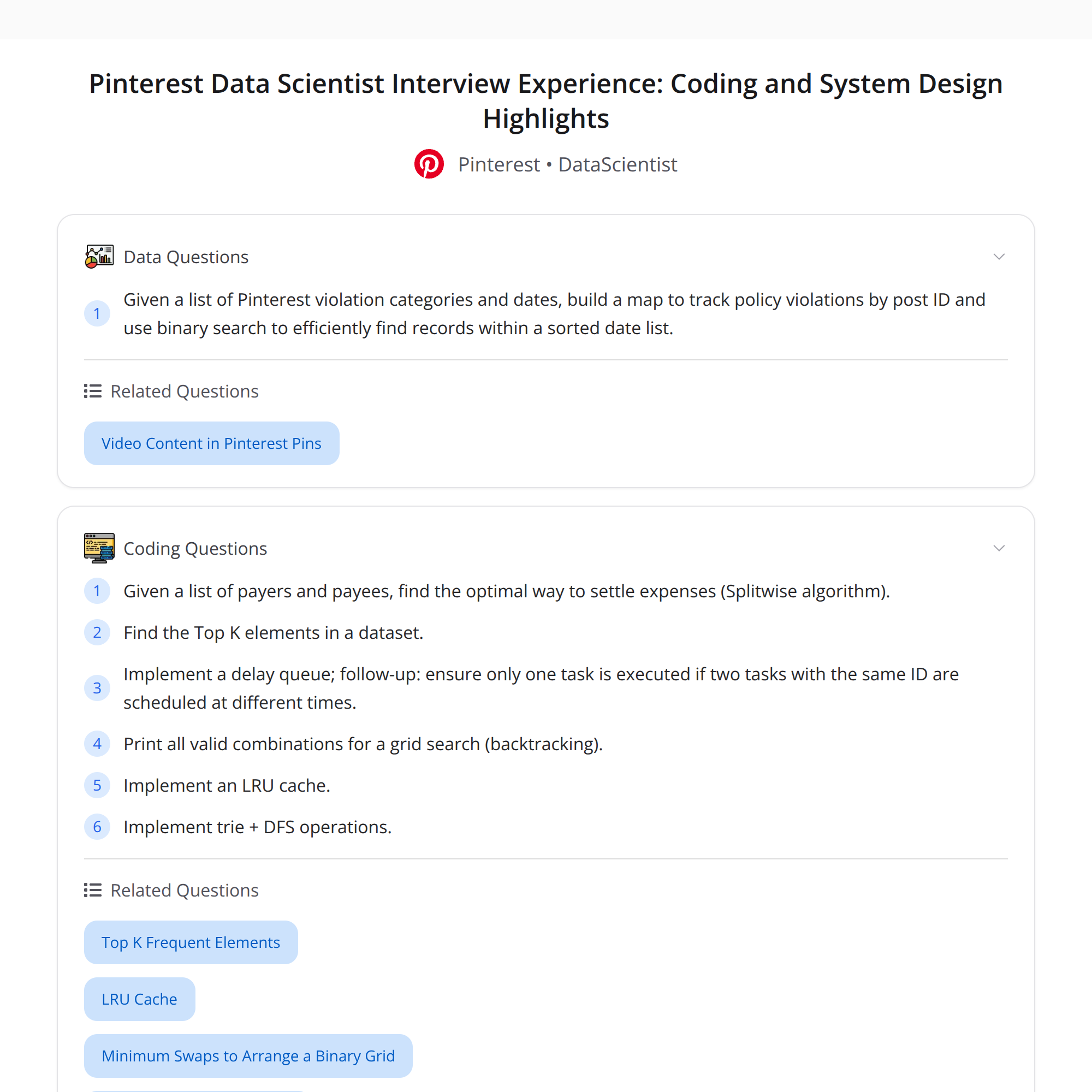
- Interview focused on: coding problems (Splitwise-style settlement, Top-K, delay queue constraints), classic data-structure problems (LRU cache, tries/DFS, grid combinations), a permissions-system design using a trie, and a data round centered on mapping policy violations and range queries over dates.
- Emphasis across the loop: clarity of assumptions, explaining trade-offs, and applying both algorithmic rigor and pragmatic system thinking.
Coding problems & approaches
Here are the specific problem types mentioned and concise strategies for each.
Splitwise-style expense settlement
- Problem: Given users with net balances (who owes or is owed), compute the minimal set of transactions to settle debts.
- Approach: Compute net balance per user. Use two heaps (creditors and debtors) or a greedy two-pointer approach on sorted balances: match largest creditor with largest debtor, settle the smaller amount, update balances. This produces O(n log n) time with heaps (or O(n log n) for sorting) and O(n) space.
- Tip: Explain correctness (greedy minimizes number of transactions under the typical transaction model) and edge cases (zeros, single user).
Top-K
- Problem: Find the top-K items from a stream or array.
- Approach: Use a min-heap of size K (O(n log K)) or Quickselect for average O(n) time. For streaming or memory-limited scenarios use count-min sketch / approximate methods with discussion of trade-offs.
Delay queue constraints
- Problem: Model elements that can only be processed after a delay or when certain constraints are met.
- Approach: Typical implementation uses a priority queue keyed by next-available timestamp; poll the earliest element, if its timestamp <= now, process it, otherwise wait. For distributed systems, combine with a visibility timeout (like SQS) and a dead-letter queue for retries.
- Tip: Discuss expiration, retries, visibility, idempotency, and backoff strategies.
LRU cache (classic)
- Approach: Use a hash map for O(1) lookups plus a doubly-linked list to maintain recency order. Discuss thread-safety, expiration, and size-based eviction.
Tries / DFS (classic)
- Problem variants: prefix queries, word search, or enumerating valid combinations in a grid.
- Approach: Implement trie nodes with child maps and end-of-word markers; for DFS problems, combine pruning (early cutoff) with memoization when possible.
Grid valid-combinations / backtracking
- Approach: Standard DFS/backtracking with visited-state tracking. Use heuristics to prune (e.g., constraint propagation, bounding) and consider DP/memoization for overlapping subproblems.
System design highlight: Permissions system using a trie
The standout system design problem in this loop was designing a permissions system that models geography (country → city) and supports fast permission checks.
Problem sketch
- Entities: resources/posts and actors/users
- Permissions scoped by geography: e.g., allow/deny actions at country or city granularity
- Requirements: fast permission checks, support inherited permissions (country-level default overridden by city-level), efficient updates and lookups, and scalability
Design summary
- Model the geographic hierarchy as a trie (or prefix tree) where each node corresponds to a geographic unit (root → country → city → neighborhood).
- Store permission rules at nodes. A permission check walks the trie from root down to the most specific node for the target location and resolves the effective permission using inheritance rules (most-specific wins, or explicit deny precedence depending on policy).
- Optimizations:
- Cache resolved permissions for (user, location) tuples to speed reads; use TTL and invalidation on updates.
- Use bitsets or compact permission encodings in nodes for fast evaluation.
- Partition the trie by geography shard or tenant to keep hot paths localized.
- For very large hierarchies, store the trie in a fast key-value store (e.g., Redis) with node keys and child pointers or use a materialized path column in a relational DB.
- Scalability notes: decide between strongly consistent writes (synchronous) vs eventual consistency for permission propagation depending on how critical correctness is vs latency.
Why a trie works well
- Natural mapping of hierarchical namespaces
- Fast prefix traversal and inheritance semantics
- Efficient for lookups and partial updates
Data round: mapping policy violations and efficient date-range queries
The data question involved mapping policy violations by post_id, then querying the number of violations in a date range.
Practical approach
- Build a map (dictionary) from post_id -> sorted list (or array) of violation timestamps/dates.
- For a date-range query [start, end] on a given post_id, binary-search (bisect) for the leftmost index >= start and the rightmost index <= end (or bisect right for end), then compute the difference to get a count. This yields O(log n) per query where n is the number of violations for that post.
Scaling and storage
- If per-post lists are large, consider storing compressed timestamp arrays or bucketing by day/hour and keeping counts per bucket (tradeoff: granularity vs speed).
- For analytics across many posts, build time-series stores (e.g., ClickHouse, Druid) or use pre-aggregated windows for fast OLAP queries.
Edge cases & extensions
- If queries ask for top posts by violations in a window, maintain per-time-window aggregates and use Top-K structures or inverted indices.
- For streaming ingestion, append timestamps and keep lists sorted via periodic merges or use log-structured storage.
Interview tips & takeaways
- Clarify requirements and assumptions early: ask about input sizes, concurrency needs, exact semantics for permission inheritance, and latency vs correctness trade-offs.
- Communicate thought process: describe the brute-force solution, then optimize; explain complexity and space trade-offs.
- Discuss edge cases and tests: empty inputs, singletons, boundary timestamps, permission conflicts.
- For system design: sketch components, data models, APIs, caching, replication, and failure modes.
- For data problems: mention both algorithmic solutions (binary search, heaps) and practical engineering considerations (storage format, indexing, aggregation strategies).
Resources to practice
- LeetCode: problems on heaps, LRU, Tries, backtracking
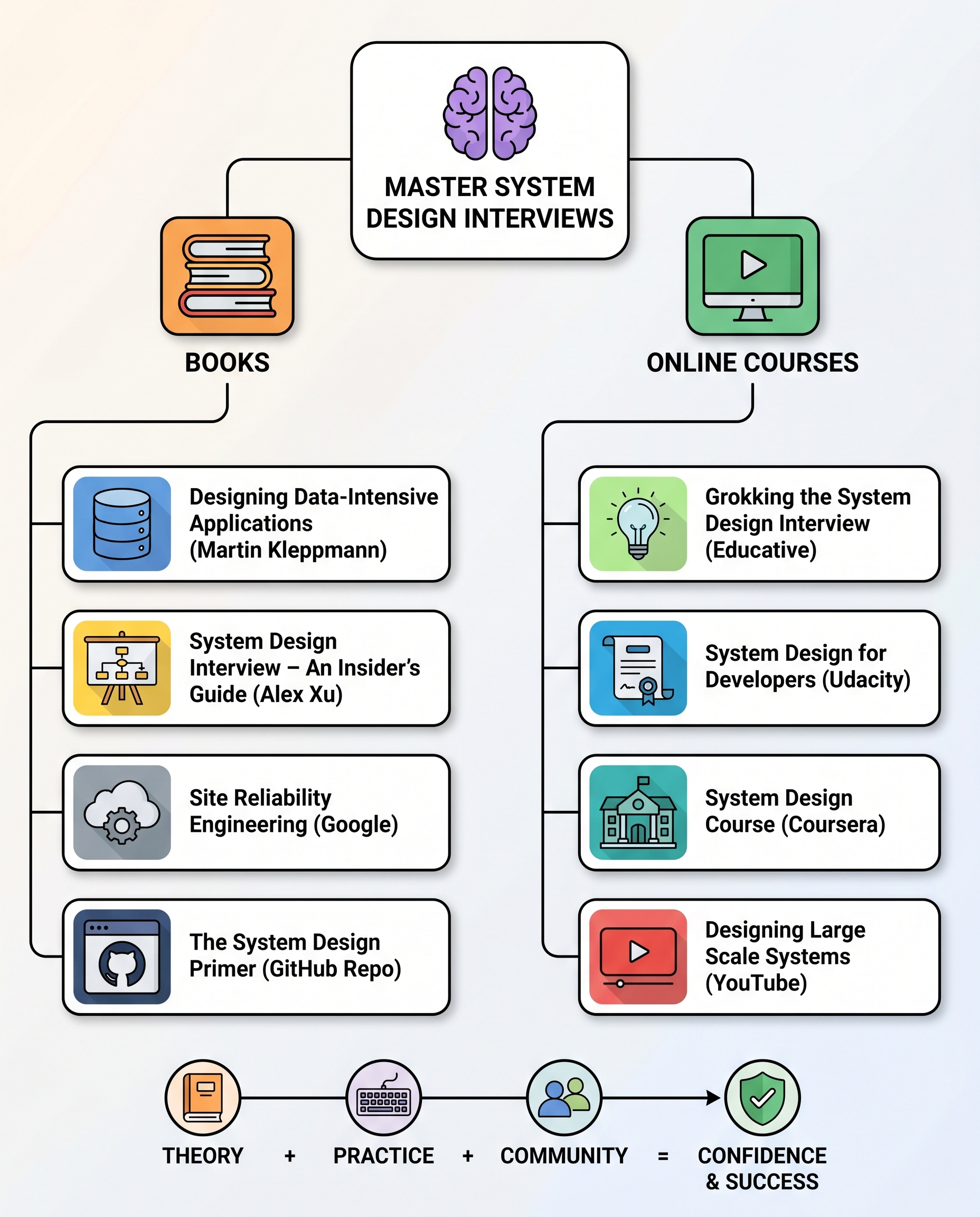
- System design primers: "Designing Data-Intensive Applications" (Kleppmann), and high-level permission-system patterns
- Time-series and OLAP stores: ClickHouse, Apache Druid, BigQuery for aggregation strategies
If you’re prepping for Pinterest or similar Data Scientist interviews, focus on: writing clean code fast, explaining trade-offs, thinking about both micro (algorithms) and macro (system/data architecture) levels, and practicing with targeted problems above.
#Tags
#DataScience #InterviewExperience #Pinterest #SystemDesign #CodingInterview #Algorithms #DataStructures #LeetCode #Bugfree
About the author
bugfree.ai is an advanced AI-powered platform designed to help software engineers master system design and behavioral interviews. Whether you’re preparing for your first interview or aiming to elevate your skills, bugfree.ai provides a robust toolkit tailored to your needs. Key Features:
150+ system design questions: Master challenges across all difficulty levels and problem types, including 30+ object-oriented design and 20+ machine learning design problems. Targeted practice: Sharpen your skills with focused exercises tailored to real-world interview scenarios. In-depth feedback: Get instant, detailed evaluations to refine your approach and level up your solutions. Expert guidance: Dive deep into walkthroughs of all system design solutions like design Twitter, TinyURL, and task schedulers. Learning materials: Access comprehensive guides, cheat sheets, and tutorials to deepen your understanding of system design concepts, from beginner to advanced. AI-powered mock interview: Practice in a realistic interview setting with AI-driven feedback to identify your strengths and areas for improvement.
bugfree.ai goes beyond traditional interview prep tools by combining a vast question library, detailed feedback, and interactive AI simulations. It’s the perfect platform to build confidence, hone your skills, and stand out in today’s competitive job market. Suitable for:
New graduates looking to crack their first system design interview. Experienced engineers seeking advanced practice and fine-tuning of skills. Career changers transitioning into technical roles with a need for structured learning and preparation.
Comments
Join the discussionNo comments yet. Be the first to comment.