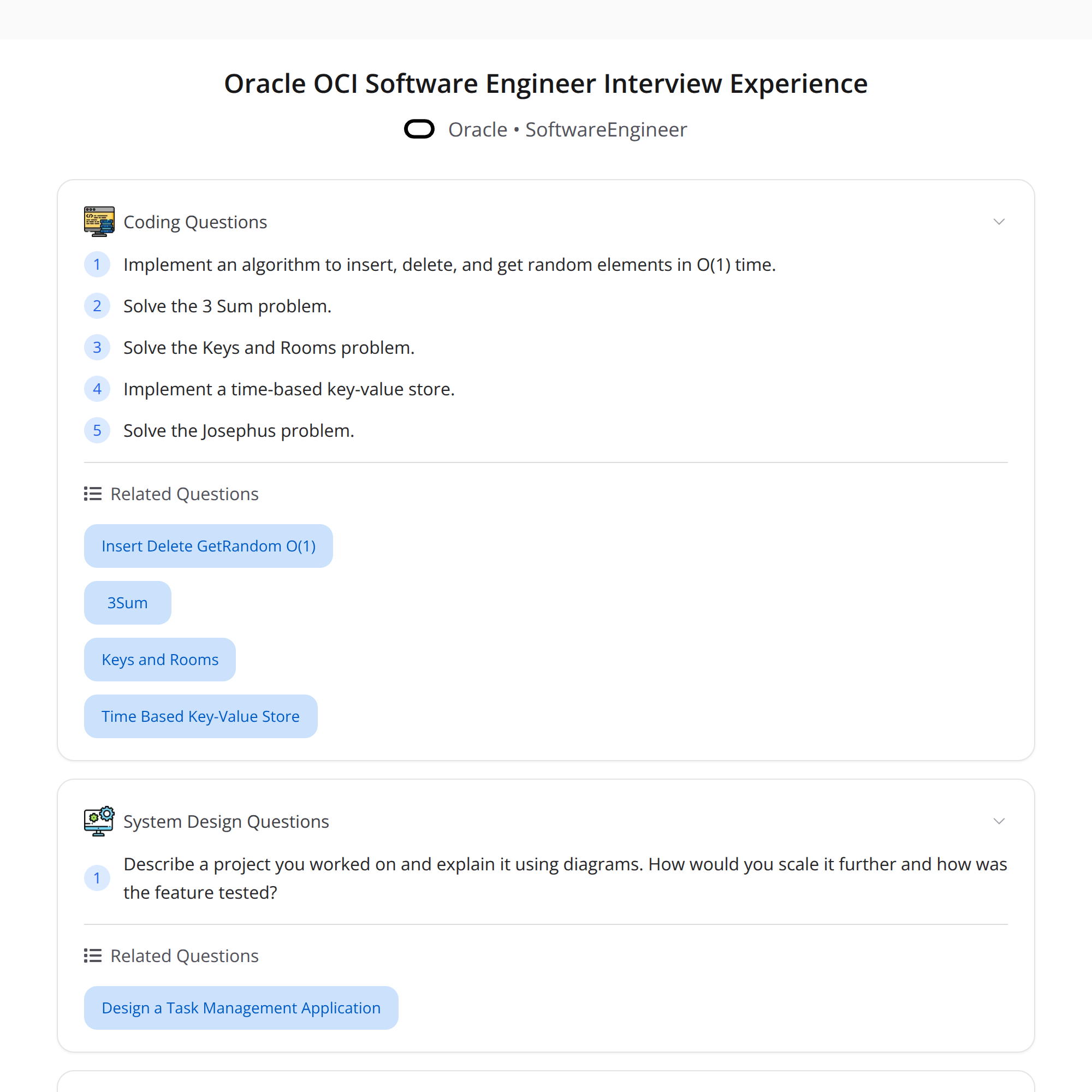
High-score interview experience reported by Bugfree users for the Oracle OCI Software Engineer role. This post breaks down what interviewers focus on and how to prepare.
Process overview
The interview loop was end-to-end and covered four broad areas:
- Screening: CS fundamentals, backend basics, web concepts, and data/DB knowledge.
- Loop rounds: deeper system design (project walkthrough, scaling, testing) and LeetCode-style coding problems.
- Behavioral: ownership, on-call incidents, key learnings, impact.
- Final discussions: trade-offs, deployment responsibilities, and follow-up questions.
Below is a concise breakdown of topics, sample questions, and prep tips.
Screening round — what they test
The screening focused on foundational knowledge across several categories:
CS & backend fundamentals
- Mutex vs semaphore: when to use each and how they control concurrency.
sleepvswaitin Java: thread state differences and use-cases.- Optimistic vs pessimistic locking: trade-offs for concurrency and throughput.
Web basics
- HTTPS/TLS: certificate verification, handshake, and why encryption matters for APIs.
- Tomcat: typical use-cases as a Java servlet container and deployment basics.
- Why Protobuf: serialization efficiency, schema evolution, and gRPC integration.
Data / database concepts
- DynamoDB LSI vs GSI: local vs global indexes, consistency, and partitioning impacts.
- Communication protocols: REST vs gRPC, idempotency, and error handling.
Prep tips for screening:
- Be ready to explain concepts succinctly and give a short example or trade-off.
- Practice a few focused, clear comparisons (e.g., LSI vs GSI) with pros/cons.
Loop rounds — system design + coding
Loop rounds deepened the screening topics and tested practical design and coding skills.
System design expectations:
- Project walkthrough: describe a recent project end-to-end — architecture, components, and your role.
- Scaling: identify bottlenecks, propose horizontal/vertical scaling, caching layers, partitioning strategies.
- Testing & reliability: unit/integration tests, chaos or load testing approaches, SLA monitoring.
- Trade-offs: cost vs latency vs consistency; choose and justify decisions.
DynamoDB-specific considerations often came up (when relevant): partition keys, hot partitions, read/write capacity modeling, GSIs/LSIs, and data access patterns.
Coding (LeetCode-style):
- Typical problems: array/string manipulation, trees/graphs, hashing, sliding window, and occasionally medium-hard dynamic programming or graph traversal.
- Focus: correct solutions, clear complexity analysis (time/space), and optimized implementations.
Prep tips for loop rounds:
- Practice system design walkthroughs for 2–3 big projects. Use diagrams and callouts for bottlenecks and metrics.
- Solve medium+ LeetCode problems under time pressure and practice explaining your approach aloud.
- When designing systems: explicitly mention APIs, data model, storage choices, caching, and failure modes.
Behavioral — what they care about
Behavioral rounds were treated as equally important. Expect questions like:
- Biggest mistakes and what you learned from them.
- Examples of measurable impact (numbers matter: latency improvements, cost reductions, error-rate drops).
- On-call incidents: a specific incident you owned, how you diagnosed it, and steps taken to prevent recurrence.
- Deployment ownership: describing a deployment you led, rollback strategy, and post-deploy validation.
How to structure answers:
- Use the STAR format (Situation, Task, Action, Result).
- Quantify results where possible and highlight your direct contribution.
- Be candid about mistakes and focus on clear learnings and follow-ups.
Common themes interviewers probe
- Ownership: Did you own the end-to-end lifecycle of features or incidents?
- Trade-off thinking: Can you weigh cost, complexity, and performance and pick a pragmatic solution?
- Reliability focus: How do you design for monitoring, alerting, and graceful degradation?
- Communication: Can you explain complex ideas clearly to technical and non-technical stakeholders?
Quick prep checklist
- Brush up: concurrency (mutex/semaphore), Java threading (
sleepvswait), locking strategies. - Review web fundamentals: TLS basics, HTTP vs HTTP/2, Tomcat roles.
- Learn Protobuf/gRPC: when and why to use them vs JSON/REST.
- Study DynamoDB: LSI vs GSI, partition keys, throughput considerations.
- Practice system design: emphasize scalability, testing, and deployment strategies.
- Solve LeetCode medium+ problems and practice whiteboard/pseudocode explanations.
- Prepare 3–5 STAR stories focusing on impact, incidents, and ownership.
Final tips
- Ask clarifying questions, state assumptions, and communicate trade-offs.
- When coding, narrate your thought process and analyze complexity.
- In design rounds, include metrics and failure scenarios, and propose mitigations.
- Be honest about what you don’t know, but show how you would learn or verify.
Good luck — focus on clear communication, measurable impact, and practical trade-offs. These are the traits the Oracle OCI interviewers emphasized in the Bugfree reports.
About the author
bugfree.ai is an advanced AI-powered platform designed to help software engineers master system design and behavioral interviews. Whether you’re preparing for your first interview or aiming to elevate your skills, bugfree.ai provides a robust toolkit tailored to your needs. Key Features:
150+ system design questions: Master challenges across all difficulty levels and problem types, including 30+ object-oriented design and 20+ machine learning design problems. Targeted practice: Sharpen your skills with focused exercises tailored to real-world interview scenarios. In-depth feedback: Get instant, detailed evaluations to refine your approach and level up your solutions. Expert guidance: Dive deep into walkthroughs of all system design solutions like design Twitter, TinyURL, and task schedulers. Learning materials: Access comprehensive guides, cheat sheets, and tutorials to deepen your understanding of system design concepts, from beginner to advanced. AI-powered mock interview: Practice in a realistic interview setting with AI-driven feedback to identify your strengths and areas for improvement.
bugfree.ai goes beyond traditional interview prep tools by combining a vast question library, detailed feedback, and interactive AI simulations. It’s the perfect platform to build confidence, hone your skills, and stand out in today’s competitive job market. Suitable for:
New graduates looking to crack their first system design interview. Experienced engineers seeking advanced practice and fine-tuning of skills. Career changers transitioning into technical roles with a need for structured learning and preparation.
Comments
Join the discussionNo comments yet. Be the first to comment.