High-Score Interview Experience: Oracle Health IC3 — Backend Role… That Turned Frontend
A high-scoring interview report from Bugfree users: what the rounds looked like, what was asked, why the role drifted, and the key lessons you should take away. This is a concise breakdown of rounds, sample topics, the outcome, and practical preparation tips.
Quick summary
- Role advertised: mostly Backend (IC3) for Oracle Health
- What changed: Hiring manager later requested a frontend-capable engineer — role clarity became the biggest lesson
- Rounds covered: Java/OOP, Spring Boot basics, System Design, Data Structures & Algorithms (DSA), concurrency, linked lists/tree problems, and behavioral
- Result: Rejected. Feedback from the company didn’t match the interview focus (they mentioned schema/time and incomplete design), highlighting the importance of clarifying expectations early
Interview rounds — what to expect and how to prepare
Below are the rounds the candidate faced, with details on topics and preparation tips.
1) Java / OOP fundamentals
- Topics: immutability, SOLID principles, design patterns
- What they looked for: clear explanations of when to use immutability, examples of applying SOLID, and pattern selection (Factory, Strategy, Observer, etc.)
- Prep tips: be ready to explain trade-offs and give mini code snippets or mental models. Practice describing real situations where you applied a pattern or refactored for SOLID.
2) Spring Boot basics
- Topics: basic starter configuration, REST controllers, dependency injection, transactional boundaries
- What they looked for: familiarity with building/bootstrapping services, wiring beans, and common pitfalls (e.g., transaction propagation)
- Prep tips: review controllers, service/repository layering, basic annotations, and common gotchas.
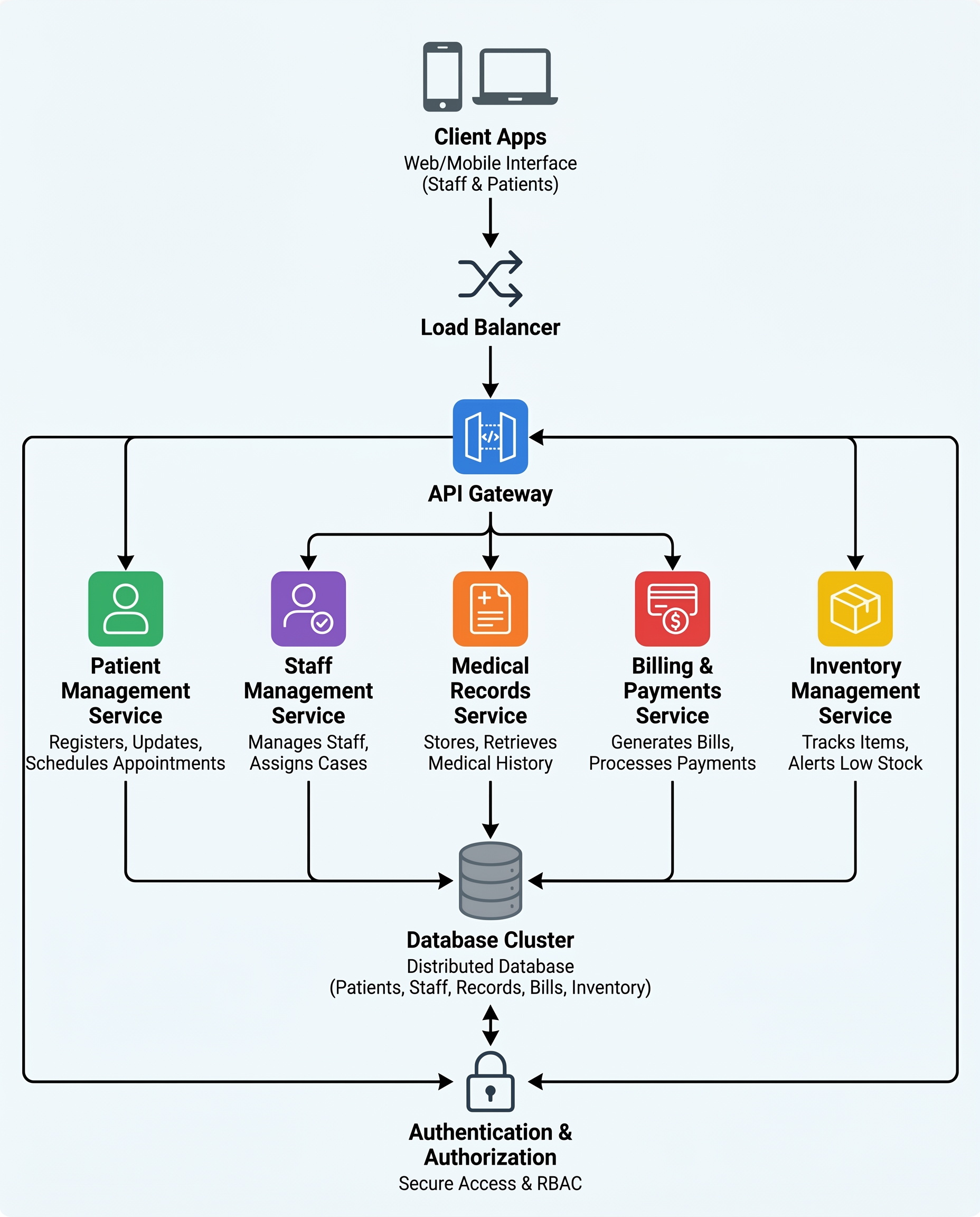
3) System design (BookMyShow-style APIs + high-level architecture)
- Task: design ticketing/booking APIs and a high-level architecture for the service
- What they expected: API endpoints, data flow, high-level components (load balancer, app servers, DB, caching), and thought on scaling/availability
- Common mismatch: interviewers may want different levels of detail — APIs vs DB schema vs low-level scaling choices. Clarify whether to focus on endpoints, database design, or scaling patterns at the start.
- Prep tips: practice designing user-facing services (booking, ordering) end-to-end: API contracts, data model, caching strategy, database sharding/replication, and failure/retry handling.
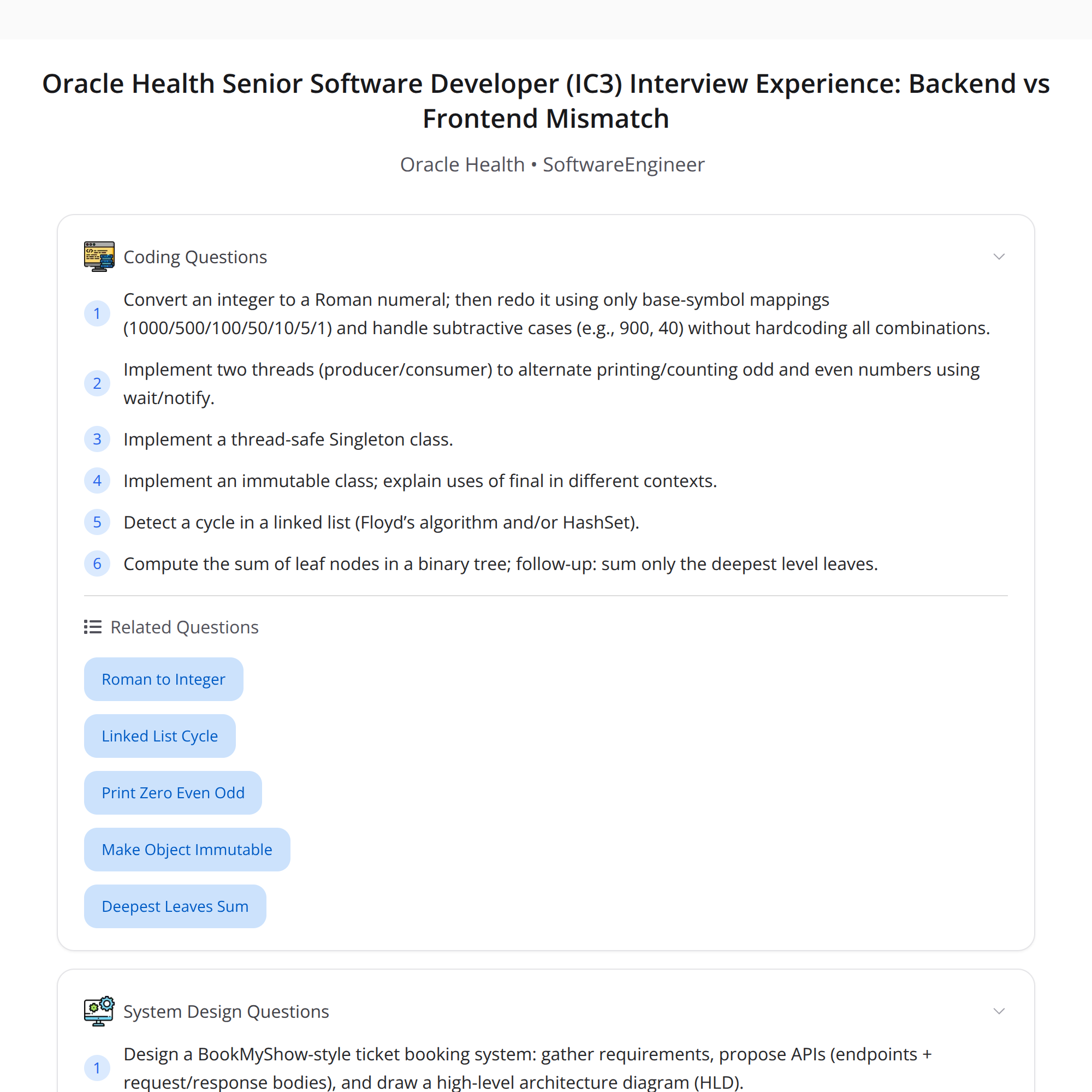
4) DSA: Roman numerals with extensible subtractive logic
- Problem: convert or validate Roman numerals with support for extensible/subtractive rules
- What they tested: ability to model rules cleanly so the logic is extensible (not just hard-coded edge cases)
- Prep tips: practice implementing mapping tables and a rule-driven approach. Write clean iteration logic and add tests for extensibility.
5) Behavioral deep-dive
- Topics: past projects, decision-making, trade-offs, ownership
- What they looked for: clarity, depth of contribution, how you handled ambiguity, and examples of technical leadership at the IC3 level
- Prep tips: use STAR (Situation, Task, Action, Result) or similar frameworks; be ready to discuss trade-offs rather than just outcomes.
6) Concurrency: odd/even printing with wait/notify
- Problem: coordinate threads to print odd/even numbers in order using low-level primitives
- What they tested: understanding of wait/notify, synchronized/locks, and corner cases (spurious wakeups, missed signals)
- Prep tips: practice thread coordination problems and explain both correctness and performance.
7) Classic problems: linked list cycle & deepest-leaf sum
- Linked list cycle detection: implement Floyd’s algorithm and explain runtime/space trade-offs
- Deepest-leaf sum: traverse tree (BFS or DFS with depth tracking) and compute sums for the deepest level
- Prep tips: justify choices (iterative vs recursive), validate edge cases, and discuss complexity.
Outcome & feedback
The candidate was rejected. The feedback cited issues like schema/time and incomplete design — feedback that didn’t align with the interview topics. That mismatch underlines a recurring hiring problem: expectations weren’t fully aligned between interviewer(s) and candidate.
Key takeaways
- Confirm role expectations early. If a role says "mostly backend" but the team needs frontend skills, it’s better to know that before you prepare extensively for backend-only questions.
- Clarify the desired depth of design discussions. Ask whether the focus will be API design, database schema, capacity planning, or all of the above.
- Ask about evaluation criteria for each round: is the system design graded on high-level trade-offs, or detailed schemas and data models?
- Be ready for pivots. Teams sometimes discover a different need mid-hiring. If you’re open to cross-stack work, state that clearly during interviews.
Practical questions to ask the recruiter/hiring manager before interviews
- Is this role frontend, backend, or full-stack in practice?
- For system design: what level of detail do you expect (APIs, DB schema, scaling strategies)?
- Which libraries/frameworks and tech stack will I be expected to know day-to-day?
- How are the rounds weighted when making hiring decisions?
Prep checklist (actionable)
- Review SOLID, immutability patterns, and common design patterns with short examples
- Build a small Spring Boot REST service and review controller/service/repository layering
- Practice 2–3 system design problems with both API contracts and scaling considerations
- Implement extendable DSA solutions (e.g., Roman numerals) with tests
- Practice concurrency primitives and common coordination problems
- Prepare behavioral stories using STAR, focusing on trade-offs and measurable outcomes
Final thoughts
This Oracle Health IC3 loop highlights a common hiring friction: mismatch in expectations. Asking precise questions before the loop and clarifying the focus for each round will save time and help you prepare the right depth. Whether you’re gunning for backend, frontend, or full-stack, being explicit about the role and evaluation criteria gives you the best shot.
#SoftwareEngineering #SystemDesign #Java
About the author
bugfree.ai is an advanced AI-powered platform designed to help software engineers master system design and behavioral interviews. Whether you’re preparing for your first interview or aiming to elevate your skills, bugfree.ai provides a robust toolkit tailored to your needs. Key Features:
150+ system design questions: Master challenges across all difficulty levels and problem types, including 30+ object-oriented design and 20+ machine learning design problems. Targeted practice: Sharpen your skills with focused exercises tailored to real-world interview scenarios. In-depth feedback: Get instant, detailed evaluations to refine your approach and level up your solutions. Expert guidance: Dive deep into walkthroughs of all system design solutions like design Twitter, TinyURL, and task schedulers. Learning materials: Access comprehensive guides, cheat sheets, and tutorials to deepen your understanding of system design concepts, from beginner to advanced. AI-powered mock interview: Practice in a realistic interview setting with AI-driven feedback to identify your strengths and areas for improvement.
bugfree.ai goes beyond traditional interview prep tools by combining a vast question library, detailed feedback, and interactive AI simulations. It’s the perfect platform to build confidence, hone your skills, and stand out in today’s competitive job market. Suitable for:
New graduates looking to crack their first system design interview. Experienced engineers seeking advanced practice and fine-tuning of skills. Career changers transitioning into technical roles with a need for structured learning and preparation.
Comments
Join the discussionNo comments yet. Be the first to comment.