
Oracle Health IC3 Interview Experience — Backend Role That Turned Frontend
A high-score interview experience shared by Bugfree users. This write-up summarizes rounds, sample questions, the outcome, and the biggest lessons learned when the hiring expectations shifted mid-process.
Quick overview
- Role advertised/started as “mostly backend.”
- Hiring manager later said they needed a frontend dev — role clarity changed during the loop.
- Outcome: rejected. Feedback from hiring didn’t match the interview focus (schema/time, design completeness).
- Main lesson: confirm expectations and the required depth (APIs vs schema vs scaling) early.
Interview rounds and what they covered
Java / OOP fundamentals
- Topics: immutability, SOLID principles, common design patterns.
- Tip: explain trade-offs (e.g., immutability vs performance) and point to concrete examples from past work.
Spring Boot basics
- Typical questions: building REST APIs, configuration, dependency injection, and basic app structure.
- Tip: be ready to describe controllers, services, repositories, and transaction boundaries.
System design
- Example prompt: BookMyShow-style APIs + a high-level architecture.
- Expected focus: API contracts, data flow, caching, basic scaling strategy, and trade-offs.
- Tip: clarify whether the interviewer wants whiteboard-level high-level architecture or low-level schema detail.
Data Structures & Algorithms (DSA)
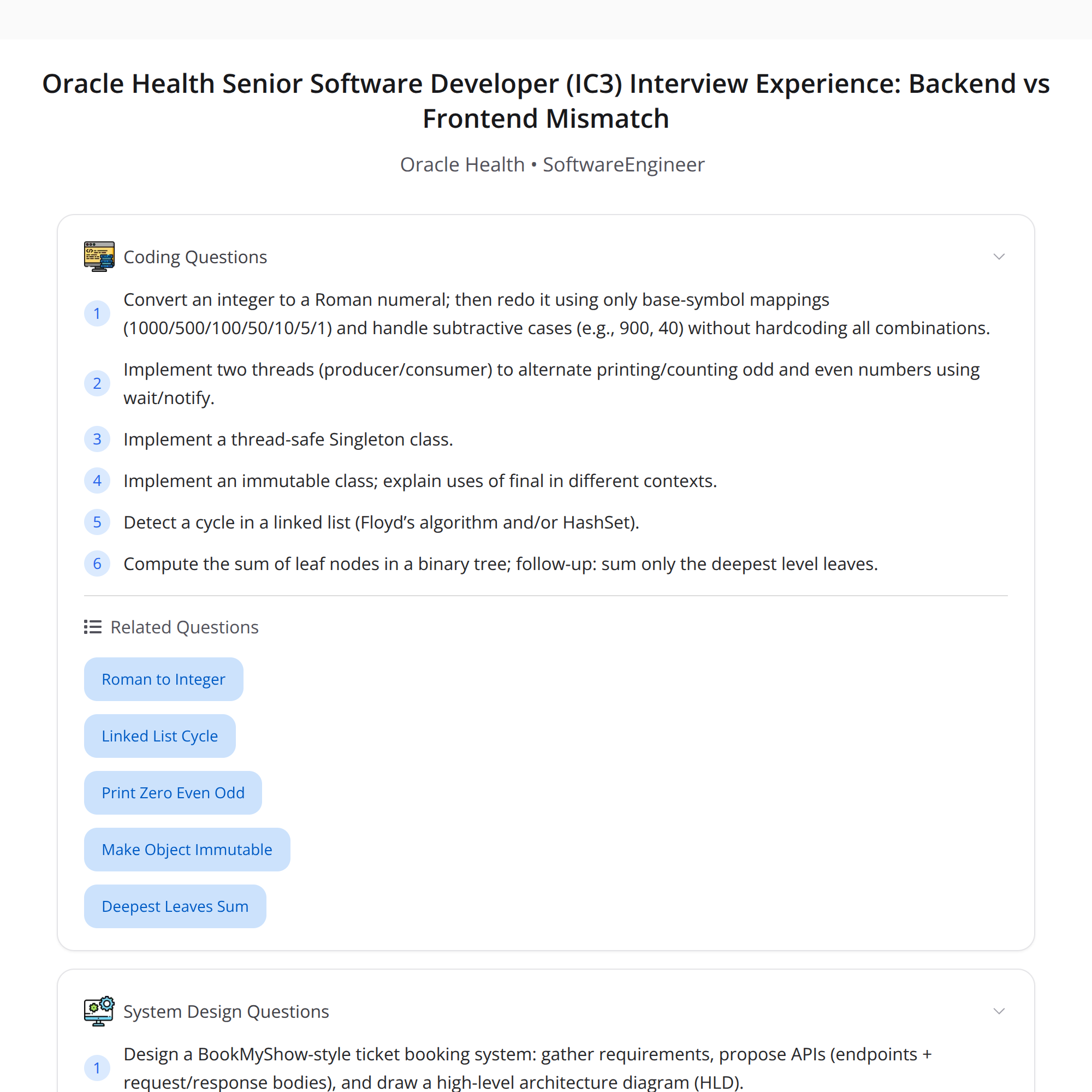
- Example problem: Roman numerals with “extensible” subtractive logic (design a solution that supports future changes to subtractive rules).
- Also included: linked list cycle detection and a deepest-leaf-sum (tree) problem.
- Tip: show both a correct solution and how you'd adapt it when requirements change.
Concurrency
- Example: coordinate two threads to print odd/even numbers using wait/notify.
- Tip: explain thread-safety, potential pitfalls (deadlocks, missed signals), and alternatives like higher-level concurrency utilities.
Behavioral deep-dive
- Expect concrete stories tied to impact, trade-offs, and collaboration.
- Tip: use STAR (Situation, Task, Action, Result) and quantify outcomes where possible.
What happened vs. the feedback
The interview heavily emphasized APIs, algorithms, and concurrency. The final feedback mentioned issues around schema design and incomplete design scope — areas that weren’t the explicit focus in several rounds. This mismatch felt unexpected and was the main frustration.
Why this matters:
- If interviewers expect schema-level detail, candidates should plan to spend time on data models, constraints, and queries.
- If interviewers expect high-level system scaling and trade-offs, candidates should prioritize throughput/latency and architecture components.
Key takeaways and actionable advice
Confirm role and scope early:
- Ask the recruiter or hiring manager: “What percent of the role is backend vs frontend?” and “What stack/areas will interviews emphasize?”
- Ask for examples of typical tasks you'd be doing in the first 3–6 months.
Clarify question depth during the interview:
- For system design: ask whether they want high-level architecture, API design, data schema, or scaling details.
- For coding/DSA: confirm constraints (input sizes, extensibility requirements) before coding.
Prepare breadth and depth:
- Backend candidates: practice API design, data modeling, and scaling trade-offs, plus coding questions and concurrency.
- Frontend-shift risk: if there’s a chance the role may involve frontend tasks, be ready to show basic frontend knowledge (component structure, state management, integration points) or explicitly state your strengths and limits.
If feedback seems mismatched, ask for clarification:
- Request specific examples or follow-up questions to understand gaps. Use feedback to shape future interviews or an appeal if appropriate.
Preparation checklist (practical)
- Java/OOP: immutability, SOLID, patterns (e.g., factory, strategy, builder).
- Spring Boot: REST controllers, DI, common annotations, transactional behavior.
- System design: design APIs, sketch high-level components, discuss caching, data partitioning, availability.
- Data modeling: practice normal forms, indexing strategies, and basic schema for typical services.
- DSA: linked lists (cycle detection), trees (deepest-leaf sum), string parsing (extensible Roman numerals), and complexity analysis.
- Concurrency: wait/notify patterns, synchronized blocks, and modern alternatives (Executors, Locks, concurrent collections).
- Behavioral: 4–5 STAR stories with metrics.
Example interview question breakdowns (short)
Roman numerals (extensible subtractive logic): design a parser that maps numeral tokens to values but allows configuration of subtractive pairs (e.g., I before V and X). Discuss O(n) parsing and how to extend rules without rewriting core logic.
Odd/even printing: implement two threads that print numbers alternately using wait/notify. Mention edge cases, spurious wake-ups, and show how higher-level primitives (BlockingQueue, Semaphore) simplify the solution.
BookMyShow-like API: define endpoints for booking tickets, seat allocation strategy, concurrency/consistency trade-offs, and a simple schema for users, shows, seats, and bookings.
Final thoughts
This interview is a good reminder that expectations can change mid-process. The strongest safeguard is proactive clarification: confirm role focus, ask the depth required for each question, and align interview time with the topics that matter most to the hiring team. Even when the outcome isn’t positive, documenting what happened and the feedback mismatch helps you improve future approaches and interview conversations.
Tags: #SoftwareEngineering #SystemDesign #Java
About the author
bugfree.ai is an advanced AI-powered platform designed to help software engineers master system design and behavioral interviews. Whether you’re preparing for your first interview or aiming to elevate your skills, bugfree.ai provides a robust toolkit tailored to your needs. Key Features:
150+ system design questions: Master challenges across all difficulty levels and problem types, including 30+ object-oriented design and 20+ machine learning design problems. Targeted practice: Sharpen your skills with focused exercises tailored to real-world interview scenarios. In-depth feedback: Get instant, detailed evaluations to refine your approach and level up your solutions. Expert guidance: Dive deep into walkthroughs of all system design solutions like design Twitter, TinyURL, and task schedulers. Learning materials: Access comprehensive guides, cheat sheets, and tutorials to deepen your understanding of system design concepts, from beginner to advanced. AI-powered mock interview: Practice in a realistic interview setting with AI-driven feedback to identify your strengths and areas for improvement.
bugfree.ai goes beyond traditional interview prep tools by combining a vast question library, detailed feedback, and interactive AI simulations. It’s the perfect platform to build confidence, hone your skills, and stand out in today’s competitive job market. Suitable for:
New graduates looking to crack their first system design interview. Experienced engineers seeking advanced practice and fine-tuning of skills. Career changers transitioning into technical roles with a need for structured learning and preparation.
Comments
Join the discussionNo comments yet. Be the first to comment.


