Collaborative Spreadsheets: Why Optimistic Concurrency Beats Locking in Interviews
Building a collaborative spreadsheet isn’t primarily about streaming realtime updates — it’s about correctness when multiple users edit the same data simultaneously. In interviews, the simplest clear correctness story often wins. Optimistic concurrency gives you that story with low latency and fewer system-level complications than locking.
The core idea
- Accept client edits locally and send them to the server without acquiring global locks.
- Attach a version identifier (or timestamp) to each cell or update.
- On write, the server compares the client's base version against the current version.
- If the base version matches, accept and increment the version.
- If it’s stale, either reject and surface a conflict to the client or try a deterministic merge.
This approach keeps latency low (no waiting on locks), avoids deadlocks, and forces you to define a clear conflict policy — exactly the kind of principled trade-off interviewers expect.
Conflict-handling strategies (short and practical)
- Reject + UI merge: Server rejects and returns the newer value and metadata; client shows a diff and asks the user to pick/merge.
- Last-Write-Wins (LWW): For simple value cells, accept the latest timestamped write. Cheap but may lose edits.
- Merge rules: For structured cells (numbers, formulas) define deterministic merge rules (e.g., sum deltas, pick max).
- OT / CRDT: For rich collaborative operations (text, formulas with ranges), mention Operational Transformation or CRDTs — they provide automatic convergent merges but add complexity.
Simple server-side protocol (pseudo)
- Client reads cell -> receives value + version.
- Client edits and submits {cellId, baseVersion, newValue}.
- Server reads currentVersion:
- if baseVersion == currentVersion: accept, store newValue, currentVersion++ and broadcast.
- else: conflict -> either reject with current value or apply merge policy.
Example (JSON payload):
{ "cellId": "A1", "baseVersion": 42, "newValue": "100" }
Response when stale:
{ "status": "conflict", "currentValue": "95", "currentVersion": 43 }
Why this is interview-friendly
- Correctness story: You can clearly explain how conflicts are detected and handled (server compares versions and applies a rule).
- Trade-offs: You can justify low-latency optimistic approach vs. heavy-handed locks and discuss where locking might be appropriate (multi-step transactions or when strong invariants must be enforced).
- Scalability & availability: Optimistic approaches compose well with sharding and eventual consistency models — mention LWW, OT/CRDT when appropriate.
When might locking be appropriate?
- If operations require atomic multi-cell invariants (e.g., balance transfers that must not be concurrent), a transaction or short-lived lock may be necessary.
- Prefer coarse-grained, short locks only when you must enforce strict serializability. For per-cell edits, optimistic approaches usually suffice.
Interview talking points (concise)
- Explain your protocol: versioned writes + conflict detection on the server.
- Present a conflict policy and why you chose it (LWW for simplicity, OT/CRDT for rich editing).
- Discuss UX: how you surface conflicts to users and when to auto-merge vs. ask.
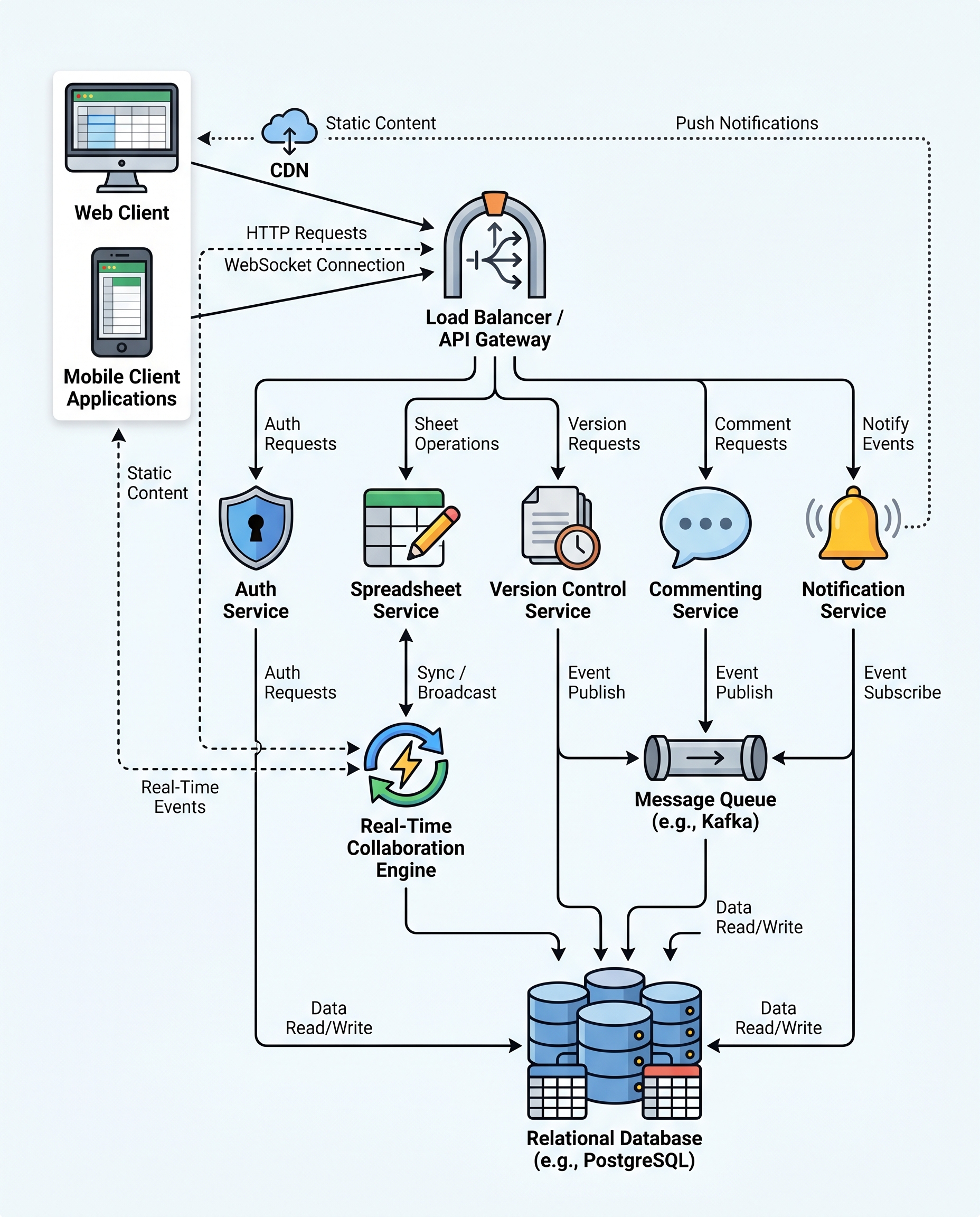
- Mention system concerns: broadcast via WebSockets, per-cell version counters, sharding keys, and eventually consistent replication.
Bottom line
Optimistic concurrency gives you a low-latency, deadlock-free design with a clear, testable correctness story. In interviews, that clarity, plus thoughtful trade-offs and a conflict-resolution plan, is far more convincing than proposing a heavy locking system.
#SystemDesign #DistributedSystems #WebSockets
About the author
bugfree.ai is an advanced AI-powered platform designed to help software engineers master system design and behavioral interviews. Whether you’re preparing for your first interview or aiming to elevate your skills, bugfree.ai provides a robust toolkit tailored to your needs. Key Features:
150+ system design questions: Master challenges across all difficulty levels and problem types, including 30+ object-oriented design and 20+ machine learning design problems. Targeted practice: Sharpen your skills with focused exercises tailored to real-world interview scenarios. In-depth feedback: Get instant, detailed evaluations to refine your approach and level up your solutions. Expert guidance: Dive deep into walkthroughs of all system design solutions like design Twitter, TinyURL, and task schedulers. Learning materials: Access comprehensive guides, cheat sheets, and tutorials to deepen your understanding of system design concepts, from beginner to advanced. AI-powered mock interview: Practice in a realistic interview setting with AI-driven feedback to identify your strengths and areas for improvement.
bugfree.ai goes beyond traditional interview prep tools by combining a vast question library, detailed feedback, and interactive AI simulations. It’s the perfect platform to build confidence, hone your skills, and stand out in today’s competitive job market. Suitable for:
New graduates looking to crack their first system design interview. Experienced engineers seeking advanced practice and fine-tuning of skills. Career changers transitioning into technical roles with a need for structured learning and preparation.
Comments
Join the discussionNo comments yet. Be the first to comment.