OOD Interviews: Stop Guessing Classes—Identify Core Entities Like a Pro
In object-oriented design (OOD) interviews, interviewers aren't impressed by a long list of classes — they're looking for a systematic approach. The quickest way to show you know what you're doing is to identify the domain's core entities: objects that own both data and behavior (for example, Product or Order). Here's a practical, repeatable method to do that confidently.
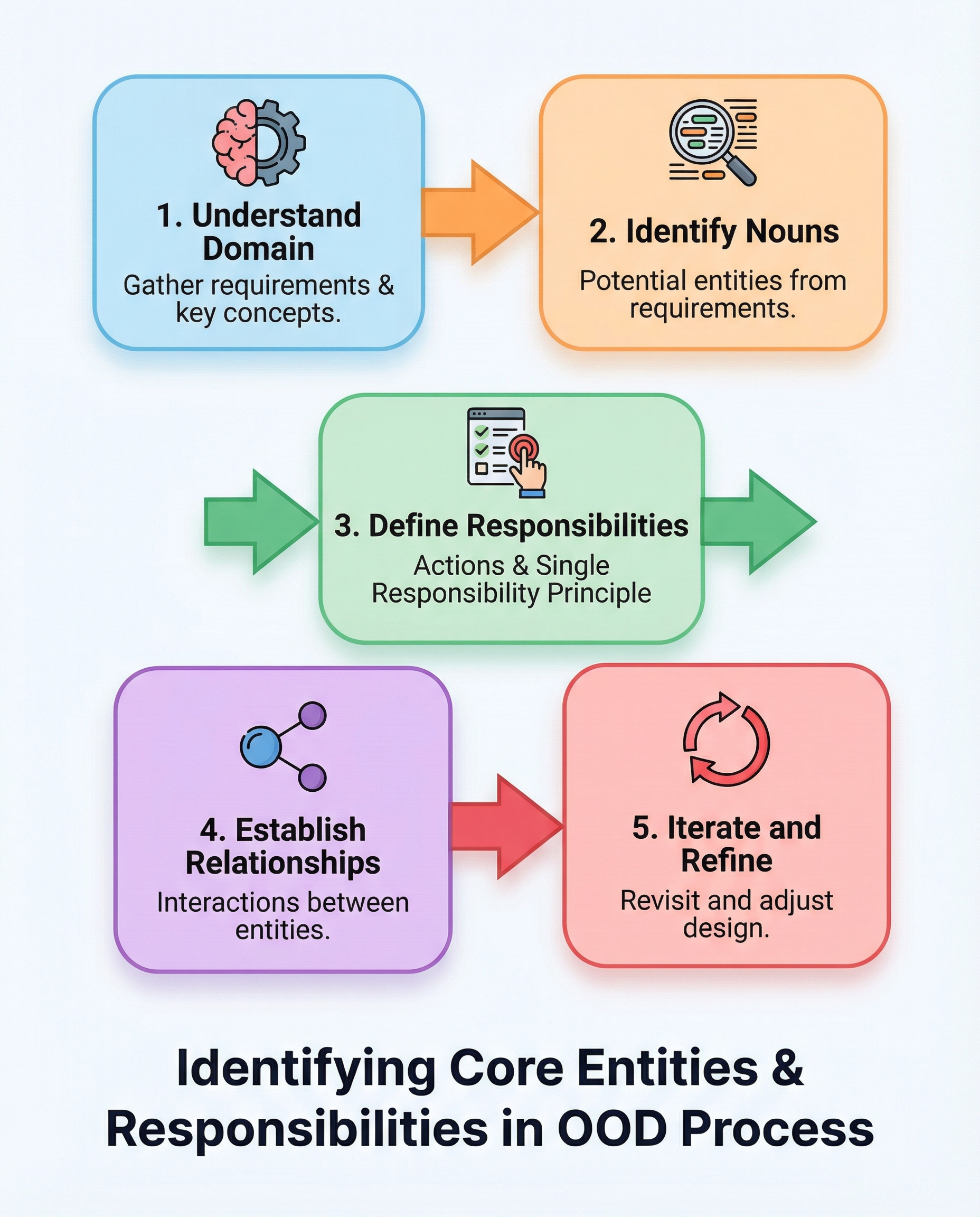
A 5-step checklist for finding core entities
Understand the domain first
- Ask clarifying questions to reveal goals, constraints, and key flows. Don't assume terminology — confirm what the interviewer means by terms like "user," "account," or "session."
Extract nouns from requirements
- Scan the problem statement and notes for nouns: Book, Member, Loan, Product, Cart, Payment.
- Nouns are candidates for entities. Keep them as seeds, not final answers.
Assign clear responsibilities (apply SRP)
- For each candidate entity, ask: what is this responsible for? A class should have one primary reason to change.
- Example: Loan manages borrowing dates and status; Member tracks member details and loan history; Book contains bibliographic info and availability.
Define relationships and ownership
- Map associations: Member has many Loans; Loan links to Book; Order contains OrderItems; Product has Inventory.
- Decide aggregation vs. composition and which side owns lifecycle (does deleting a Member delete their Loans?).
Iterate and refine as requirements evolve
- As you add features (reservation, fines, search), some nouns split into new entities or become value objects.
- Refactor responsibilities to keep classes cohesive and decoupled.
Mini example: library system
- Noun extraction: Book, Member, Loan, Reservation
- Responsibilities:
- Book: metadata, availability check
- Member: profile, borrowing limits, fines
- Loan: start/end dates, renewal, status
- Reservation: queue position, notify on availability
- Relationships: Member 1..* Loan; Loan -> Book; Reservation associates Member and Book
Show this thought process in the interview—draw a simple UML or diagram and narrate why each class exists and what it does.
Interview tips — what to say and show
- Think aloud: explain how you derived entities from nouns and scenarios.
- Prioritize: highlight the core entities first, then secondary ones.
- Justify responsibilities: use SRP as your reasoning for why a class has (or doesn't have) a responsibility.
- Discuss trade-offs: when to merge vs. split classes, or use value objects instead of full entities.
- Iterate: ask "what if" questions (concurrency, deletes, scale) and show how your model adapts.
Quick checklist to use during interviews
- Did I extract nouns from the prompt?
- Can I name 3–6 core entities and their main responsibilities?
- Have I defined relationships and ownership?
- Can I point to one reason each class might change (SRP)?
- Did I sketch a small diagram and explain it clearly?
Identify entities like this and you'll stop guessing classes — you'll design them deliberately.
#ObjectOrientedDesign #SystemDesign #SoftwareEngineering
About the author
bugfree.ai is an advanced AI-powered platform designed to help software engineers master system design and behavioral interviews. Whether you’re preparing for your first interview or aiming to elevate your skills, bugfree.ai provides a robust toolkit tailored to your needs. Key Features:
150+ system design questions: Master challenges across all difficulty levels and problem types, including 30+ object-oriented design and 20+ machine learning design problems. Targeted practice: Sharpen your skills with focused exercises tailored to real-world interview scenarios. In-depth feedback: Get instant, detailed evaluations to refine your approach and level up your solutions. Expert guidance: Dive deep into walkthroughs of all system design solutions like design Twitter, TinyURL, and task schedulers. Learning materials: Access comprehensive guides, cheat sheets, and tutorials to deepen your understanding of system design concepts, from beginner to advanced. AI-powered mock interview: Practice in a realistic interview setting with AI-driven feedback to identify your strengths and areas for improvement.
bugfree.ai goes beyond traditional interview prep tools by combining a vast question library, detailed feedback, and interactive AI simulations. It’s the perfect platform to build confidence, hone your skills, and stand out in today’s competitive job market. Suitable for:
New graduates looking to crack their first system design interview. Experienced engineers seeking advanced practice and fine-tuning of skills. Career changers transitioning into technical roles with a need for structured learning and preparation.
Comments
Join the discussionNo comments yet. Be the first to comment.