OOD Interviews: Stop Guessing Classes—Identify Core Entities Like a Pro
In object-oriented design (OOD) interviews, hiring managers rarely want clever one-liners — they want to see that you can reliably find the domain's core entities and justify their responsibilities. Instead of guessing classes, use a repeatable process to identify the objects that own both data and behavior (e.g., Product, Order, Member).
Why this matters
- Interviewers assess your ability to model a domain, not memorized class names.
- Clear entities + single, well-justified responsibilities = maintainable, testable code.
- Demonstrates understanding of SRP (Single Responsibility Principle) and relationships between objects.
A simple, systematic approach
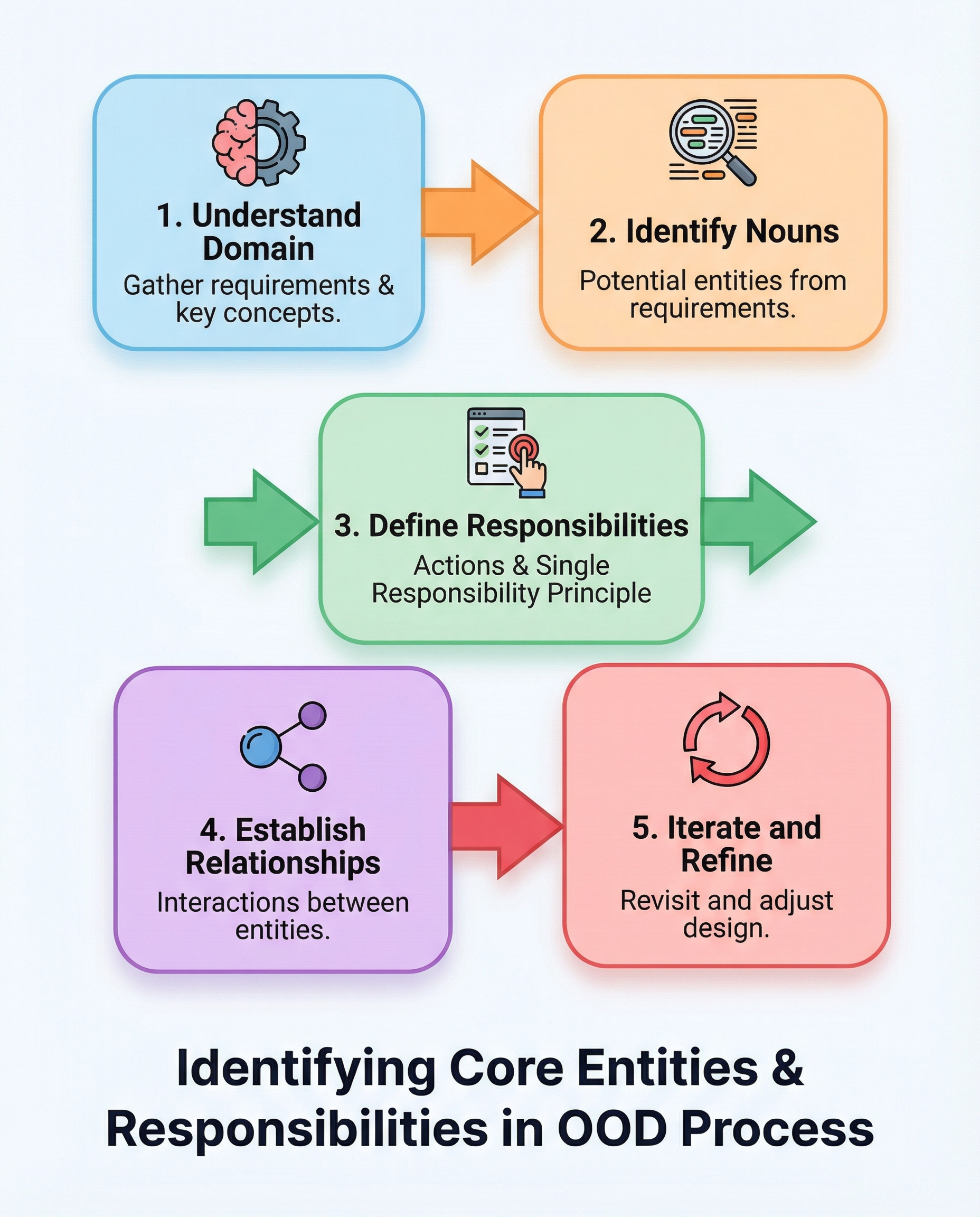
- Understand the domain: ask clarifying questions. What are the business goals, flows, and constraints?
- Extract candidate entities: scan requirements for nouns (Book, Member, Loan, Product, Order). Treat nouns as seeds, not final answers.
- Assign responsibilities: give each candidate one primary reason to change. If a class has multiple unrelated duties, split it.
- Define relationships: decide associations (e.g., Member has many Loans; Loan references a Book). Model multiplicity and ownership.
- Iterate: refine as you uncover new requirements or edge cases.
Example (library system)
- Nouns: Book, Member, Loan, Catalog
- Responsibilities:
- Book: metadata and availability logic
- Member: contact info, borrowing limits
- Loan: due date, renew, return behavior
- Relationships: Member 1..* Loan; Loan -> Book
Interview tips
- Talk your process out loud—explain how you found nouns and assigned responsibilities.
- Use SRP as a guiding rule to split or merge classes.
- Draw a quick class/relationship diagram and walk through typical use cases.
- Admit assumptions and show how your model adapts when requirements change.
Focus on discoverability and rationale, not a perfect diagram. If you can consistently identify core entities and justify why each exists and what it does, you'll stand out in OOD interviews.
About the author
bugfree.ai is an advanced AI-powered platform designed to help software engineers master system design and behavioral interviews. Whether you’re preparing for your first interview or aiming to elevate your skills, bugfree.ai provides a robust toolkit tailored to your needs. Key Features:
150+ system design questions: Master challenges across all difficulty levels and problem types, including 30+ object-oriented design and 20+ machine learning design problems. Targeted practice: Sharpen your skills with focused exercises tailored to real-world interview scenarios. In-depth feedback: Get instant, detailed evaluations to refine your approach and level up your solutions. Expert guidance: Dive deep into walkthroughs of all system design solutions like design Twitter, TinyURL, and task schedulers. Learning materials: Access comprehensive guides, cheat sheets, and tutorials to deepen your understanding of system design concepts, from beginner to advanced. AI-powered mock interview: Practice in a realistic interview setting with AI-driven feedback to identify your strengths and areas for improvement.
bugfree.ai goes beyond traditional interview prep tools by combining a vast question library, detailed feedback, and interactive AI simulations. It’s the perfect platform to build confidence, hone your skills, and stand out in today’s competitive job market. Suitable for:
New graduates looking to crack their first system design interview. Experienced engineers seeking advanced practice and fine-tuning of skills. Career changers transitioning into technical roles with a need for structured learning and preparation.
Comments
Join the discussionNo comments yet. Be the first to comment.