OOD Interviews: Explain Inheritance vs. Relationships Like You Mean It
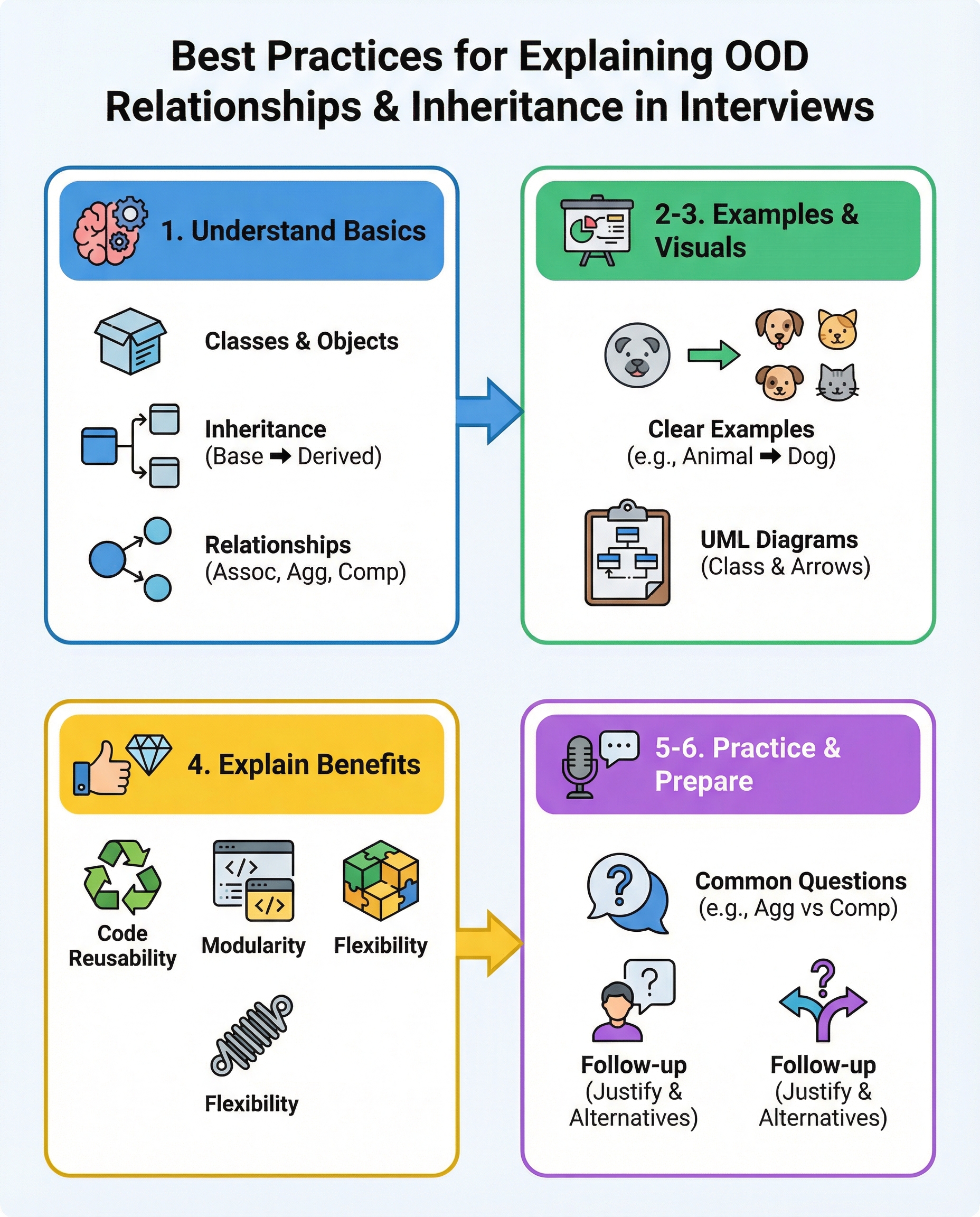
In object-oriented design (OOD) interviews, vague answers lose points. Interviewers want crisp definitions, clear examples, and a short defense of your design choices. Below is a compact, interview-ready guide to explaining inheritance vs relationships (association, aggregation, composition), plus what follow-up questions to expect.
The quick definitions (say these first)
- Inheritance ("is-a"): A subclass is a specialized form of a superclass. Use inheritance when the subclass truly is a type of the superclass.
- Example:
Dogis anAnimal.
- Example:
- Association ("uses") : A loose relationship where one object references or uses another. No ownership implied.
- Example:
TeacherusesStudentfor classroom interactions.
- Example:
- Aggregation ("has-a", independent): A whole that contains parts which can exist independently of the whole.
- Example:
ClassroomhasStudents— students can exist outside the classroom.
- Example:
- Composition ("has-a", dependent): Strong ownership where parts do not have an independent lifecycle; they're created/destroyed with the whole.
- Example:
Housecomposed ofRooms— rooms don't meaningfully exist without the house.
- Example:
Tip: Summarize these out loud in one sentence each, then show examples.
Concrete examples to say and draw
- Inheritance:
Animal → Dog, Cat(use an inheritance arrow in UML) - Association:
Teacher ↔ Student(draw a simple line; maybe label multiplicity e.g. 1..* ) - Aggregation:
Library ◇— Book(draw an open diamond at the library end; books can be moved between libraries) - Composition:
Car ◆— Engine(draw a filled diamond at the car end; engine lifecycle tied to car)
When drawing UML: keep it small and clean—class name, one or two key methods/fields, and the relationship arrow or diamond.
Why each choice matters (talk benefits & costs)
- Inheritance
- Benefits: code reuse, polymorphism, clear subtype behavior.
- Costs: tighter coupling, fragile base class problems, violation of Liskov Substitution Principle if misused.
- Composition / Relationships
- Benefits: greater flexibility, lower coupling, easier to change at runtime, often safer for reuse.
- Costs: may require more boilerplate or wrapper methods, can add indirection.
Rule of thumb to state in interviews: "Prefer composition over inheritance unless there's a clear 'is-a' relationship and the subclass won't break substitutability." Mention LSP when applicable.
Interview-ready checklist (say this when asked how you designed something)
- Define: "Is this an
is-aorhas-arelationship?" — pick inheritance only if it’s trulyis-a. - Consider lifecycle: independent? use aggregation or association. dependent? composition.
- Consider substitutability: can you use the subclass anywhere the base type is expected? If not, avoid inheritance.
- Trade-offs: explain why you chose reuse (inheritance) vs flexibility (composition).
- Draw a minimal UML to support your choice.
Expect follow-ups — how to defend your choice
- "Why not inheritance?" → Explain coupling, fragility, and LSP concerns.
- "Could you use an interface or abstract class instead?" → Discuss replacing concrete inheritance with interfaces + composition for behavior.
- "What about performance or memory?" → Usually negligible; focus on maintainability. If strict constraints exist, mention profiling or simpler data structures.
- "How will this change as requirements evolve?" → Explain extension points, provenance of behavior, and how composition enables swapping components.
Short sample answer (ready to deliver in an interview)
"Inheritance expresses an is-a relation — use it when the subclass naturally extends and can substitute the superclass (e.g., Dog is an Animal). Use association when objects simply reference or use each other (Teacher uses Student). Aggregation means a whole contains parts that can live independently (Library has Books). Composition means strong ownership and shared lifecycle (Car composed of Engine). I prefer composition over inheritance unless there's a clear substitutable subtype, and I’d sketch a small UML to justify the choice and discuss trade-offs like coupling and maintainability."
Final tips
- Keep examples concrete and simple.
- Draw a tiny UML diagram — visuals score points.
- Mention Liskov Substitution Principle and "prefer composition over inheritance" when relevant.
- Be ready to defend trade-offs and suggest alternatives.
Good luck — be precise, draw it, and defend the trade-offs.
#SoftwareEngineering #SystemDesign #CodingInterview
About the author
bugfree.ai is an advanced AI-powered platform designed to help software engineers master system design and behavioral interviews. Whether you’re preparing for your first interview or aiming to elevate your skills, bugfree.ai provides a robust toolkit tailored to your needs. Key Features:
150+ system design questions: Master challenges across all difficulty levels and problem types, including 30+ object-oriented design and 20+ machine learning design problems. Targeted practice: Sharpen your skills with focused exercises tailored to real-world interview scenarios. In-depth feedback: Get instant, detailed evaluations to refine your approach and level up your solutions. Expert guidance: Dive deep into walkthroughs of all system design solutions like design Twitter, TinyURL, and task schedulers. Learning materials: Access comprehensive guides, cheat sheets, and tutorials to deepen your understanding of system design concepts, from beginner to advanced. AI-powered mock interview: Practice in a realistic interview setting with AI-driven feedback to identify your strengths and areas for improvement.
bugfree.ai goes beyond traditional interview prep tools by combining a vast question library, detailed feedback, and interactive AI simulations. It’s the perfect platform to build confidence, hone your skills, and stand out in today’s competitive job market. Suitable for:
New graduates looking to crack their first system design interview. Experienced engineers seeking advanced practice and fine-tuning of skills. Career changers transitioning into technical roles with a need for structured learning and preparation.
Comments
Join the discussionNo comments yet. Be the first to comment.