Observer Pattern: The Interview-Ready Way to Explain Real Systems
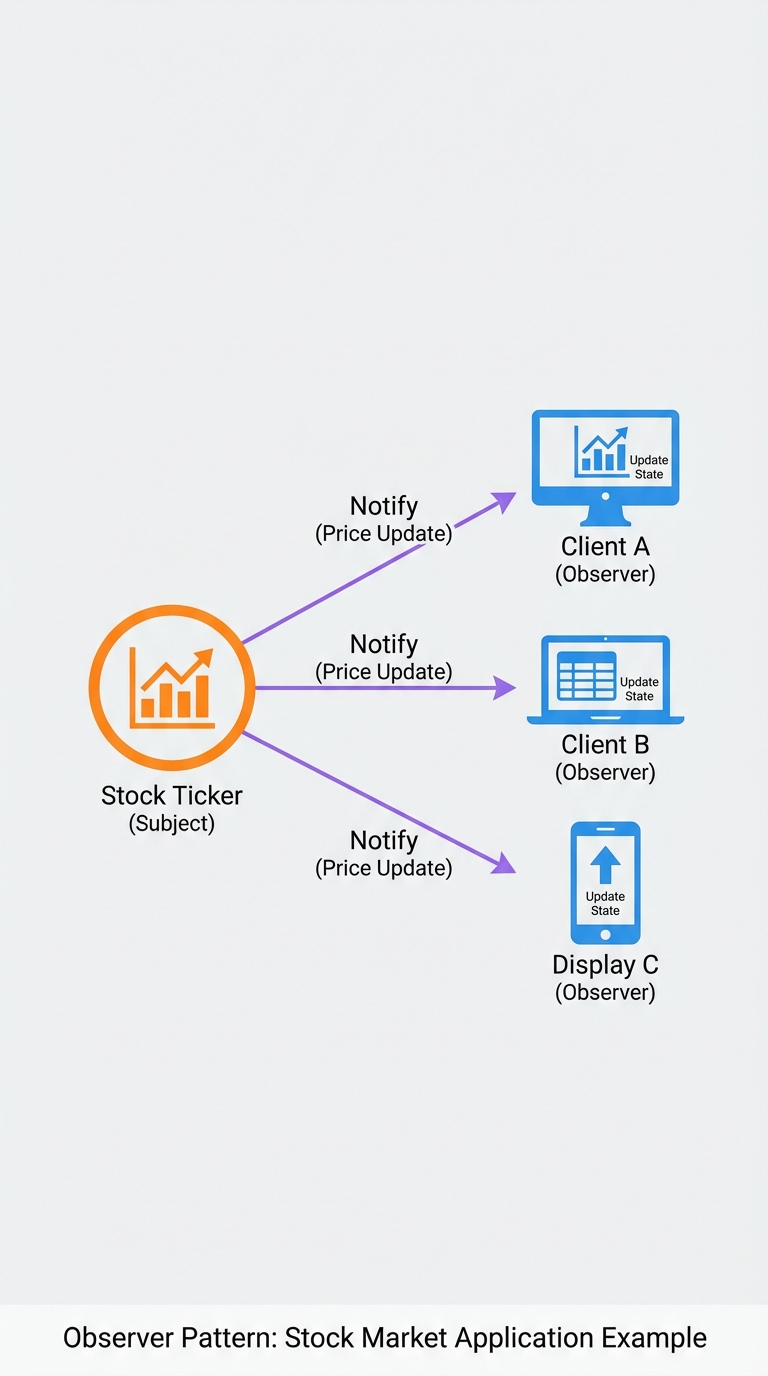
The Observer pattern defines a one-to-many dependency between objects so that when the Subject changes state, all its Observers are notified automatically — without tight coupling. It's a staple for interview answers because it maps directly to many real-world, scalable systems.
Core pieces (concise)
- Subject: registers, unregisters, and notifies observers.
- Observer: defines an update method (called when Subject changes).
- ConcreteSubject: maintains state and a list of observers.
- ConcreteObserver: reacts to notifications (e.g., refresh UI, trigger logic).
Example interfaces (pseudo-Java):
interface Subject {
  void register(Observer o);
  void unregister(Observer o);
  void notifyObservers();
}

interface Observer {
  void update(Object data); // push or pull
}
Two delivery styles:
- Push: Subject provides the data in the notification (update(data)). Good when observers need current state.
- Pull: Subject only signals a change; observers call back to pull the data they need. Good to reduce redundant data transfer.
Real-world examples (easy to mention in interviews)
- UI events: Button -> multiple event listeners (click handlers).
- Stock tickers: Price updates -> client dashboards and trading engines.
- Weather stations: Sensor data -> displays, logs, alerts.
- Social feeds: New post -> followers' feeds/notifications.
- Games: Player achievement -> UI updates, leaderboard, unlocking logic.
Why use it (benefits)
- Decouples components: Subject doesn't need to know concrete observer classes.
- Scalable: Add/remove observers without changing Subject code.
- Promotes modular, testable design.
Common pitfalls and trade-offs
- Memory leaks: Observers must be unregistered (or use weak references) to avoid leaks.
- Notification storms: If many observers react expensively, consider batching or rate-limiting.
- Ordering: Notifications may be delivered in undefined order unless you enforce it.
- Thread-safety: Concurrent register/unregister/notify requires synchronization.
Interview-friendly answer (short script)
"The Observer pattern creates a one-to-many relationship between a Subject and Observers. The Subject maintains a list of observers and notifies them on state change. It's ideal for decoupling event producers and consumers — think UI listeners, feeds, or pub/sub systems. Important follow-ups: push vs pull, thread-safety, and how to avoid memory leaks (e.g., unregistering observers or weak references)."
If you need a tiny example, show this simple flow in JavaScript:
class Subject {
  constructor() { this.observers = new Set(); }
  register(o) { this.observers.add(o); }
  unregister(o) { this.observers.delete(o); }
  notify(data) { this.observers.forEach(o => o.update(data)); }
}

class Observer {
  constructor(name) { this.name = name; }
  update(data) { console.log(this.name, 'received', data); }
}
Quick interview follow-ups (how to answer)
- Thread-safety: "Use synchronization or immutable snapshots of the observer list during notify; consider concurrent collections or lock-free designs depending on requirements."
- Memory leaks: "Provide explicit unregister APIs or use weak references for observers — especially in long-lived subjects like global event buses."
- Ordering guarantees: "If ordering matters, use an ordered collection and document the behavior; otherwise treat order as unspecified."
- Alternative patterns: "For more decoupling or distributed scenarios, prefer pub/sub or message brokers; for tight control use callbacks or reactive streams."
TL;DR (one-liner to memorize)
Observer = one-to-many, Subject notifies Observers on state change. Use it to decouple producers from consumers in UI, feeds, sensors, and more — and mention push vs pull, memory management, and thread-safety in interviews.
#SystemDesign #SoftwareEngineering #DesignPatterns
About the author
bugfree.ai is an advanced AI-powered platform designed to help software engineers master system design and behavioral interviews. Whether you’re preparing for your first interview or aiming to elevate your skills, bugfree.ai provides a robust toolkit tailored to your needs. Key Features:
150+ system design questions: Master challenges across all difficulty levels and problem types, including 30+ object-oriented design and 20+ machine learning design problems. Targeted practice: Sharpen your skills with focused exercises tailored to real-world interview scenarios. In-depth feedback: Get instant, detailed evaluations to refine your approach and level up your solutions. Expert guidance: Dive deep into walkthroughs of all system design solutions like design Twitter, TinyURL, and task schedulers. Learning materials: Access comprehensive guides, cheat sheets, and tutorials to deepen your understanding of system design concepts, from beginner to advanced. AI-powered mock interview: Practice in a realistic interview setting with AI-driven feedback to identify your strengths and areas for improvement.
bugfree.ai goes beyond traditional interview prep tools by combining a vast question library, detailed feedback, and interactive AI simulations. It’s the perfect platform to build confidence, hone your skills, and stand out in today’s competitive job market. Suitable for:
New graduates looking to crack their first system design interview. Experienced engineers seeking advanced practice and fine-tuning of skills. Career changers transitioning into technical roles with a need for structured learning and preparation.
Comments
Join the discussionNo comments yet. Be the first to comment.