High-Score (Bugfree Users) Interview Experience: Netflix Frontend L4 — What Really Gets Tested
Posted by bugfree users — a high-score Netflix Frontend L4 interview experience and breakdown of what the interview loop actually focuses on.
TL;DR
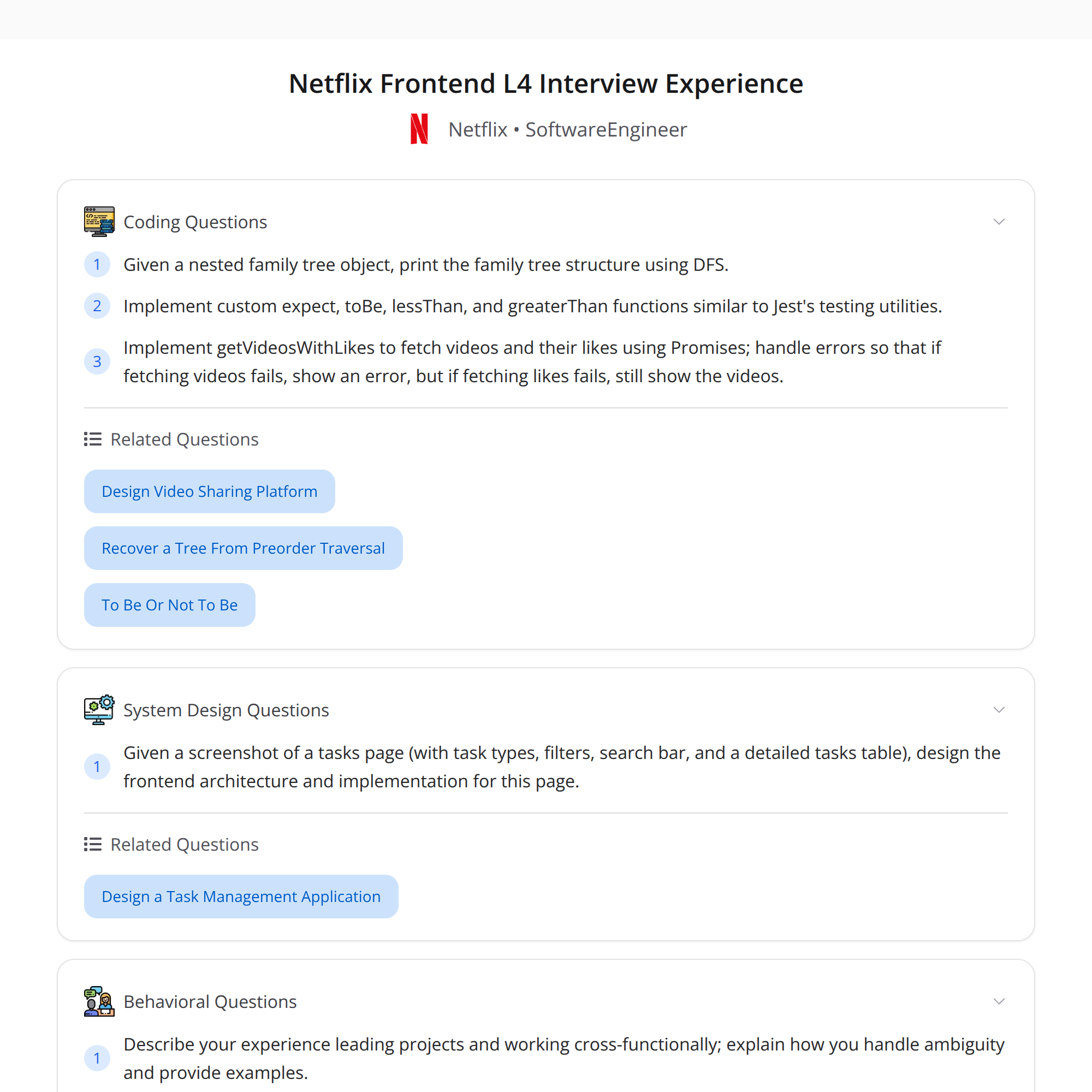
- Phone screen: 1 hour, three JavaScript tasks (DFS-style family tree printing, build a Jest-like
expect/toBe/comparison helpers with higher-order functions, Promise error-handling for resilient UI behavior). - Onsite: autocomplete component (debounce + latest-result-wins), frontend system design from a screenshot (tasks page with filters/search/table), and deep dives into fundamentals (state, CSS, observability, DOM, testing, feature flags, networking).
- Hiring manager rounds leaned heavily on ownership, cross-functional leadership, and reducing ambiguity — L4 expectations are senior.
Phone Screen (≈1 hour) — What to expect and how to prepare
The phone screen focused on three short JS problems that hit practical engineering fundamentals and code clarity.
DFS-style "print family tree"
- Problem: traverse a nested family structure and print or return a formatted listing.
- What they check: recursion/iteration choices, edge-case handling (cycles, missing children), and readable output.
- Prep tips: practice recursive and iterative traversals, and explain time/space complexity out loud.
Build a Jest-like
expect/matchers (toBe,lessThan,greaterThan) using higher-order functions- Problem: implement a tiny assertion library with composable matchers and readable failure messages.
- What they check: higher-order functions, closures, API ergonomics, and helpful error messages.
- Prep tips: implement a few small assertion utilities and practice writing expressive tests that a consumer would use.
Promise error-handling: show videos even if likes fail
- Problem: call multiple async APIs (e.g., load video data and separately load likes). Ensure UI shows videos even if likes fetch fails.
- What they check: Promise combinators (
Promise.all,Promise.allSettled,Promise.race), error resilience, and reasoning about UX trade-offs. - Prep tips: know
allvsallSettledvssettlepatterns and how to fallback on partial failures.
General phone-screen advice:
- Write clean, testable code and narrate trade-offs.
- Discuss alternative approaches and why you pick one.
- Mention complexity and fault scenarios.
Onsite — Deep functional problems and system thinking
Onsite included a mix of a component-level task, a frontend system design from a screenshot, and deeper fundamentals interviews.
Autocomplete component
- Requirements: debounce input, cancel or ignore stale requests, ensure the latest typed input wins ("latest-result wins").
- What they check:
- Debouncing and cancellation (use
setTimeout+ cleanup, AbortController or token checks). - Concurrency handling: avoiding UI flicker from out-of-order responses.
- UX edge cases: empty input, keyboard navigation, accessibility (aria attributes).
- Debouncing and cancellation (use
- Prep tips:
- Practice implementing debounce and throttle utilities.
- Know AbortController and patterns to ignore stale promises.
- Consider accessibility and keyboard interactions.
Frontend system design from a tasks-page screenshot
- Scenario: given a screenshot of a tasks page (filters/search/table), design the frontend architecture to support it.
- Discussion points:
- Component decomposition (filters, search bar, table, pagination, row actions).
- State management: where data lives (local component state vs global store), optimistic updates, caching.
- API design: endpoints for filtering/search/pagination; GraphQL vs REST trade-offs.
- Performance: virtualization for long lists, memoization, minimizing re-renders.
- Observability: logging user actions, metrics for latency/error rate, how to debug regressions.
- Feature flags & rollout strategies for UI changes.
- Prep tips:
- Practice drawing component hierarchies and data flows from a mock UI.
- Be ready to discuss trade-offs for data fetching and caching strategies.
Deep dives on fundamentals
Interviewers drilled into several core topics. Expect follow-ups and whiteboarding-style explanations.
State
- Where state should live, derived state vs canonical source, and minimizing prop drilling.
- Techniques: hooks, context, selectors, memoization, and when to use a global store.
CSS
- Layout strategies (flexbox/grid), performance considerations, and scoping (BEM, CSS modules, CSS-in-JS).
- Handling theming and responsive behavior.
Observability
- What to log, key metrics (latency, error rates, user flows), and how to instrument front-end code.
DOM
- Reconciliation, event delegation, and minimizing expensive DOM operations.
Testing
- Unit vs integration vs E2E, testing strategies for components, mocking network requests, and when to rely on contract tests.
Feature flags
- Use cases, rollout strategies, kill-switches, and telemetry for flagged features.
Networking
- Retry strategies, circuit-breaking patterns, caching headers, and offline considerations.
Prep tips for fundamentals:
- Be ready to explain a concept, then show how you'd apply it to the tasks page or autocomplete.
- Use concrete examples from your work to demonstrate depth.
Hiring Manager (HM) Rounds — L4 expectations
HM conversations emphasized senior, cross-cutting behaviors beyond pure coding:
Ownership
- Drive problems end-to-end, propose and own technical solutions, and follow through on incidents.
Cross-functional leadership
- Communicate clearly with PMs, UX, infra, and backend teams; align on trade-offs and delivery.
Removing ambiguity
- Break down vague requirements, ask the right questions, and propose measurable success criteria.
At L4 they expected a candidate to think and operate at a senior level — not only deliver code but lead decisions.
Practical tips & prep checklist
- Practice small, focused JS problems: recursion, closures, promise combinators.
- Implement a mini autocomplete locally: debounce, AbortController, keyboard nav, accessibility.
- Walk through several frontend-system-design prompts from screenshots and mock pages.
- Review fundamentals: state management patterns, CSS layout techniques, DOM performance, testing strategy.
- Prepare concrete stories demonstrating ownership, cross-team collaboration, and ambiguity resolution.
- During interviews: explain trade-offs, measure complexity, and focus on resilient UX for partial failures.
Final takeaways
Netflix Frontend L4 interviews blend practical coding checks with strong emphasis on system thinking and leadership. Expect technical depth (both component-level and architectural) and behavioral scrutiny that evaluates whether you can own and reduce ambiguity at a senior level. Practicing the specific JS patterns above plus system-design sketches and ownership stories will pay off.
#Netflix #FrontendEngineering #JavaScript #SystemDesign #InterviewPrep
About the author
bugfree.ai is an advanced AI-powered platform designed to help software engineers master system design and behavioral interviews. Whether you’re preparing for your first interview or aiming to elevate your skills, bugfree.ai provides a robust toolkit tailored to your needs. Key Features:
150+ system design questions: Master challenges across all difficulty levels and problem types, including 30+ object-oriented design and 20+ machine learning design problems. Targeted practice: Sharpen your skills with focused exercises tailored to real-world interview scenarios. In-depth feedback: Get instant, detailed evaluations to refine your approach and level up your solutions. Expert guidance: Dive deep into walkthroughs of all system design solutions like design Twitter, TinyURL, and task schedulers. Learning materials: Access comprehensive guides, cheat sheets, and tutorials to deepen your understanding of system design concepts, from beginner to advanced. AI-powered mock interview: Practice in a realistic interview setting with AI-driven feedback to identify your strengths and areas for improvement.
bugfree.ai goes beyond traditional interview prep tools by combining a vast question library, detailed feedback, and interactive AI simulations. It’s the perfect platform to build confidence, hone your skills, and stand out in today’s competitive job market. Suitable for:
New graduates looking to crack their first system design interview. Experienced engineers seeking advanced practice and fine-tuning of skills. Career changers transitioning into technical roles with a need for structured learning and preparation.
Comments
Join the discussionNo comments yet. Be the first to comment.