Negative R² in Interviews: It’s Not a Bug—It’s Your Model Losing to the Mean
Many candidates assume R² must lie between 0 and 1. That’s a common misconception. R² is defined as:
R² = 1 − SSE / SST
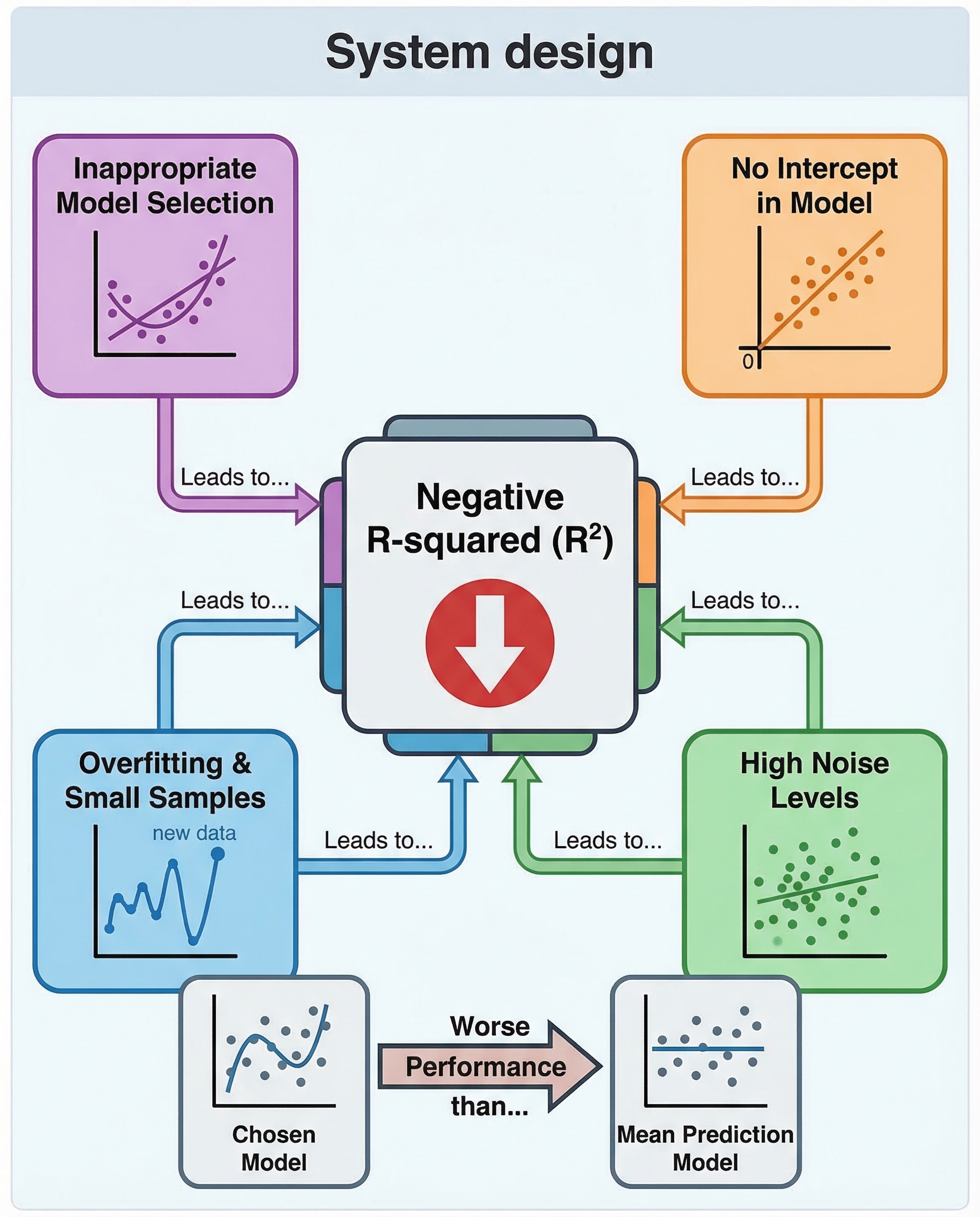
where SSE is the model's sum of squared errors and SST is the total sum of squares (the variance around the mean). If SSE > SST, the fraction SSE/SST exceeds 1 and R² becomes negative. In plain language: your model predicts worse than a trivial predictor that always outputs the mean ȳ.
Why R² goes negative
- Baseline reminder: the mean predictor ȳ has SSE = SST, so it has R² = 0 by definition. Negative R² simply means your model's SSE is larger than that baseline.
- Common causes:
- Model misspecification: e.g., fitting a straight line to strongly nonlinear data.
- Evaluating on a test set after overfitting the train set: the model generalizes poorly so SSE_test outgrows SST_test.
- Forcing a model without an intercept: removing the intercept often increases SSE relative to SST.
- Bad preprocessing or target leakage issues that break generalization.
Quick numeric example
Suppose SST = 100 and SSE = 150. Then
R² = 1 − 150 / 100 = 1 − 1.5 = −0.5.
Interpretation: your model is making predictions so bad that the mean of y would have been a better forecast.
What to say (and why) in an interview
Be concise and precise. For example:
"Negative R² means the model's SSE exceeds the total variance SST, so it performs worse than the baseline predictor ȳ. Typical causes are misspecification (e.g., linear model for nonlinear data), evaluating on a test set after severe overfitting, or removing the intercept. Remedies include adding an intercept, transforming features, regularization, or choosing a more appropriate model."
That answer shows you know the formula, the intuition (comparison to the mean), and practical causes and fixes.
How to fix or avoid it
- Restore/allow an intercept unless there's a good reason not to.
- Try feature transformations (polynomials, logs) or non-linear models.
- Use regularization (Ridge, Lasso) to prevent overfitting.
- Validate on a properly held-out test set or with cross-validation.
- Check data preprocessing and leakage issues.
Bottom line
Negative R² isn't a bug in the metric — it's a signal. It tells you the model is doing worse than the dumb baseline that always predicts the mean. Say that clearly in interviews and follow up with likely causes and fixes.
About the author
bugfree.ai is an advanced AI-powered platform designed to help software engineers master system design and behavioral interviews. Whether you’re preparing for your first interview or aiming to elevate your skills, bugfree.ai provides a robust toolkit tailored to your needs. Key Features:
150+ system design questions: Master challenges across all difficulty levels and problem types, including 30+ object-oriented design and 20+ machine learning design problems. Targeted practice: Sharpen your skills with focused exercises tailored to real-world interview scenarios. In-depth feedback: Get instant, detailed evaluations to refine your approach and level up your solutions. Expert guidance: Dive deep into walkthroughs of all system design solutions like design Twitter, TinyURL, and task schedulers. Learning materials: Access comprehensive guides, cheat sheets, and tutorials to deepen your understanding of system design concepts, from beginner to advanced. AI-powered mock interview: Practice in a realistic interview setting with AI-driven feedback to identify your strengths and areas for improvement.
bugfree.ai goes beyond traditional interview prep tools by combining a vast question library, detailed feedback, and interactive AI simulations. It’s the perfect platform to build confidence, hone your skills, and stand out in today’s competitive job market. Suitable for:
New graduates looking to crack their first system design interview. Experienced engineers seeking advanced practice and fine-tuning of skills. Career changers transitioning into technical roles with a need for structured learning and preparation.
Comments
Join the discussionNo comments yet. Be the first to comment.