
Stop guessing home offers — the discount is the price of convenience
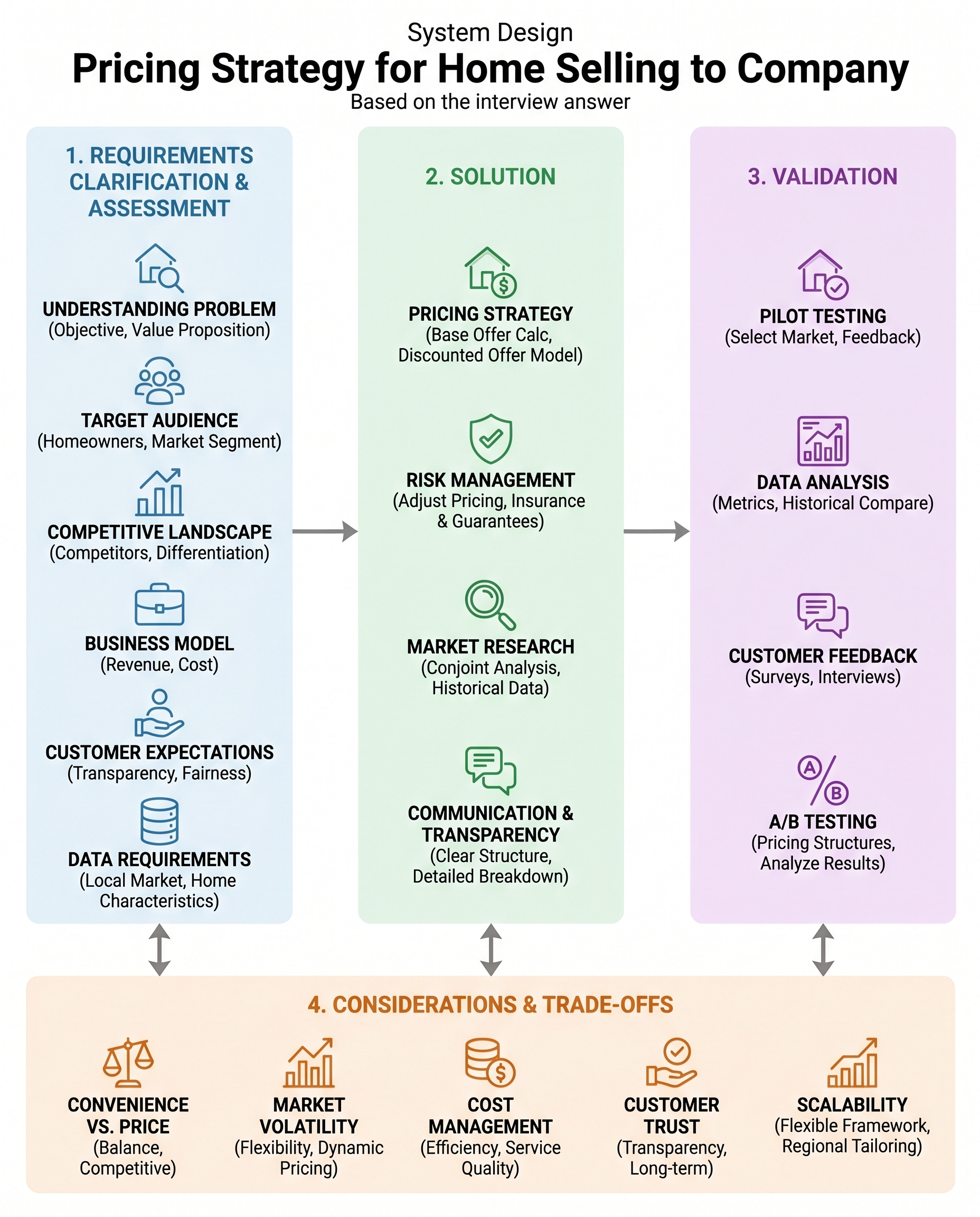
In pricing conversations about home offers, the reflexive answer is often “market price minus X%.” That’s a blunt instrument. A better view: the discount buyers (or institutional buyers) offer is the explicit price of convenience — a measurable trade-off sellers make to avoid time-on-market, showings, uncertainty, and repairs.
Treat the convenience discount as a product feature you can model and expose to users. Then you can quantify trade-offs (speed vs price) and make transparent, defensible offers.
Break the model into three separable components
Baseline market value
- Estimate the home’s baseline using local comps, time-adjusted price trends, and property features (square footage, beds/baths, lot, neighborhood). Hedonic regression or recent-sales nearest-neighbor comps work well here.
Risk adjustments (conditional and market volatility)
- Account for condition-related repairs, inspection uncertainties, and local market volatility. Use repair-cost estimates or condition flags, plus measures of price volatility and tail risks in the zip code or micro-market.
Transparent service fee (fixed cost)
- Separate out a clear, per-transaction service fee that covers carrying costs, transaction overhead, and profit. Present this as a line item so the seller sees what’s negotiable (convenience trade-off) vs fixed.
Putting it together in one line:
Offer Price = Baseline Market Value - Convenience Discount - Risk Adjustment - Service Fee
Where the Convenience Discount is the seller’s willingness-to-accept (WTA) for speed, certainty, and lower hassle.
How to measure the convenience discount
- Observational signals: infer WTA from historical offers, take-rate vs time-on-market, and price concessions in fast-sale channels.
- Experimental approaches: run a conjoint (choice-based) or discrete-choice experiment to quantify how much price sellers trade for faster closings, fewer showings, or simpler contracts.
- Survival/hazard models: model time-to-sale and map expected days saved to implied dollar value using historic sale-price deltas.
Quick conjoint design (interview tip)
Propose a concise conjoint to quantify WTA for speed vs price. Example attributes and levels:
- Closing time: 7 days / 30 days / 90 days
- Sale condition: As-is / Minor repairs required / Fully repaired
- Certainty: Non-refundable deposit / Standard contingency / Cash-close guaranteed
- Showings allowed: Yes / No
Run 8–12 choice tasks per respondent across a mix of sellers (by motivation/segment). Estimate part-worths and convert the marginal utility of time into a dollar WTA (convenience discount). This gives actionable numeric trade-offs to expose in product UI.
Productize the result
- Expose a slider: speed vs price. As the user moves the slider toward speed, dynamically show the predicted convenience discount and final offer.
- Show a breakdown: baseline comps, estimated repair/risk adjustments, convenience discount, and service fee — all transparent.
- Provide scenarios: "Sell in 7 days" vs "Sell in 90 days" with expected net proceeds and probability of closing.
Data & features to include
- Property attributes and recent comps (baseline)
- Condition flags and repair estimates (risk)
- Local volatility metrics (sigma of price changes, days-on-market distribution)
- Historical take-rates and time-to-sale outcomes (for inferred WTA)
- Seller segment features: urgency, reason for selling, past experience
Why this wins interviews and products
- It moves the conversation from guesswork to measurable trade-offs.
- It produces defensible offers and a better seller experience (they see what they pay for convenience).
- It’s product-friendly: the same model powers UI controls, pricing rules, and AB tests.
If you’re in an interview, frame this approach succinctly: separate baseline value, risk adjustments, and a measurable convenience discount; propose conjoint to quantify WTA; and suggest a UI that makes the trade-off visible and actionable.
#DataScience #ProductManagement #Analytics
About the author
bugfree.ai is an advanced AI-powered platform designed to help software engineers master system design and behavioral interviews. Whether you’re preparing for your first interview or aiming to elevate your skills, bugfree.ai provides a robust toolkit tailored to your needs. Key Features:
150+ system design questions: Master challenges across all difficulty levels and problem types, including 30+ object-oriented design and 20+ machine learning design problems. Targeted practice: Sharpen your skills with focused exercises tailored to real-world interview scenarios. In-depth feedback: Get instant, detailed evaluations to refine your approach and level up your solutions. Expert guidance: Dive deep into walkthroughs of all system design solutions like design Twitter, TinyURL, and task schedulers. Learning materials: Access comprehensive guides, cheat sheets, and tutorials to deepen your understanding of system design concepts, from beginner to advanced. AI-powered mock interview: Practice in a realistic interview setting with AI-driven feedback to identify your strengths and areas for improvement.
bugfree.ai goes beyond traditional interview prep tools by combining a vast question library, detailed feedback, and interactive AI simulations. It’s the perfect platform to build confidence, hone your skills, and stand out in today’s competitive job market. Suitable for:
New graduates looking to crack their first system design interview. Experienced engineers seeking advanced practice and fine-tuning of skills. Career changers transitioning into technical roles with a need for structured learning and preparation.
Comments
Join the discussionNo comments yet. Be the first to comment.