ML Interviews: What They Actually Test (and How to Prepare)
Interviewers don't hire candidates for buzzwords—they hire for fundamentals and the ability to execute. Below is a concise map of what ML interviews usually probe and practical steps to prepare.
What interviewers check (and how to show it)
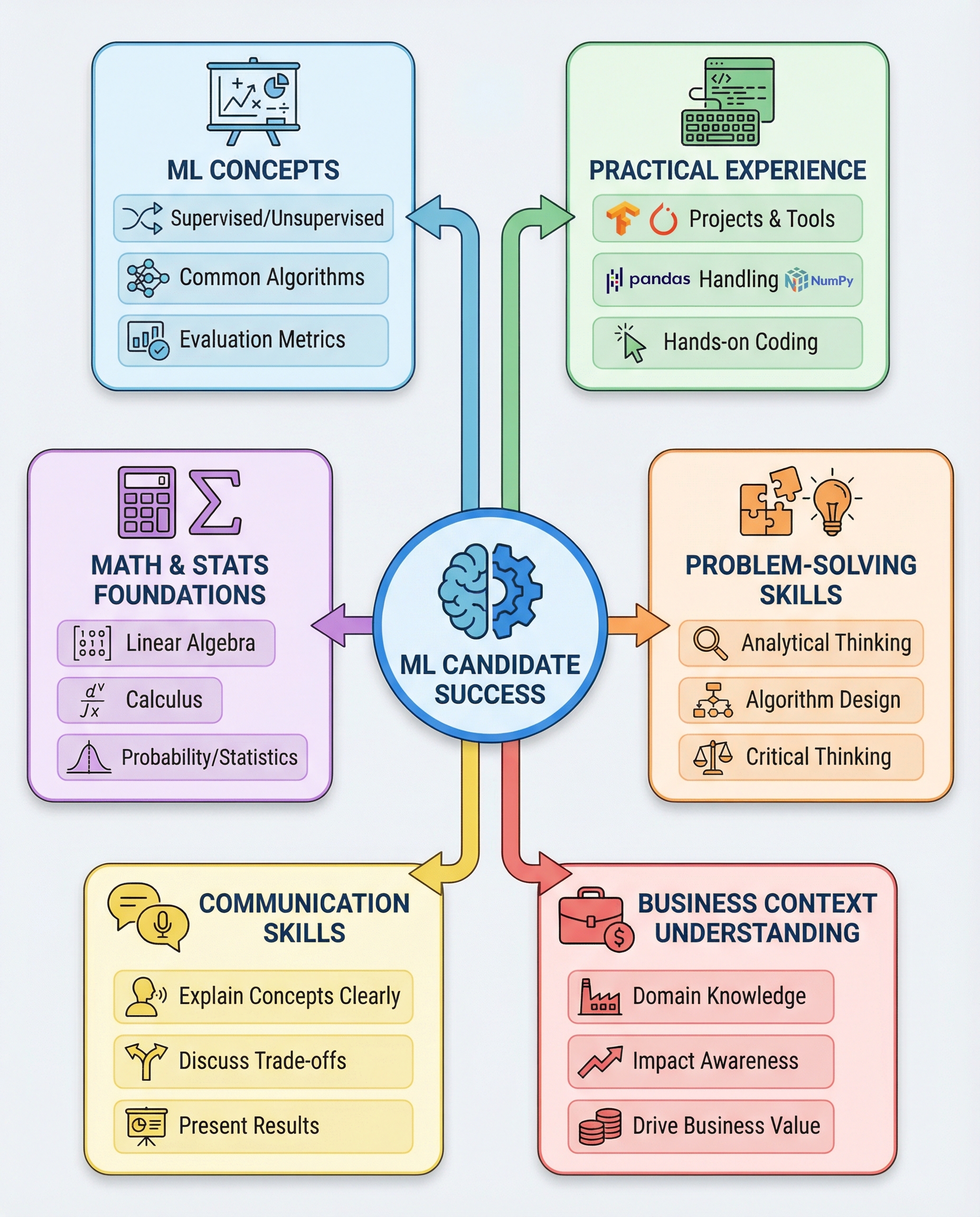
1) Core ML concepts
- What they test: distinctions like supervised vs unsupervised learning, common algorithms (linear/logistic regression, decision trees, SVMs, k-means, PCA, neural nets), and evaluation metrics (accuracy, precision, recall, F1, ROC-AUC).
- How to demonstrate it: explain when and why you’d choose a model, show familiarity with metric trade-offs (e.g., precision vs recall in imbalanced data), and interpret learning curves and bias–variance behavior.
- Prep tips: revisit basic algorithms, implement simple classifiers from scratch, and compare metrics on toy datasets.
2) Practical skill
- What they test: evidence of shipping ML work—end-to-end projects, familiarity with frameworks (TensorFlow/PyTorch/Scikit-learn), and clean data preparation with Pandas/NumPy.
- How to demonstrate it: walk through a project end-to-end (data ingestion → cleaning → modeling → deployment/monitoring). Share code snippets, notebooks, or a deployed demo.
- Prep tips: build 1–2 projects you can explain in 10 minutes; practice coding common data transformations and training loops.
3) Math maturity
- What they test: understanding of linear algebra (vectors, matrices, eigenvectors), calculus (gradients, chain rule), and probability/statistics (conditional probability, distributions, hypothesis testing).
- How to demonstrate it: derive or explain gradients, justify initialization/regularization choices, and reason about uncertainty or confidence intervals.
- Prep tips: refresh the math behind optimization (gradient descent variants) and practice explaining equations in plain language.
4) Problem-solving
- What they test: how you handle ambiguity—breaking down open-ended problems, selecting feasible approaches, and justifying trade-offs (latency vs accuracy, data labeling cost, model interpretability).
- How to demonstrate it: structure your thought process out loud (clarify assumptions, propose multiple solutions, estimate costs and timelines).
- Prep tips: practice system design and case-style ML questions; use a framework (clarify → brainstorm → choose → justify).
5) Communication & business sense
- What they test: ability to explain technical choices to non-experts and tie model outcomes to business impact or metrics (CTR, retention, revenue, safety).
- How to demonstrate it: state the objective, expected gains, risks, and how you’d measure success and monitor production models.
- Prep tips: practice concise explanations for different audiences and prepare a short pitch for each of your projects.
Quick interview checklist (do these before and during interviews)
- Prepare a 2–3 minute summary for each project: problem, data, model, results, impact, and lessons learned.
- Rehearse common whiteboard problems: implement logistic regression or gradient descent on paper or whiteboard.
- Brush up on a small set of libraries (Scikit-learn + one DL framework) and basic Pandas/NumPy idioms.
- Practice communicating trade-offs and writing down assumptions explicitly.
- Have questions ready about the team’s ML lifecycle, data quality, and production monitoring.
Sample questions you should be able to handle
- How would you evaluate a classifier on an imbalanced dataset? Which metrics matter and why?
- Describe how you’d detect data drift in production and respond to it.
- Implement or pseudocode gradient descent for linear regression and explain convergence factors.
- Design an approach to recommend items for a new user (cold start).
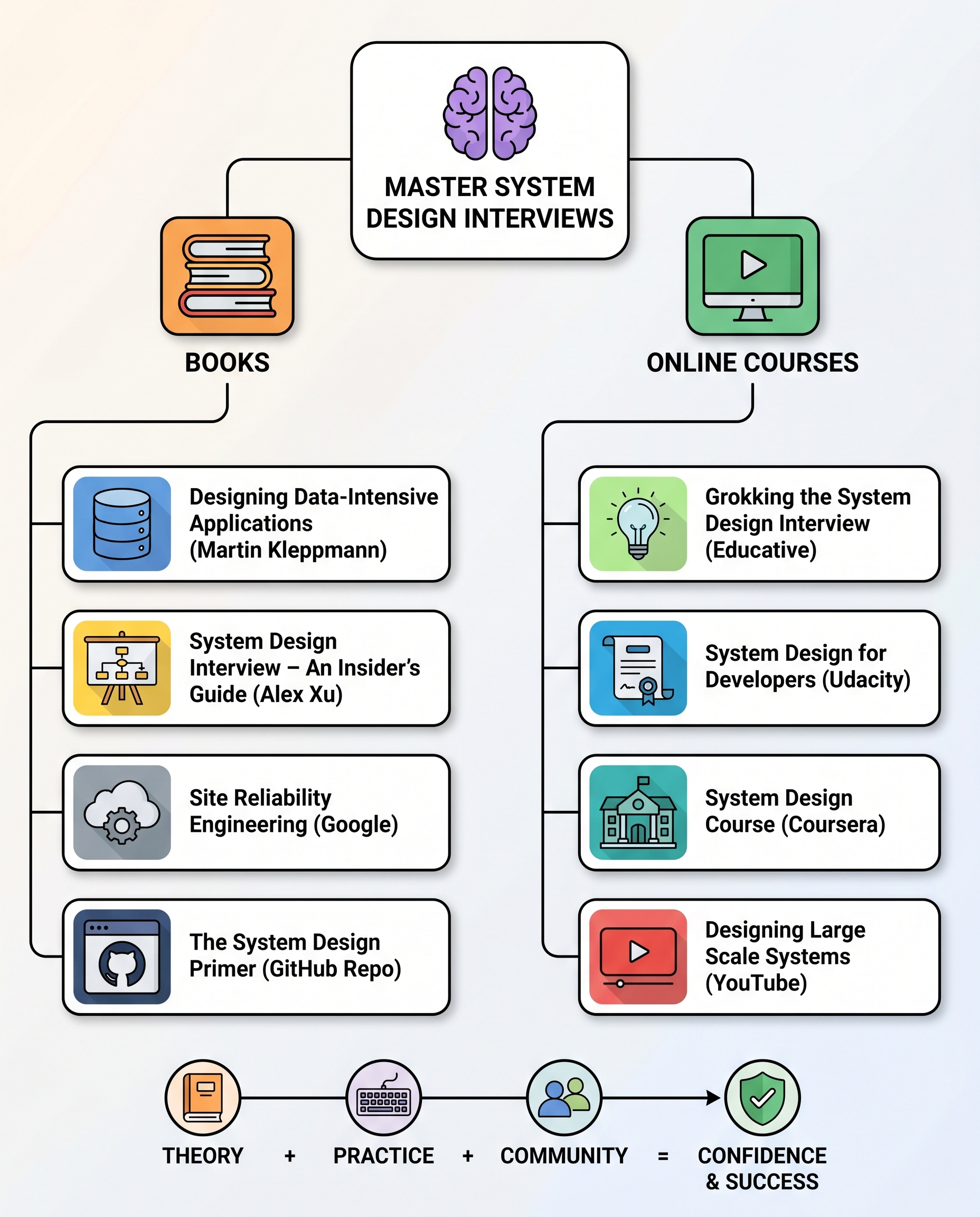
Resources to practice
- Hands-on projects: Kaggle micro-challenges, building CRUD + model APIs.
- Books/courses: "Hands-On Machine Learning" (practical), CS231n notes (deep learning intuition), probability/statistics primers.
- Mock interviews: system design + ML-role-specific platforms, pair programming with peers.
Final note
Interviewers want to see that you understand core principles, can implement and ship models, reason quantitatively, and communicate impact. Focus your prep on clear explanations, reproducible projects, and structured problem-solving.
#MachineLearning #DataScience #AI
About the author
bugfree.ai is an advanced AI-powered platform designed to help software engineers master system design and behavioral interviews. Whether you’re preparing for your first interview or aiming to elevate your skills, bugfree.ai provides a robust toolkit tailored to your needs. Key Features:
150+ system design questions: Master challenges across all difficulty levels and problem types, including 30+ object-oriented design and 20+ machine learning design problems. Targeted practice: Sharpen your skills with focused exercises tailored to real-world interview scenarios. In-depth feedback: Get instant, detailed evaluations to refine your approach and level up your solutions. Expert guidance: Dive deep into walkthroughs of all system design solutions like design Twitter, TinyURL, and task schedulers. Learning materials: Access comprehensive guides, cheat sheets, and tutorials to deepen your understanding of system design concepts, from beginner to advanced. AI-powered mock interview: Practice in a realistic interview setting with AI-driven feedback to identify your strengths and areas for improvement.
bugfree.ai goes beyond traditional interview prep tools by combining a vast question library, detailed feedback, and interactive AI simulations. It’s the perfect platform to build confidence, hone your skills, and stand out in today’s competitive job market. Suitable for:
New graduates looking to crack their first system design interview. Experienced engineers seeking advanced practice and fine-tuning of skills. Career changers transitioning into technical roles with a need for structured learning and preparation.
Comments
Join the discussionNo comments yet. Be the first to comment.