ML Interviews: What Hiring Panels Actually Test (and How to Prepare)
Interviews for machine learning roles aren’t a buzzword contest. Hiring panels want to know you understand fundamentals, can execute in practice, reason mathematically, and make sensible trade-offs that align with business goals. Below is a compact guide to what interviewers look for and how to prepare effectively.
What interviewers are testing
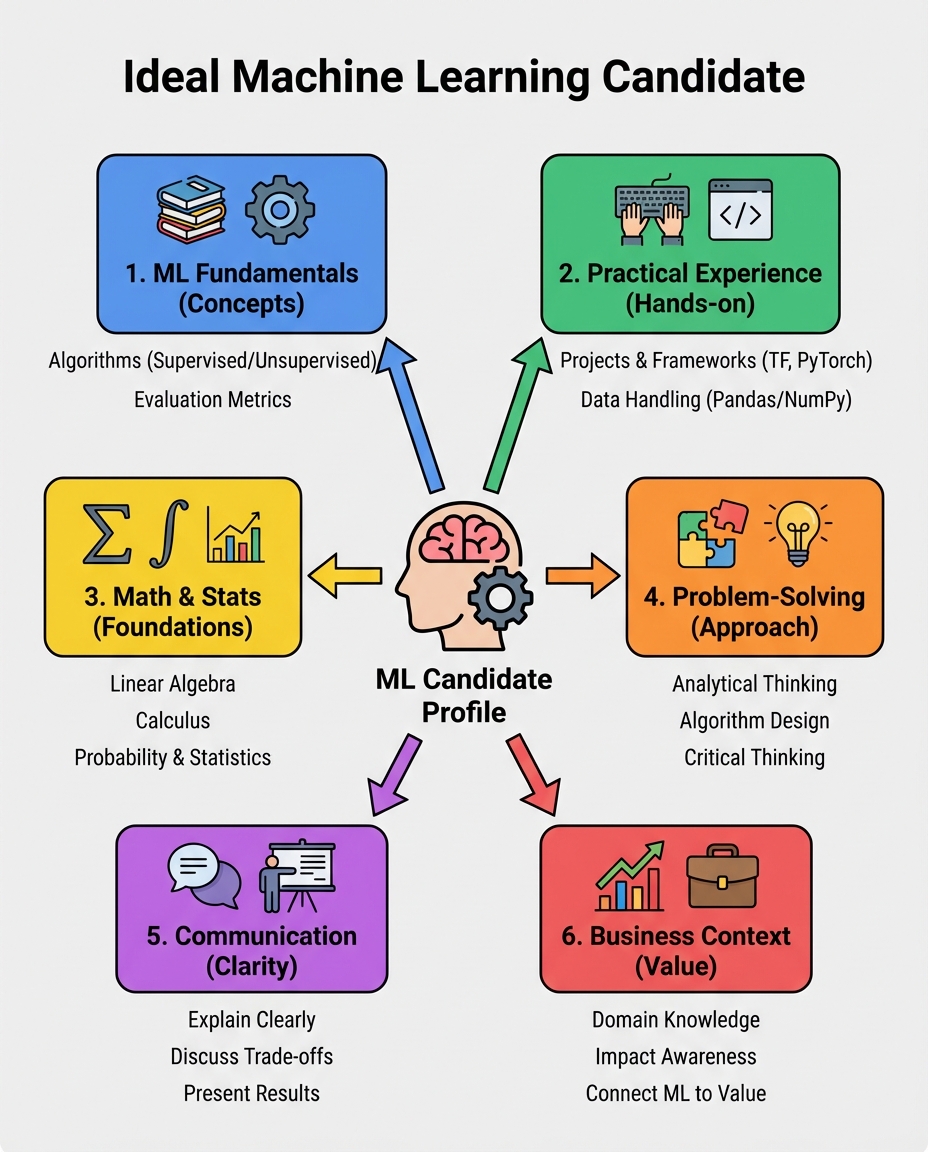
1) Core ML concepts
- Be ready to clearly explain supervised vs unsupervised learning, reinforcement learning, and common algorithms (linear/logistic regression, decision trees, SVMs, k-means, random forests, gradient-boosted trees, neural nets).
- Know when to use which model and why: data size, feature types, interpretability, latency, and label availability.
- Evaluation metrics: accuracy vs precision/recall/F1, ROC-AUC, PR-AUC — explain when each matters (class imbalance, cost of false positives vs negatives).
2) Hands-on engineering skill
- Show code and projects: training pipelines, data cleaning, feature engineering, model evaluation, and deployment basics.
- Be fluent with common tools: TensorFlow/PyTorch/Keras, scikit-learn, Pandas, NumPy. Explain choices (e.g., why PyTorch for research vs TensorFlow for some production setups).
- Demonstrate reproducibility: versioning, experiments, unit tests, and simple CI/CD or deployment approaches.
3) Math maturity
- Linear algebra: matrix multiplication, eigenvalues/SVD intuition, shapes and broadcasting.
- Calculus/optimization: gradients, chain rule, basic convex vs nonconvex optimization, gradient descent variants.
- Probability & statistics: conditional probability, Bayes’ rule, distributions, bias/variance trade-off, confidence intervals, hypothesis testing, MLE.
- You don’t need to be a theorem-prover—show you can apply math to explain model behavior and failure modes.
4) Problem-solving and trade-offs
- Use a structured approach: clarify the goal and constraints, propose a baseline, choose models, design evaluation metrics, discuss data needs, and iterate.
- Always justify trade-offs: accuracy vs latency, model complexity vs interpretability, cost of features vs incremental gain.
- Expect system-level questions: how would you build a real-time recommender? How to handle stale data or concept drift?
5) Communication and business impact
- Translate technical choices into business outcomes: how does improving precision help the product? What are the costs of false positives?
- Tell stories about projects: your role, the problem, the models you tried, how you validated them, and the measurable impact.
- Communicate clearly, structure answers, and surface assumptions up front.
How to prepare (practical checklist)
- Refresh core concepts: a concise course/book or notes covering supervised/unsupervised, basic algorithms, and metrics.
- Hands-on practice: tidy up 1–2 projects you can walk through in 10–15 minutes (notebooks, clear README, key plots/metrics).
- Code practice: implement common algorithms or model pipelines; practice with scikit-learn and a deep‑learning framework.
- Math: revisit matrix ops, gradients, probability basics; do a few walkthroughs showing how math explains model behavior.
- Mock interviews: whiteboard or video calls to practice explaining trade-offs and answering clarifying questions.
- Read system-design for ML: data pipelines, monitoring, retraining, latency trade-offs, and feature stores.
Quick example answers
- Metric choice: "For a rare disease classifier I'd prioritize recall and PR-AUC because false negatives are costly and classes are imbalanced."
- Baseline first: "Start with a simple model (logistic regression or decision tree) to get a baseline and features; only add complexity if needed and justified by cross-validated gains."
- Handling missing data: "Impute carefully (median for skewed distributions), add missing indicators if informative, and evaluate with and without imputation to check sensitivity."
Recommended resources
- Hands-On Machine Learning with Scikit‑Learn, Keras & TensorFlow (book)
- Fast.ai and deep learning specialization (practical courses)
- CS229 / Stanford lecture notes (theory)
- Kaggle competitions and reproducible notebooks (practice)
- Papers With Code for state-of-the-art baselines
Final tips for interview day
- Ask clarifying questions early.
- Think aloud—interviewers want to follow your reasoning.
- Start with a simple baseline and iterate.
- Quantify impact: connect metrics to business outcomes.
- If you don’t know something, say so and outline how you’d find or approximate the answer.
Focus on fundamentals, practice explaining trade-offs, and have a couple of polished projects to demonstrate hands-on skill. Good luck!
#MachineLearning #DataScience #TechCareers
About the author
bugfree.ai is an advanced AI-powered platform designed to help software engineers master system design and behavioral interviews. Whether you’re preparing for your first interview or aiming to elevate your skills, bugfree.ai provides a robust toolkit tailored to your needs. Key Features:
150+ system design questions: Master challenges across all difficulty levels and problem types, including 30+ object-oriented design and 20+ machine learning design problems. Targeted practice: Sharpen your skills with focused exercises tailored to real-world interview scenarios. In-depth feedback: Get instant, detailed evaluations to refine your approach and level up your solutions. Expert guidance: Dive deep into walkthroughs of all system design solutions like design Twitter, TinyURL, and task schedulers. Learning materials: Access comprehensive guides, cheat sheets, and tutorials to deepen your understanding of system design concepts, from beginner to advanced. AI-powered mock interview: Practice in a realistic interview setting with AI-driven feedback to identify your strengths and areas for improvement.
bugfree.ai goes beyond traditional interview prep tools by combining a vast question library, detailed feedback, and interactive AI simulations. It’s the perfect platform to build confidence, hone your skills, and stand out in today’s competitive job market. Suitable for:
New graduates looking to crack their first system design interview. Experienced engineers seeking advanced practice and fine-tuning of skills. Career changers transitioning into technical roles with a need for structured learning and preparation.
Comments
Join the discussionNo comments yet. Be the first to comment.