
High-Score (Bugfree Users) Interview Experience: Microsoft SWE Loop
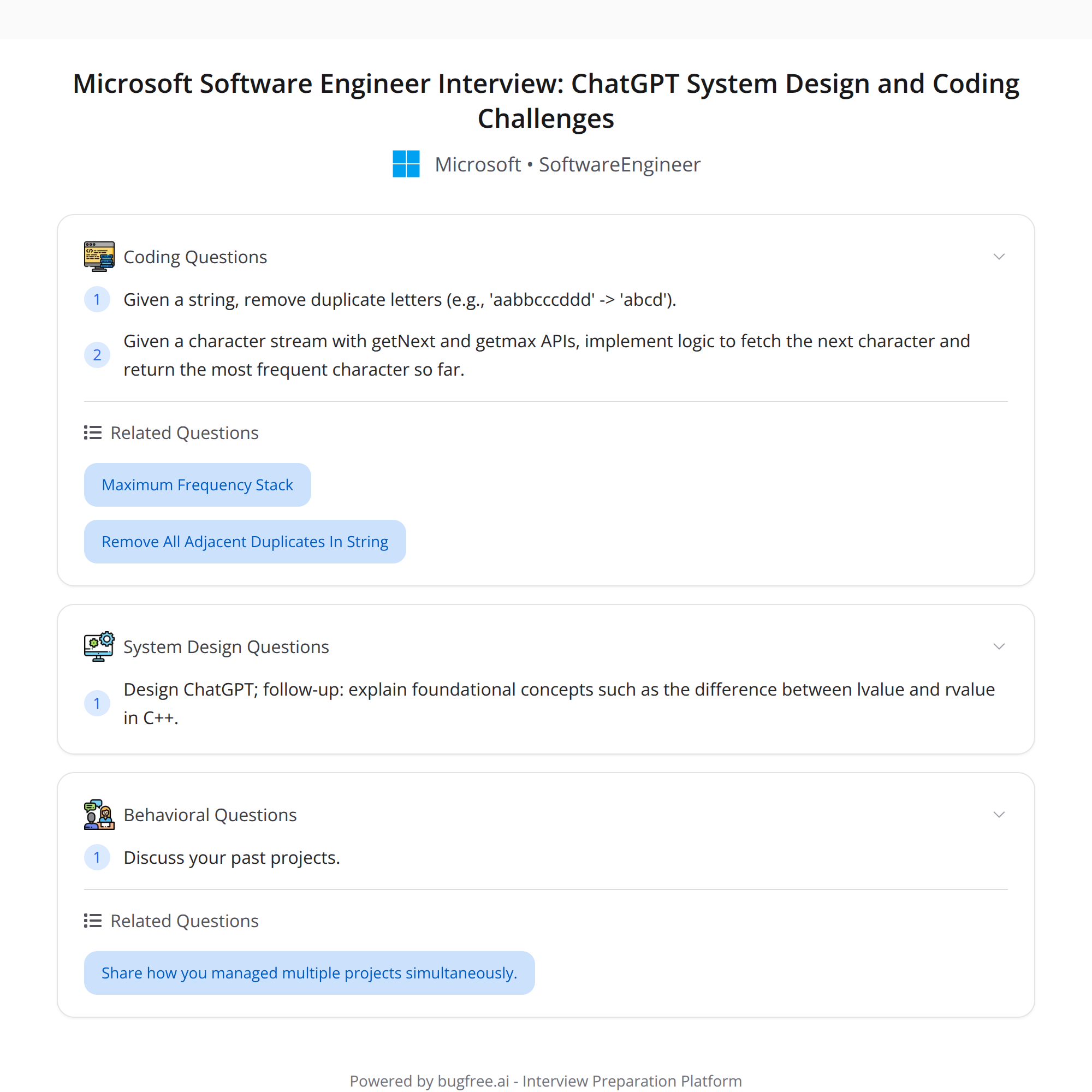
This interview report (shared by Bugfree users) summarizes a Microsoft Software Engineer loop that combined system design, C++ fundamentals, and coding challenges. The loop required continuous screen sharing and emphasized API-driven thinking and real-time problem solving.
Interview structure (high level)
- System design round: "Design ChatGPT"
- C++ fundamentals: lvalue vs rvalue (plus related move semantics basics)
- Two coding problems:
- Remove duplicate letters in a string (e.g., "aabbcccddd" → "abcd")
- A character stream API with getNext() and getMax() returning the most frequent character seen so far
- Behavioral questions sprinkled throughout
System design: "Design ChatGPT"
This is a broad, open-ended prompt. Interviewers typically expect a structured approach: clarify requirements, sketch high-level components, dive into key subsystems, and reason about scale, costs, and trade-offs.
Key areas to cover:
Clarify requirements
- User-facing features: chat interface, multi-turn context, typed responses, rate limits
- Non-functional: latency targets, concurrency, availability, cost, safety (content filtering)
- Analytics and observability needs
High-level components
- Client/UI layer (web/mobile)
- API Gateway and Auth
- Orchestration layer to handle conversation state and prompt construction
- Model serving/inference cluster(s)
- Caching layer for recent context or embeddings
- Storage: conversation DB, user metadata, logs, metrics
- Moderation & safety filter pipeline
- Monitoring, alerting, and A/B experiment infra
Model & inference considerations
- Model selection: small fast models vs large high-quality models; multi-tier serving (fast tier for short answers, slow/accurate tier for complex queries)
- Sharding and autoscaling: GPU/TPU pools, batching to improve throughput vs per-request latency
- Latency optimizations: quantization, distillation, operator fusion, prompt caching
Data pipeline & fine-tuning
- Data collection, labeling, and privacy/safety controls
- Continuous evaluation, rollout strategy, and canarying
Safety, moderation & compliance
- Pre- and post-processing filters, user reporting, human-in-the-loop for escalations
- Rate-limiting and abuse detection
API design and client contract
- Streaming responses vs complete response
- Streaming: chunked responses, backpressure, resumable sessions
- Versioning, error codes, retry semantics
Observability & operations
- Metrics: p99 latency, throughput, error rates, model drift
- Tracing conversation flow for debugging
Trade-offs and final recommendations
- When to prioritize latency vs correctness
- Cost controls: model tiering, request sampling, cache hits
When asked follow-ups, be ready to dive deeper into any subsystem (e.g., exactly how you’d implement stream APIs, how to store conversation context efficiently, or how to handle state in a distributed system).
C++ fundamentals: lvalue vs rvalue (short refresher)
Interviewers often probe move semantics and object lifetime. Be concise and precise:
- lvalue: an expression that refers to a persistent object (has an address). Example: variables, dereferenced pointers.
- rvalue: a temporary value or a value without a persistent address (e.g., results of expressions, temporaries).
- Move semantics: allow resources to be transferred from rvalues using rvalue references (T&&) and std::move to avoid expensive copies.
Tip: explain when copy constructors vs move constructors are called and give a one-line example showing std::move usage.
Coding problem 1: Remove duplicate letters
Problem: given a string like "aabbcccddd", compress adjacent duplicates into a single character => "abcd".
Clarify: Are duplicates only adjacent runs? The given example suggests removing consecutive duplicate characters rather than removing all duplicates globally.
Simple approach (O(n) time, O(1) extra space):
- Iterate through the string and copy each char if it differs from the previous appended char.
Pseudocode:
- If string empty, return empty
- Initialize write_index = 0
- For read_index from 0 to n-1:
- If read_index == 0 or s[read_index] != s[read_index - 1]:
- s[write_index++] = s[read_index]
- If read_index == 0 or s[read_index] != s[read_index - 1]:
- Resize/truncate string to write_index and return
This is stable and uses in-place modification with linear time.
Edge cases:
- Empty string
- All identical characters
- Case sensitivity ("A" vs "a") — clarify requirements
Coding problem 2: Character stream with getNext() and getMax()
Problem summary: You're given a character stream interface where getNext(c) appends a character to the stream. getMax() should return the character that has appeared most frequently so far.
Clarifying questions to ask:
- What should getMax() return on ties? (earliest seen? lexicographically smallest? any?)
- What about empty stream—return sentinel/none?
- Expected constraints: stream length, character domain (ASCII, Unicode), memory limits
Typical approaches:
1) Hash map + max-heap (priority queue)
- Maintain a frequency map freq[char].
- Push (freq[char], char) into a max-heap when a char is updated.
- When getMax() is called, pop outdated heap entries whose stored frequency != current freq[char] until top is up-to-date.
- Complexity: O(log n) per update (heap push) and amortized O(log n) per getMax in worst case.
2) Hash map + buckets (O(1) getMax)
- Maintain freq[char] and maintain buckets where bucket[k] holds the set of chars with frequency k.
- Track currentMaxFreq and update as characters arrive.
- getMax() returns any char from bucket[currentMaxFreq] (or apply tie-breaker rule).
- Complexity: O(1) amortized updates and getMax, but may need careful implementation for sparse large alphabets.
3) If domain small (e.g., lowercase letters), simply use an array of size 26 and maintain current max by tracking the index with highest count. On update, check if the updated char beats current max.
Implementation notes:
- For real-time API-driven design, consider thread safety, lock granularity, and consistency of returned result.
- If streaming high-volume data, consider approximate heavy hitters algorithms (e.g., Count-Min Sketch, Misra-Gries) to reduce memory.
Interview logistics & tips
- Screen sharing may be required end-to-end; practice thinking aloud and using a shared editor.
- For system design prompts, structure your thoughts: clarify, propose high-level design, dive into a few components, and discuss trade-offs.
- For coding: ask clarifying questions about constraints and tie-breaking rules, write clean code with complexity analysis, and handle edge cases.
- Rehearse common C++ gotchas (references, lifetimes, move vs copy) with short examples.
- Practice streaming APIs and real-time problem patterns (heaps, sliding windows, sketches).
Closing
This loop tests breadth: high-level architecture thinking, low-level language fundamentals, and on-the-spot algorithm design for streaming/real-time problems. Focus on clear communication, asking smart clarifying questions, and justifying trade-offs.
Good luck!
About the author
bugfree.ai is an advanced AI-powered platform designed to help software engineers master system design and behavioral interviews. Whether you’re preparing for your first interview or aiming to elevate your skills, bugfree.ai provides a robust toolkit tailored to your needs. Key Features:
150+ system design questions: Master challenges across all difficulty levels and problem types, including 30+ object-oriented design and 20+ machine learning design problems. Targeted practice: Sharpen your skills with focused exercises tailored to real-world interview scenarios. In-depth feedback: Get instant, detailed evaluations to refine your approach and level up your solutions. Expert guidance: Dive deep into walkthroughs of all system design solutions like design Twitter, TinyURL, and task schedulers. Learning materials: Access comprehensive guides, cheat sheets, and tutorials to deepen your understanding of system design concepts, from beginner to advanced. AI-powered mock interview: Practice in a realistic interview setting with AI-driven feedback to identify your strengths and areas for improvement.
bugfree.ai goes beyond traditional interview prep tools by combining a vast question library, detailed feedback, and interactive AI simulations. It’s the perfect platform to build confidence, hone your skills, and stand out in today’s competitive job market. Suitable for:
New graduates looking to crack their first system design interview. Experienced engineers seeking advanced practice and fine-tuning of skills. Career changers transitioning into technical roles with a need for structured learning and preparation.
Comments
Join the discussionNo comments yet. Be the first to comment.