High-Score (Bugfree Users) Microsoft L60 SDE1 Interview Experience: What Really Mattered Across DSA, LLD/HLD & HM
TL;DR: A high-score loop for Microsoft SDE1 (L60) from Bugfree users. Strong performance across OA and DSA rounds, a shallow LLD that may have cost the role, excellent HLD and behavioral rounds. The overall lesson: cumulative signals matter—and LLD depth can be a deciding factor.
Quick summary of rounds
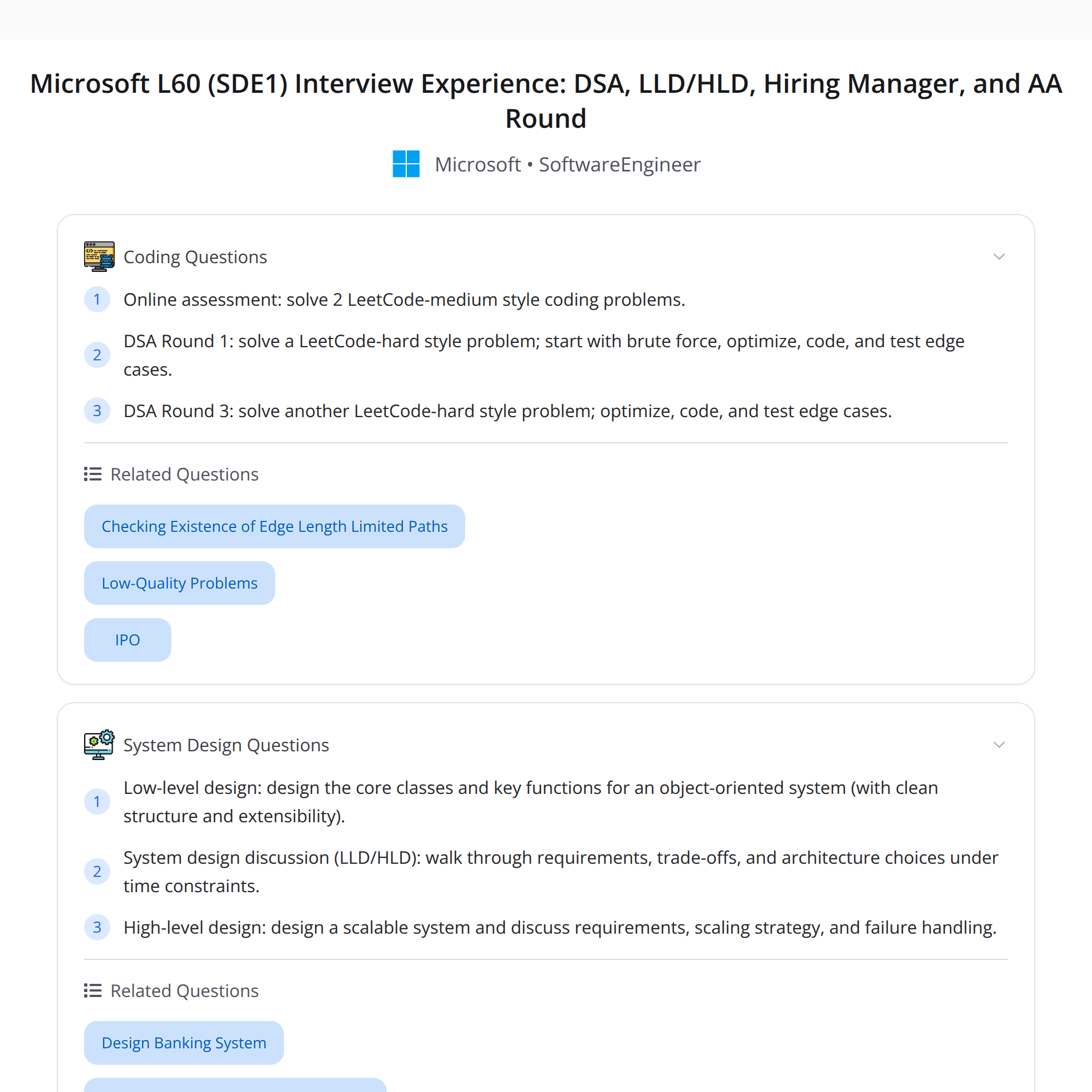
- OA (Online Assessment): 2 LeetCode-medium problems — both solved.
- R1 (DSA): LeetCode-hard — started with brute force then improved to optimal; coded and handled edge cases.
- R2 (LLD): Pure low-level design; covered basics but felt shallow on complexity and trade-offs.
- R3 (DSA + design): LeetCode-hard solved; interviewer allowed extra time to finish design trade-offs — best round overall.
- R4 (HM / HLD + projects): Deep project dive and high-level design — covered requirements, scaling, and failure modes.
- R5 (AA): Behavioral + growth mindset questions.
Though many rounds had “cleared” signals, final outcome was a rejection — a reminder that interviewers weigh the whole profile and that depth in LLD/technical design matters.
Round-by-round breakdown and lessons
OA — 2 LC-medium (Solved both)
What went well:
- Clean, correct solutions under time pressure.
- Good familiarity with common patterns.
Tips:
- Practice timed OAs to simulate exam conditions.
- Focus on fast, correct solutions for medium problems—polish edge cases afterward.
R1 — DSA (LC-hard)
What happened:
- Tackled a hard problem by first presenting a brute-force approach, then iterating to an optimal solution.
- Coded fully and handled edge cases.
Why it stood out:
- Interviewers like to see your thought process: show correctness first, then optimization.
- Clear communication while transitioning from naive to optimal is critical.
Tips:
- Always articulate complexity (time/space) of each approach.
- If you start with brute force, map the route to the optimization clearly.
R2 — LLD (pure low-level design)
What happened:
- Covered fundamental aspects of LLD (classes, interfaces, basic interactions), but the discussion stayed relatively shallow.
- Missed deeper trade-offs and complexity estimations.
Why this matters:
- LLD is about clarity, correctness, and anticipating real-world concerns: state, concurrency, error handling, testing strategies, and extensibility.
- Interviewers often look for the ability to reason about design choices and to justify trade-offs.
How to improve:
- Prepare templates for common LLD topics (e.g., design a Cache, Rate Limiter, File Storage, Messaging component).
- Walk through lifecycle: creation, usage, error paths, edge cases, concurrency, and testing.
- Explicitly discuss complexity and why a given design scales (or doesn’t).
R3 — DSA + Design (LC-hard)
What happened:
- Solved a hard DSA problem; the interviewer allowed time to finish design trade-offs.
- This was rated the best round.
Why it worked:
- Solid DSA with thoughtful design follow-up and trade-off reasoning.
- Ability to extend solutions and discuss consequences of choices.
Tips:
- Keep some design hygiene after DSA: if the problem maps to a data model or system behavior, sketch it quickly and discuss scale.
R4 — HM (Project deep dive + HLD)
What happened:
- Deep dive into past projects and a high-level design discussion covering requirements, scaling, and failure modes.
Why it mattered:
- Demonstrated system thinking — requirements-to-design-to-failure-recovery.
- Showed ownership and understanding of production considerations.
Tips:
- For project deep dives: quantify your impact, state your role, and highlight trade-offs you made.
- For HLD: start with requirements, propose a high-level architecture, identify bottlenecks, and outline scaling/failure strategies.
R5 — AA (Behavioral + Growth Mindset)
What happened:
- Standard behavioral interview focusing on learning, feedback, and growth stories.
Tips:
- Use STAR (Situation, Task, Action, Result) for structure.
- Emphasize learning from failures and concrete steps you took to improve.
Why the final rejection? The role of cumulative signals
- Despite many positive signals across rounds, the final decision was a reject. That indicates recruiters and hiring committees evaluate the whole picture.
- One hypothesis: the LLD round lacked depth. Even when other rounds are strong, a weak design signal — especially at L60 where design expectations are higher — can tip the scales.
- Hiring decisions weigh consistency and the candidate’s ability to demonstrate the level-specific skills expected for the role.
Key takeaway: Don’t assume that excelling in some rounds compensates fully for shallower performance in others. Aim for consistent, sufficiently deep signals across DSA, LLD/HLD, and HM.
Actionable checklist before an interview loop
- DSA
- Practice 30–40 hard problems and 100+ medium problems.
- Practice explaining brute→optimal transitions.
- LLD
- Prepare 8–10 common LLD scenarios with class diagrams, concurrency considerations, and failure handling.
- Practice articulating trade-offs, testing, and performance implications.
- HLD/HM
- Practice 4–6 system design problems end-to-end (requirements → bottlenecks → scaling → failure recovery).
- Prepare project stories with measured impact and learned lessons.
- Behavioral
- Have 6–8 STAR stories focusing on leadership, ownership, and growth.
- Logistics
- Time yourself on coding questions; practice coding on a whiteboard or shared editor.
- Mock interviews with peers or platforms; ask for feedback on depth, not just correctness.
Final thoughts
This loop is a useful reminder: interview loops are composite signals. Strong DSA performance and a compelling system-design discussion are vital, but LLD depth and consistent demonstration of level-appropriate skills often make the difference. When preparing, treat each round as its own opportunity to demonstrate both competence and the maturity of your trade-off reasoning.
Good luck—and prepare for depth, not just breadth.
#SoftwareEngineering #InterviewPrep #SystemDesign
About the author
bugfree.ai is an advanced AI-powered platform designed to help software engineers master system design and behavioral interviews. Whether you’re preparing for your first interview or aiming to elevate your skills, bugfree.ai provides a robust toolkit tailored to your needs. Key Features:
150+ system design questions: Master challenges across all difficulty levels and problem types, including 30+ object-oriented design and 20+ machine learning design problems. Targeted practice: Sharpen your skills with focused exercises tailored to real-world interview scenarios. In-depth feedback: Get instant, detailed evaluations to refine your approach and level up your solutions. Expert guidance: Dive deep into walkthroughs of all system design solutions like design Twitter, TinyURL, and task schedulers. Learning materials: Access comprehensive guides, cheat sheets, and tutorials to deepen your understanding of system design concepts, from beginner to advanced. AI-powered mock interview: Practice in a realistic interview setting with AI-driven feedback to identify your strengths and areas for improvement.
bugfree.ai goes beyond traditional interview prep tools by combining a vast question library, detailed feedback, and interactive AI simulations. It’s the perfect platform to build confidence, hone your skills, and stand out in today’s competitive job market. Suitable for:
New graduates looking to crack their first system design interview. Experienced engineers seeking advanced practice and fine-tuning of skills. Career changers transitioning into technical roles with a need for structured learning and preparation.
Comments
Join the discussionNo comments yet. Be the first to comment.