Microsoft SDE II Interview — System Design + Coding Wins (Bugfree Users)
A concise, high-score interview recap from a Bugfree user who progressed through Microsoft SDE II interviews and moved forward to an offer with the security team. This post covers the OA, each final-round focus, design decisions, and practical tips to prepare.
Quick summary
- OA: 3 coding problems (2 medium, 1 hard)
- Final loop: 4 rounds
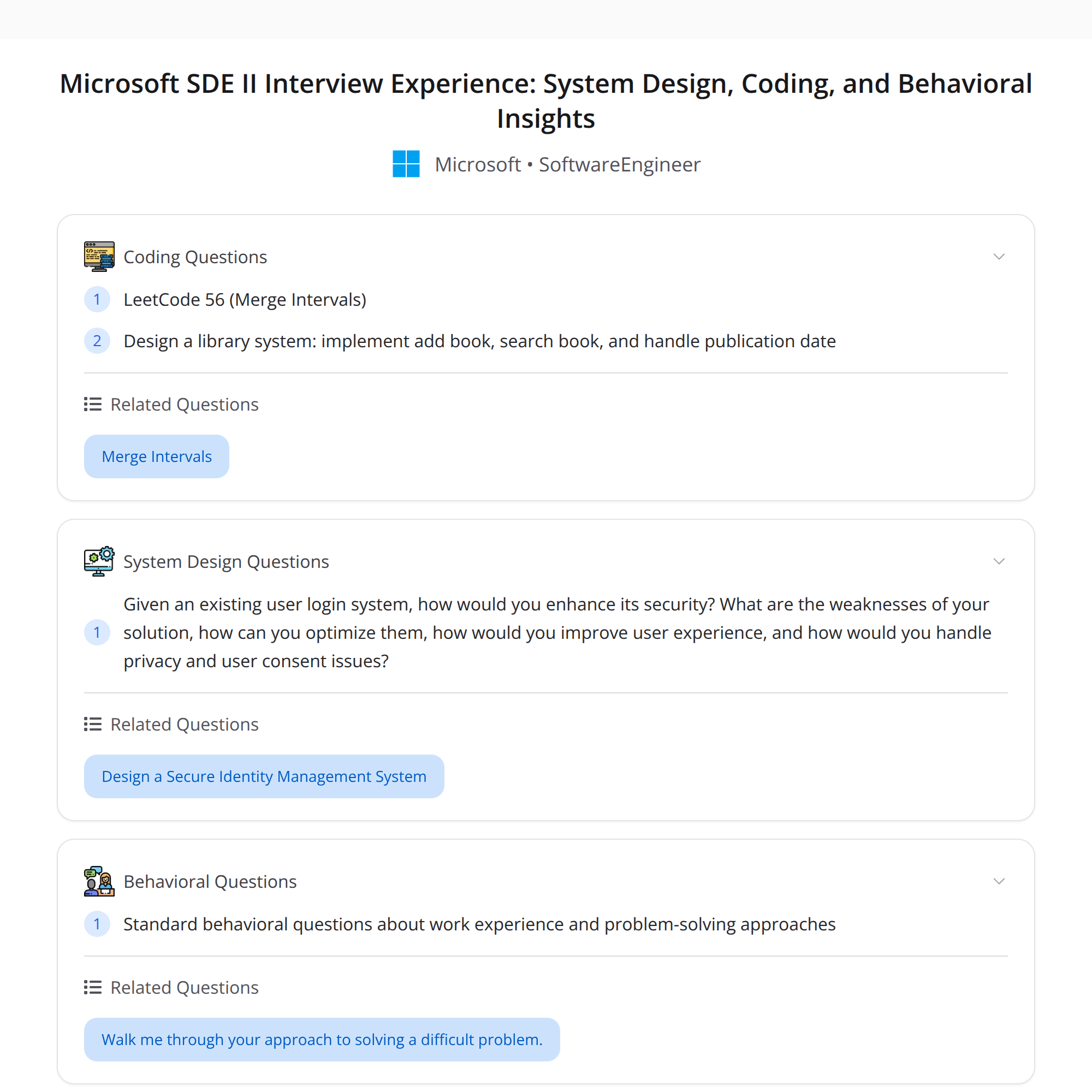
- Rounds 1–2: behavioral + coding / OOD (designed a library system: add/search books, handle publication dates)
- Round 3: algorithms + behavioral (LeetCode 56 — Merge Intervals)
- Round 4: system design deep dive — hardening an existing login system (threat modeling, optimizations, UX tradeoffs, privacy & consent)
- Outcome: advanced toward an offer with the security team
Online Assessment (OA)
Format: 3 coding problems — two medium and one hard. Typical expectations:
- Time management: budget time per problem; start with one you can finish to secure points.
- Clarify inputs, constraints, and edge cases early.
- Write clean code with a short explanation and complexity analysis.
Preparation tips:
- Practice LeetCode medium/hard problems with timed sessions.
- Mock OAs to simulate the pressure of solving three problems back-to-back.
Final loop breakdown (what each round covered)
Rounds 1–2: Behavioral + Coding / Object-Oriented Design
One exercise was designing a library system with capabilities like:
- Add books, search by title/author, filter by publication date
- Considerations: data model for books, indexing strategy for search, and how to store publication dates across time zones
Design notes and suggestions:
- Data model: Book { id, title, authors[], publication_date (ISO 8601), ISBN, metadata }
- Storage: relational DB for transactional integrity; add a document store or search index (Elasticsearch) for full-text search and faceted queries
- Indexing: create indexes on title, author, and publication_date; use an inverted index for text search
- APIs: POST /books, GET /books?title=&author=&from_date=&to_date=&page=&size
- Edge cases: multiple editions, missing publication dates, varying date granularities (year-only vs full date)
OOD tips:
- Sketch APIs, data models, and basic class diagrams (Book, LibraryService, SearchService, Indexer)
- Mention consistency and scalability tradeoffs (eventual vs strong consistency for search pipelines)
Round 3: Algorithms + Behavioral — LeetCode 56 (Merge Intervals)
Problem summary: Given intervals, merge overlapping intervals.
Common approach (O(n log n) due to sort):
Pseudo-steps:
- Sort intervals by start time
- Iterate and merge: if current.start <= last.end then last.end = max(last.end, current.end) else append current
Python-like sketch:
intervals.sort(key=lambda x: x.start)
merged = []
for interval in intervals:
    if not merged or merged[-1].end < interval.start:
        merged.append(interval)
    else:
        merged[-1].end = max(merged[-1].end, interval.end)
return merged
Behavioral portion: expect follow-ups about complexity, in-place merging, and handling large streams of intervals.
Round 4: System Design Deep Dive — Harden an Existing Login System
This was the most in-depth round. The interviewer asked about threat modeling, optimizations, UX tradeoffs, privacy and consent, and defending your choices. Below are distilled topics and how to approach them.
Threat model (examples):
- Brute-force and credential stuffing
- Phishing and social engineering
- Session hijacking and stolen tokens
- Replay attacks and weak password reuse
- Insider threats and log tampering
Mitigations and design choices:
- Authentication: support MFA (SMS/Authenticator/Push), device trust, risk-based authentication
- Rate limiting & lockouts: apply exponential backoff, per-IP and per-account throttling
- Credential protection: salted hashing (bcrypt/argon2), rotation, leak detection (compare against breached-password lists)
- Session management: short-lived access tokens + refresh tokens, secure cookie flags (HttpOnly, Secure, SameSite)
- Anomaly detection: behavioral analytics, suspicious IP/device flags, adaptive challenges (step-up auth)
- Recovery UX: secure but usable flows for password reset (email + time-limited tokens, device verification)
Performance & optimization:
- Cache sessions or token introspection results with TTLs
- Use CDNs and edge-auth where appropriate (but keep sensitive decisions centralized)
- Horizontal scale of auth services behind API gateways; isolate stateful components (session store) with Redis or similar
UX tradeoffs:
- Tight security vs friction: MFA improves security but increases abandonment; consider remembered devices and adaptive MFA
- Password complexity vs user behavior: long, user-friendly passphrases are often better than complex rules
Privacy & consent:
- Data minimization: store only what’s necessary (avoid logging sensitive PII in plaintext)
- Consent & transparency: clear privacy notices for biometric/MFA data
- Compliance: GDPR/CCPA considerations for logging, retention, and data subject requests
Defending your decisions:
- Use measurable metrics: adoption rate, login success/failure, false positive MFA triggers, account recovery time
- Risk-based rationale: explain threats addressed, expected reduction in incidents, and cost/UX tradeoffs
- Rollout plan: canary releases, A/B test security changes, monitor key metrics before global roll-out
Practical prep tips for similar interviews
- Practice OOD by sketching designs on a whiteboard and explaining tradeoffs.
- Do timed coding drills and review common patterns (sorting, two pointers, heaps, graphs).
- For security/system-design loops, practice threat modeling frameworks (STRIDE) and be ready to defend choices with metrics.
- When given a system to harden, enumerate threats first, then propose defenses prioritized by impact and feasibility.
Outcome
Candidate advanced toward an offer with the security team — a good example of how combining solid coding, clear OOD thinking, and thorough security-oriented system design can win interviews for SDE II roles.
If you'd like, I can:
- Expand the library system design into a full component diagram and API spec
- Provide a step-by-step mock interview script for the login system hardening round
- Supply more code examples for common OA patterns
Which would help you most?
About the author
bugfree.ai is an advanced AI-powered platform designed to help software engineers master system design and behavioral interviews. Whether you’re preparing for your first interview or aiming to elevate your skills, bugfree.ai provides a robust toolkit tailored to your needs. Key Features:
150+ system design questions: Master challenges across all difficulty levels and problem types, including 30+ object-oriented design and 20+ machine learning design problems. Targeted practice: Sharpen your skills with focused exercises tailored to real-world interview scenarios. In-depth feedback: Get instant, detailed evaluations to refine your approach and level up your solutions. Expert guidance: Dive deep into walkthroughs of all system design solutions like design Twitter, TinyURL, and task schedulers. Learning materials: Access comprehensive guides, cheat sheets, and tutorials to deepen your understanding of system design concepts, from beginner to advanced. AI-powered mock interview: Practice in a realistic interview setting with AI-driven feedback to identify your strengths and areas for improvement.
bugfree.ai goes beyond traditional interview prep tools by combining a vast question library, detailed feedback, and interactive AI simulations. It’s the perfect platform to build confidence, hone your skills, and stand out in today’s competitive job market. Suitable for:
New graduates looking to crack their first system design interview. Experienced engineers seeking advanced practice and fine-tuning of skills. Career changers transitioning into technical roles with a need for structured learning and preparation.
Comments
Join the discussionNo comments yet. Be the first to comment.