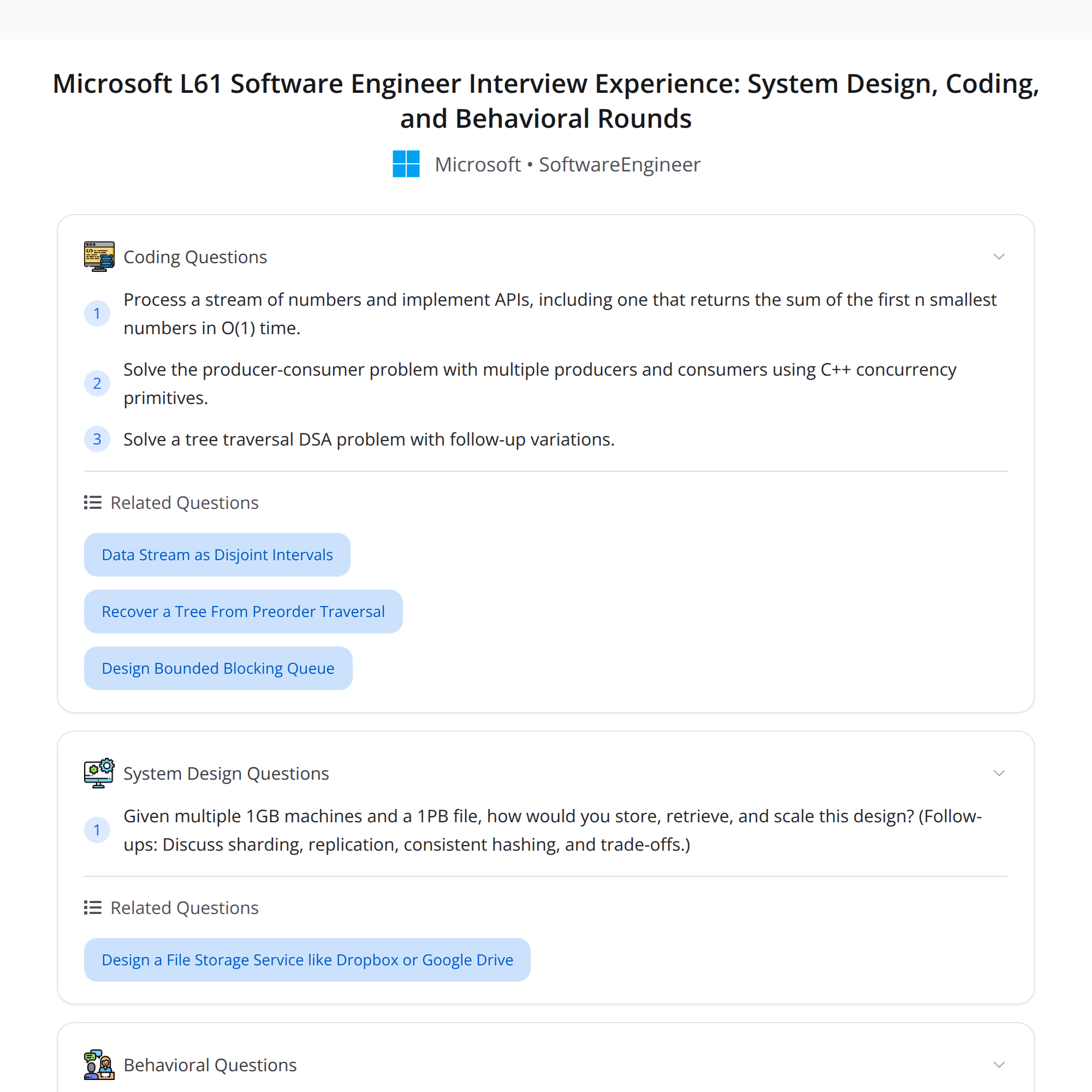

A high-score interview experience from Bugfree Users — a Microsoft L61 Software Engineer loop. This write-up summarizes the rounds, key problems, and approaches: system design at scale, algorithm & API design, multithreading in C++, plus tech and behavioral questions.
Quick summary
- Format: OA (DP + bitmasking) + onsite loop
- Onsite highlights:
- System design + project deep dive: storing/retrieving/scaling a 1 PB file on 1 GB machines using sharding, replication, consistent hashing, and trade-offs
- DSA + API design on a number stream — included an approach to support O(1) queries for sum of first n smallest (given constraints) and other options
- Multithreading: multi-producer/multi-consumer in C++ with mutex, unique_lock, condition_variable
- Tech + managerial + behavioral: C++ details (thread_local), tree traversal variants, teamwork and communication
Round-by-round breakdown
OA — Dynamic Programming & Bitmasking
The online assessment began with DP + bitmasking problems. Expect subset DP, bitmask state compression, and optimizing transitions with memoization. Typical tips:
- Clarify constraints (n, value ranges) to select bitmasking vs other approaches.
- Use bit operations to iterate subsets efficiently.
- Consider time/memory trade-offs: compress state, prune impossible states early.
System Design + Project Deep Dive — Store & Scale a 1 PB File on 1 GB Machines
Problem statement (paraphrased): design a system that stores and retrieves a 1 PB file across machines with only 1 GB RAM each. Discuss sharding, replication, consistent hashing, and trade-offs.
Key design points and recommended components:
Chunking
- Split the 1 PB file into fixed-size chunks (e.g., 64 MB or 128 MB) to enable parallel distribution and recovery.
- Each chunk gets a unique chunk ID and is stored on multiple machines for redundancy.
Sharding and placement
- Use consistent hashing (ring + virtual nodes) to map chunk IDs to machines. Virtual nodes smooth load imbalance.
- Maintain a separate metadata service (or distributed metadata store) that maps file -> chunkIDs -> chunk locations. Keep metadata compact and partitioned.
Replication vs erasure coding
- Replication (e.g., RF=3): simpler, faster recovery, easier consistency semantics, but higher storage overhead.
- Erasure coding (e.g., Reed-Solomon): much lower storage overhead at the cost of higher CPU and network during reads/writes and more complex repair logic. Good when storage efficiency is a priority.
Read/write paths
- Clients consult metadata or a routing service to get chunk locations. For reads, prefer the nearest replica; for writes, coordinate replication (leader-or-quorum-based approach).
- Consider lease/leader per chunk or optimistic writes with versioning to simplify concurrency.
Scaling & rebalancing
- When nodes join/leave, consistent hashing reduces reassignments. Use background rebalancers to migrate chunks and maintain replication factor.
- Monitor hotspots and use virtual nodes or explicit load-aware placement to mitigate skew.
Availability & durability
- Replication factor and repair time determine durability. Use background anti-entropy/repair processes to restore replication after failures.
- Trade-offs: stronger consistency slows writes; eventual consistency improves availability and throughput.
Metadata and indexing
- Keep the metadata service partitioned and highly available (e.g., using consensus/replicated key-value store).
- For fast lookups, keep chunk index small and cache hot mappings on clients.
Trade-offs to discuss in interview
- Storage overhead vs repair/read cost (replication vs erasure coding)
- Strong vs eventual consistency
- Latency vs throughput (synchronous replication vs async)
- Simplicity vs efficiency (simple replication easier to implement and reason about)
Practical implementation notes
- Use checksums per chunk to detect corruption.
- Implement incremental repair and rate-limit rebalancing to avoid overwhelming network.
- Expose metrics for chunk distribution, read/write latencies, and node health.
DSA + APIs — Number Stream & O(1) Query for Sum of First n Smallest
Problem: design APIs over a stream of numbers that support insertion/deletion and queries that return the sum of the first n smallest numbers. The interview included an expectation to discuss an O(1) query solution under specific constraints.
Approaches and trade-offs
If values are in a small fixed range (e.g., 0..C where C is small):
- Keep a frequency array freq[0..C] and a prefix-sum array prefSum[0..C] (sum of values) plus prefixCount[0..C] (counts).
- Query(sum of k smallest): binary-search or scan on prefixCount to find the boundary, then compute result using prefSum and leftover from one bucket. With additional bookkeeping (precomputed answers for each k), you can achieve O(1) query at the cost of O(C) space and O(C) update time per insertion if you recompute the precomputed table; with incremental updates you can make updates O(1) amortized per change to a small C.
- This is the classic trade-off: bounded value domain ⇒ very fast queries.
If values are unbounded or large domain:
- Augmented balanced BST (e.g., order-statistic tree or treap) where each node stores subtree size and subtree sum. Insert/delete: O(log n). Query(sum of k smallest): descend the tree using sizes and sums to compute the sum in O(log n).
- Alternative: two-heap approach (max-heap for k smallest, min-heap for the rest) maintains the k smallest explicitly. Query is O(1) for returning the current sum (you maintain running sum of elements in the max-heap), but adjusting k dynamically or supporting deletions of arbitrary elements complicates this and generally requires extra structures (hash maps for lazy deletion) or O(log n) updates.
Recommended interview talking points
- Clarify constraints: bounded values? frequency of queries vs updates? Are deletions required?
- Present the bounded-domain O(1) idea (freq + prefix sums + optional precomputed answers) and then generalize to the augmented-tree O(log n) solution for arbitrary values.
- Discuss memory vs time trade-offs and how each solution behaves under heavy updates.
Multithreading — Multi Producer / Multi Consumer in C++
Core problem: implement a thread-safe bounded queue with multiple producers and multiple consumers using std::mutex, std::unique_lock, and std::condition_variable.
Essentials to demonstrate:
- Correct locking discipline (protect shared queue with mutex).
- Use condition_variable wait with a predicate to avoid spurious wakeups.
- Notify consumers/producers appropriately (notify_one vs notify_all depending on design).
- Clean shutdown handling (e.g., a flag to signal termination and notify all waiting threads).
Minimal example (conceptual):
// Pseudocode — conceptual, not full compilation-ready
class BoundedQueue {
  std::mutex m;
  std::condition_variable not_empty, not_full;
  std::deque<T> q;
  size_t capacity;
  bool shutdown = false;

public:
  void push(const T &item) {
    std::unique_lock<std::mutex> lk(m);
    not_full.wait(lk, [&]{ return q.size() < capacity || shutdown; });
    if (shutdown) return; // or throw
    q.push_back(item);
    lk.unlock();
    not_empty.notify_one();
  }

  bool pop(T &out) {
    std::unique_lock<std::mutex> lk(m);
    not_empty.wait(lk, [&]{ return !q.empty() || shutdown; });
    if (q.empty()) return false; // shutdown and empty
    out = q.front(); q.pop_front();
    lk.unlock();
    not_full.notify_one();
    return true;
  }

  void close() {
    std::lock_guard<std::mutex> lk(m);
    shutdown = true;
    not_empty.notify_all();
    not_full.notify_all();
  }
};
Additional talking points
- Use thread_local for per-thread caches or counters (e.g., local buffers to reduce contention). Explain lifetime and pitfalls (initialization, destruction order, interactions with thread pools).
- Discuss spurious wakeups and why waiting with a predicate is mandatory.
- Consider lock-free alternatives (e.g., MPMC ring buffers) if low latency is critical, but mention complexity and correctness challenges.
Tech + Managerial + Behavioral
Topics covered included:
- C++ specifics: thread_local, RAII, move semantics, lifetime management.
- Tree traversals: preorder, inorder, postorder, iterative vs recursive, and trade-offs (call-stack depth, iterative with explicit stack for tail recursion elimination).
- Teamwork & communication: examples of cross-team collaboration, how decisions were communicated, trade-off justification, and how feedback was handled.
- Managerial questions: prioritization, trade-off decisions, mentoring, and conflict resolution strategies.
Interview tips for behavioral questions
- Use the STAR structure (Situation, Task, Action, Result).
- Quantify impact where possible (latency improvements, reduced bugs, team throughput).
- Be explicit about trade-offs and why you chose one approach over another.
Final tips & checklist
- Clarify constraints upfront for every problem.
- Discuss multiple solutions and trade-offs — show that you can reason about production implications (latency, durability, cost).
- For system design, sketch high-level components, data flows, and failure/recovery strategies.
- For concurrency, show knowledge of common pitfalls: deadlocks, race conditions, spurious wakeups, and shutdown protocols.
- For algorithms, match the data structure to constraints (bounded domain vs general domain).
Good luck — and remember to explain your assumptions, trade-offs, and why you prefer one design over another.
#SystemDesign #SoftwareEngineering #InterviewPrep
About the author
bugfree.ai is an advanced AI-powered platform designed to help software engineers master system design and behavioral interviews. Whether you’re preparing for your first interview or aiming to elevate your skills, bugfree.ai provides a robust toolkit tailored to your needs. Key Features:
150+ system design questions: Master challenges across all difficulty levels and problem types, including 30+ object-oriented design and 20+ machine learning design problems. Targeted practice: Sharpen your skills with focused exercises tailored to real-world interview scenarios. In-depth feedback: Get instant, detailed evaluations to refine your approach and level up your solutions. Expert guidance: Dive deep into walkthroughs of all system design solutions like design Twitter, TinyURL, and task schedulers. Learning materials: Access comprehensive guides, cheat sheets, and tutorials to deepen your understanding of system design concepts, from beginner to advanced. AI-powered mock interview: Practice in a realistic interview setting with AI-driven feedback to identify your strengths and areas for improvement.
bugfree.ai goes beyond traditional interview prep tools by combining a vast question library, detailed feedback, and interactive AI simulations. It’s the perfect platform to build confidence, hone your skills, and stand out in today’s competitive job market. Suitable for:
New graduates looking to crack their first system design interview. Experienced engineers seeking advanced practice and fine-tuning of skills. Career changers transitioning into technical roles with a need for structured learning and preparation.
Comments
Join the discussionNo comments yet. Be the first to comment.