High-Score Interview Recap: Microsoft L61 SWE — System Design, DSA, Multithreading & Behavioral
Posted by Bugfree Users — a detailed, high-score interview experience from a Microsoft L61 Software Engineer loop. Below is a cleaned, expanded, and structured recap of the onsite and OA rounds, plus tips and trade-offs discussed.
Quick overview
- Initial OA: Dynamic programming + bitmasking problem.
- Onsite highlights:
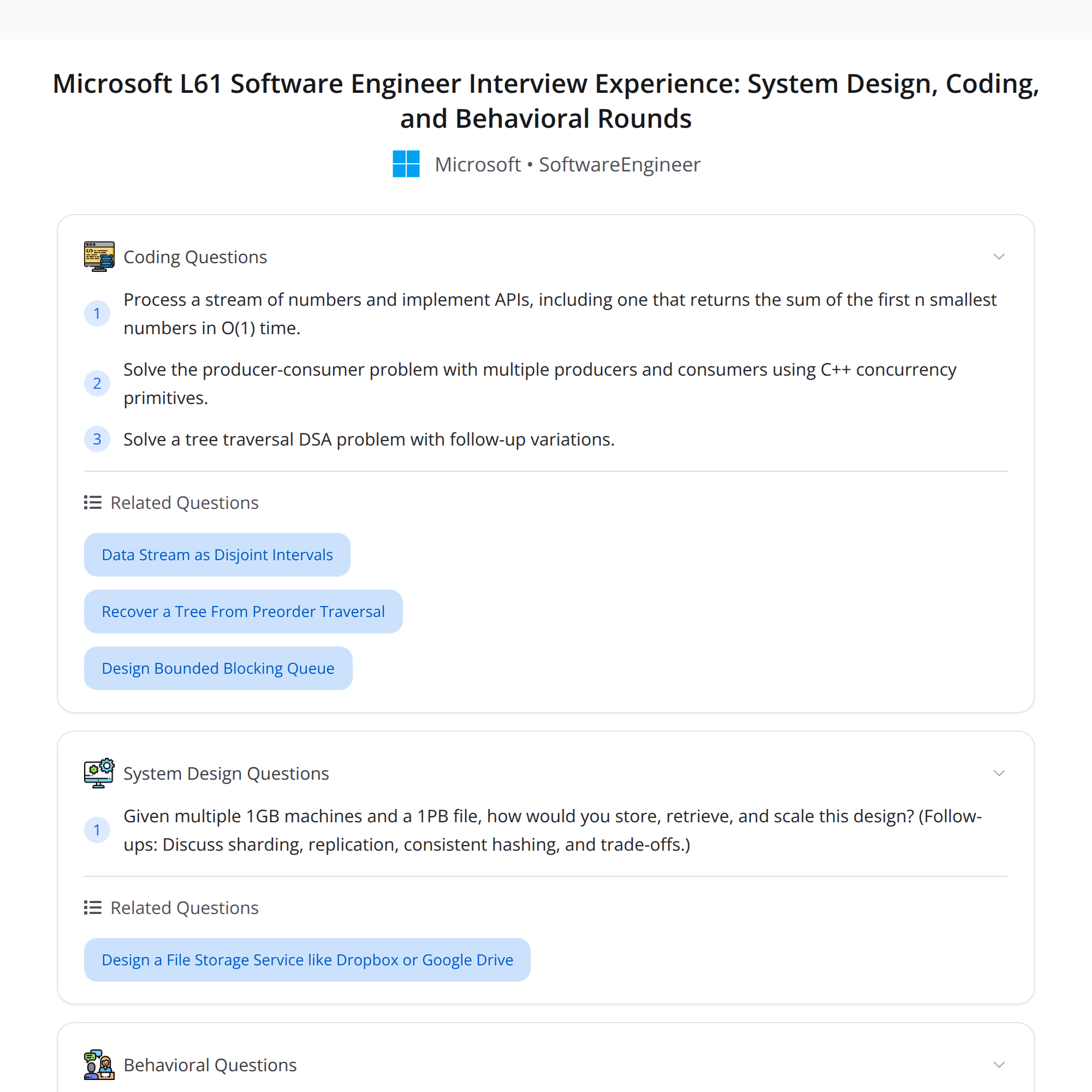
- System design + project deep dive: store/retrieve/scale a 1PB file across 1GB machines — sharding, replication, consistent hashing, and trade-offs.
- DSA + APIs on a number stream: including a requirement for an efficient query to get the sum of the first n smallest numbers.
- Multithreading: implement a multi producer-consumer in C++ using mutex, unique_lock, and condition_variable.
- Tech + managerial + behavioral: C++ details (thread_local), tree traversal variants, teamwork and communication questions.
1) OA: DP + bitmasking
- Typical pattern: DP over subsets (bitmask DP). Expect to reason about state representation, transitions, and base cases.
- Tips:
- Clearly define what each bit represents and what your DP state stores.
- Identify overlapping subproblems and optimize with memoization or bottom-up table.
- Pay attention to bit operations for enumeration and transitions (iterate submasks efficiently).
2) System design & project deep dive (1PB on 1GB machines)
Problem statement (paraphrased): design a system to store, retrieve, and scale a 1PB file using many 1GB machines. Discuss sharding, replication, consistent hashing, and trade-offs.
Key design ideas and considerations:
Partitioning (Sharding):
- Split the 1PB dataset into chunks (e.g., blocks or objects). Each chunk should be small enough to fit on a node (e.g., 64MB–1GB block size depends on workloads).
- Use sharding to distribute chunks across machines so no single host becomes a hotspot.
Consistent hashing:
- Use consistent hashing to map chunk IDs to machines to minimize reshuffling when nodes join/leave.
- Virtual nodes (vnodes) help balance load across heterogeneous machines.
Replication & durability:
- Replicate chunks across multiple nodes (e.g., 3-way replication) to handle machine failures.
- Consider erasure coding (e.g., Reed-Solomon) for storage efficiency at the cost of more complex rebuilds and higher CPU/network use.
Metadata & lookup:
- Maintain a lightweight metadata service or distributed metadata (e.g., a small cluster using consistent hashing or a scalable key-value store) that maps file → chunk IDs → locations.
- Cache metadata at clients or edge nodes to reduce lookup latency.
Rebalancing & scaling:
- When adding nodes, consistent hashing and vnodes limit the amount of data moved.
- Background rebalancer moves chunks gradually and throttles to avoid saturating network.
Availability & trade-offs:
- Replication: simpler to implement and offers fast reads, but uses more storage.
- Erasure coding: uses less storage, but increases reconstruction bandwidth and CPU.
- Choosing chunk size: small chunks give better parallelism but increase metadata overhead; large chunks reduce metadata but may reduce parallel reads.
Network & IO considerations:
- Use parallel downloads to read a large file faster (multi-part fetching).
- Optimize for common read/write patterns: cold vs hot data policies, caching hot chunks on faster machines.
What interviewers look for:
- Clear partitioning strategy and how the system handles node churn and failures.
- Explicit trade-offs (latency vs storage overhead vs rebuild complexity).
- Consideration for metadata scaling, hotspots, and monitoring/operational concerns.
3) DSA + APIs on a number stream (sum of first n smallest)
Problem sketch: design data structures and APIs for a stream of numbers that supports queries such as "sum of the first n smallest numbers" efficiently.
Approaches and trade-offs:
If value range is small/bounded:
- Maintain a frequency array and prefix sums — you can find the sum of first n smallest by scanning buckets until n is reached. If the number of buckets is limited, queries can be O(1) or O(#buckets) which is effectively O(1) for small ranges.
General case (unbounded or large values):
- Balanced BST / Order-statistics tree (e.g., augmented AVL/Red-Black) that stores subtree sizes and subtree sums. Querying sum of first n smallest can be done by walking the tree and using stored sizes/sums — O(log N) per query.
- Binary Indexed Tree / Fenwick Tree or Segment Tree if values can be mapped to indices (coordinate compression) — gives O(log M) operations where M = number of distinct values.
Heap-based approach:
- Maintain a min-heap or two-heaps technique to keep track of n smallest, but heaps alone don't provide O(1) sum queries since updating sum on insertion/removal is O(log N) and query would be O(1) if you maintain a running sum of the current n smallest.
Notes from the loop: the interviewer expected reasoning about constraints. If the problem demands O(1) queries for sum of first n smallest, you typically need to exploit domain constraints (bounded range or pre-aggregated buckets) or maintain a cached result that is updated on each insertion/deletion (amortized O(log N) update, O(1) query).
Tip: Always ask about constraints — value range, frequency of updates vs queries, memory limits.
4) Multithreading (C++): multi producer-consumer
Task: implement a multi producer / multi consumer queue with proper synchronization.
Key primitives used:
- std::mutex
- std::unique_lock
- std::condition_variable
- std::lock_guard (where appropriate)
Important design points:
- Use a thread-safe queue (e.g., std::deque or std::queue protected by a mutex).
- Producers push and notify_one/notify_all when new items are available.
- Consumers wait on a condition_variable with a predicate to avoid spurious wakeups.
- Clean shutdown: use a flag (e.g., done or shutdown) to notify consumers to exit even when queue becomes empty.
- Avoid deadlocks: minimize lock hold time, prefer notify_one for throughput or notify_all for shutdown scenarios.
Common pitfalls:
- Not using the condition variable predicate in wait -> spurious wakeups cause incorrect behavior.
- Holding locks during long blocking operations (I/O) — do work outside the lock.
- Incorrect use of notify_one vs notify_all leading to lost wakeups or thundering herd.
C++ specifics discussed:
- thread_local storage for per-thread data to avoid synchronization when each thread needs private state.
- Using unique_lock when you need to unlock and relock (e.g., around condition variable waits).
5) Tech, managerial & behavioral
Topics covered:
- Tree traversal variants (preorder/inorder/postorder and iterative vs recursive)
- C++ specifics (thread_local, lifetime and initialization rules, memory model basics)
- Behavioral questions focusing on teamwork, communication, conflict resolution, and project ownership
Preparation tips:
- Use concrete examples for behavioral answers (STAR format: Situation, Task, Action, Result).
- For managerial/leadership-style questions, emphasize trade-offs you made, how you aligned stakeholders, and how you measured success.
Key takeaways & preparation checklist
- System design: practice distributed storage problems with explicit trade-offs (replication vs erasure coding, consistent hashing, metadata scaling).
- DSA: be ready to justify your data structure choice given constraints; practice augmented trees and coordinate compression techniques.
- Multithreading: know the C++ synchronization primitives and common patterns (producer-consumer, thread pools, thread_local). Practice writing correct code that handles shutdown and spurious wakeups.
- Behavioral: prepare concise stories that highlight impact, collaboration, and measurable results.
Resources to review:
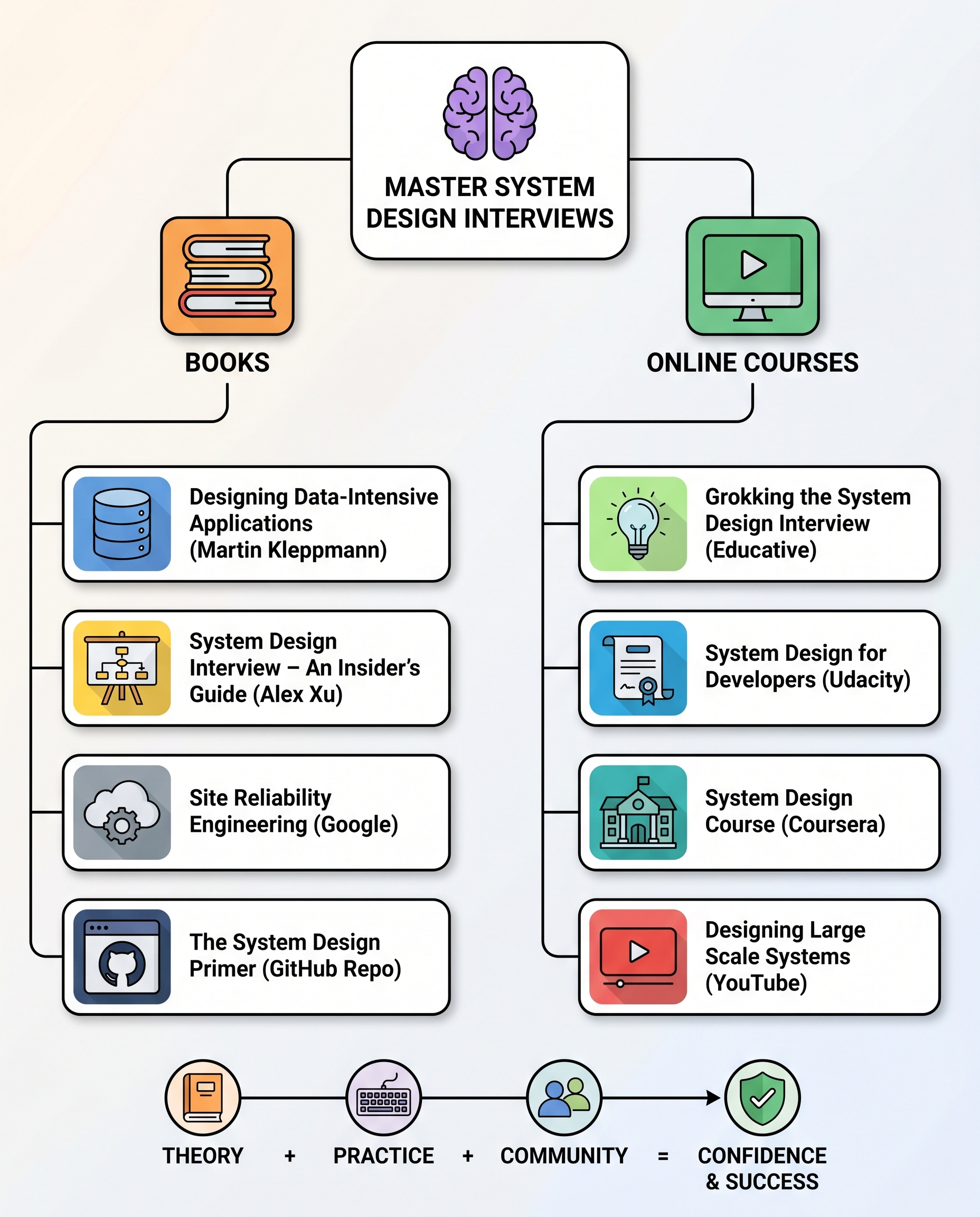
- "Designing Data-Intensive Applications" (system design fundamentals)
- CLRS or LeetCode for advanced DSA problems (order-statistics trees, Fenwick trees)
- C++ concurrency docs and examples (condition_variable, thread_local)
If you want, I can:
- Expand any section into sample code (C++ producer-consumer implementation), or
- Give a step-by-step mock interview script to practice answers and follow-up questions.
Good luck — and focus on explaining trade-offs and constraints clearly during the interview.
About the author
bugfree.ai is an advanced AI-powered platform designed to help software engineers master system design and behavioral interviews. Whether you’re preparing for your first interview or aiming to elevate your skills, bugfree.ai provides a robust toolkit tailored to your needs. Key Features:
150+ system design questions: Master challenges across all difficulty levels and problem types, including 30+ object-oriented design and 20+ machine learning design problems. Targeted practice: Sharpen your skills with focused exercises tailored to real-world interview scenarios. In-depth feedback: Get instant, detailed evaluations to refine your approach and level up your solutions. Expert guidance: Dive deep into walkthroughs of all system design solutions like design Twitter, TinyURL, and task schedulers. Learning materials: Access comprehensive guides, cheat sheets, and tutorials to deepen your understanding of system design concepts, from beginner to advanced. AI-powered mock interview: Practice in a realistic interview setting with AI-driven feedback to identify your strengths and areas for improvement.
bugfree.ai goes beyond traditional interview prep tools by combining a vast question library, detailed feedback, and interactive AI simulations. It’s the perfect platform to build confidence, hone your skills, and stand out in today’s competitive job market. Suitable for:
New graduates looking to crack their first system design interview. Experienced engineers seeking advanced practice and fine-tuning of skills. Career changers transitioning into technical roles with a need for structured learning and preparation.
Comments
Join the discussionNo comments yet. Be the first to comment.