Overview
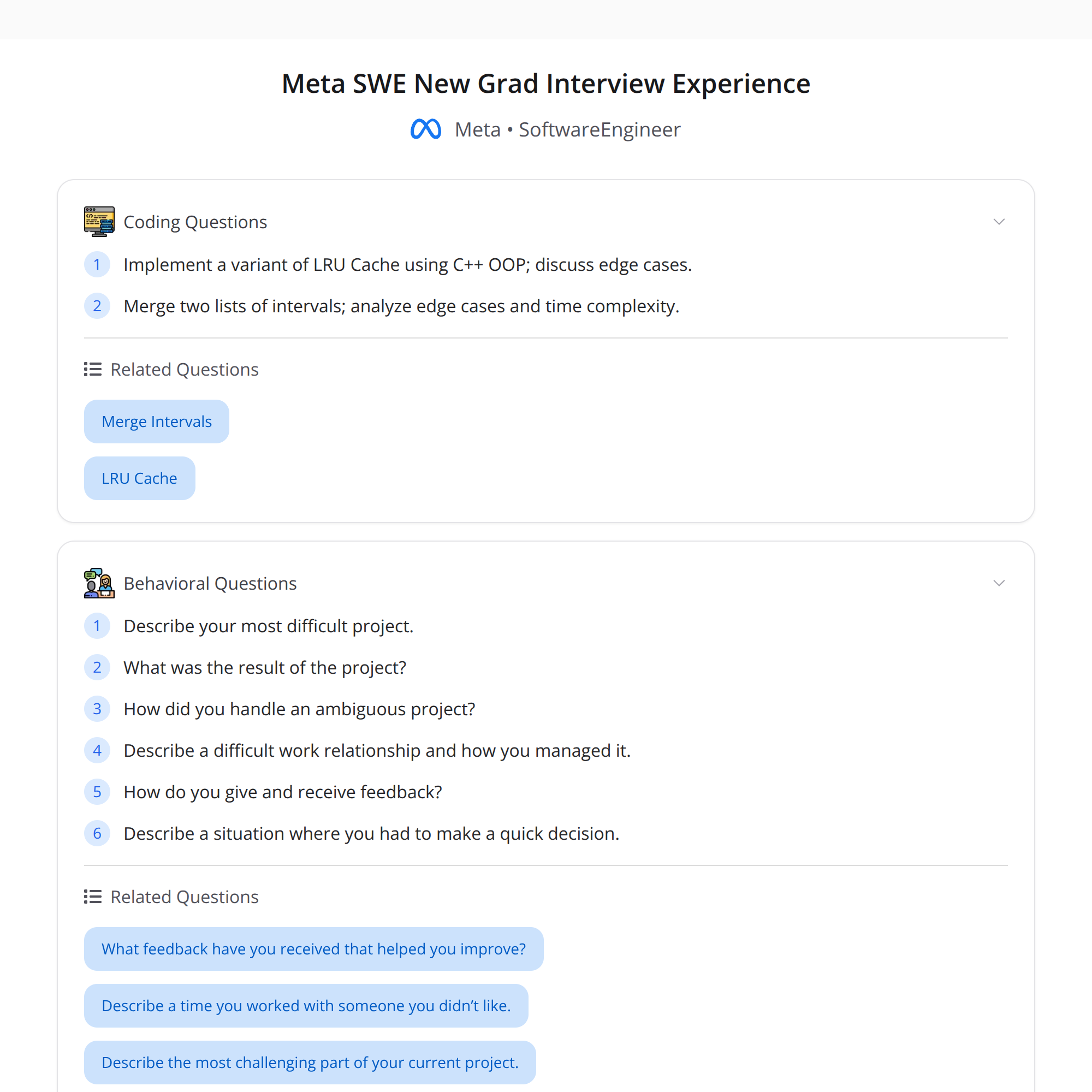
This high-score interview write-up (from Bugfree users) summarizes a smooth Meta (Facebook) SWE New Grad interview loop. It’s concise and practice-focused — what showed up on the loop and how to prioritize your preparation.
Quick summary of the loop:
- CodeSignal online assessment (OA)
- Two technical interviews (Tech 1 & Tech 2)
- Behavioral / PM-style questions
Main takeaway: grind core LeetCode patterns and polish short, crisp STAR stories.
CodeSignal OA
Format reported:
- 4 problems total: 1 easy, 2 medium, 1 hard
- Problems are LeetCode-style variants (expect common patterns and variants rather than brand-new concepts)
Prep tips:
- Practice array/two-pointer, string, and basic tree/graph pattern problems.
- Time yourself and simulate the online interface.
- If you get stuck, move on and return if time allows — prioritize solvable problems first.
Tech Interview 1 — Trees & Intervals (what came up)
Problems reported:
1) Convert a BST to a sorted doubly linked list in-place
- Typical approach: in-order traversal to visit nodes in ascending order.
- Keep a
prevpointer to stitch nodes as you traverse (recursive or iterative). - Edge cases: empty tree, single node, and preserving original node references (in-place requirement).
- Follow-ups they may ask: convert to circular DLL, iterative vs recursive, space complexity.
2) Merge-intervals twist (LC 56-like)
- Sort intervals by start, then iterate to merge overlapping ranges.
- Twist variations often test different sorting keys or ask for an online streaming merge.
- Follow-ups: handle single-point intervals, large inputs (optimize for memory), or return non-overlapping complement intervals.
Why these matter: both probe your ability to manipulate pointers and order-based reasoning — classic patterns you should recognize and code quickly.
Tech Interview 2 — Nested Lists & Expression Parsing
Problems reported:
1) Nested List Weight Sum (LC 339-like)
- Compute sum of integers weighted by depth in a nested list structure.
- Common solutions: depth-first search (recursive) or iterative BFS tracking depth.
- Follow-ups: invert weights (weight by inverse depth), handle streaming input, or compute without recursion.
2) Basic Calculator variant: operators “+” and “*”
- This tests operator precedence and parsing.
- Approaches:
- Shunting-yard algorithm (convert to postfix then evaluate), or
- Two-stack approach (one for values, one for operators), or
- Single-pass with handling for multiplication precedence (evaluate * immediately, push + operations and accumulate).
- Follow-ups: add parentheses, unary operators, division and overflow handling, or optimize for minimal extra memory.
Interview tips for these problems:
- Clarify operator set and precedence before coding.
- Walk through a non-trivial example out loud, then code.
- Discuss time and space complexity and possible edge cases.
Behavioral / System-design-lite
Format reported: STAR-focused (Situation, Task, Action, Result). Example question themes:
- Tell me about a proud project you built — emphasize impact and your specific contributions.
- Describe a time you disagreed on design — focus on how you clarified requirements, negotiated trade-offs, and reached a decision.
- How you handle ambiguity — show a pattern: ask clarifying questions, propose incremental approaches, and validate quickly.
- Areas you’re improving — be honest and show concrete steps you’re taking to grow.
Behavioral tips:
- Keep stories tight (1–2 minutes) with measurable outcomes.
- Always mention trade-offs and what you learned.
- Prepare 4–6 STAR stories covering ownership, collaboration/conflict, ambiguity, and technical depth.
Final Takeaways & Prep Checklist
- Focus on core algorithm patterns: tree traversals, linked-list pointer manipulation, interval merging, parsing and stack-based expression evaluation, and nested-structure traversals.
- Practice timed OAs (1 easy, 2 medium, 1 hard is a common split).
- Rehearse 4–6 STAR behavioral stories with metrics and clear outcomes.
- During interviews: clarify constraints, talk through examples, prefer correct readable code over clever one-liners, and discuss follow-ups.
Good luck — consistent, focused practice on these patterns plus concise behavioral storytelling will get you a long way in a Meta new-grad loop.
Tags: #SoftwareEngineering #InterviewPrep #LeetCode
About the author
bugfree.ai is an advanced AI-powered platform designed to help software engineers master system design and behavioral interviews. Whether you’re preparing for your first interview or aiming to elevate your skills, bugfree.ai provides a robust toolkit tailored to your needs. Key Features:
150+ system design questions: Master challenges across all difficulty levels and problem types, including 30+ object-oriented design and 20+ machine learning design problems. Targeted practice: Sharpen your skills with focused exercises tailored to real-world interview scenarios. In-depth feedback: Get instant, detailed evaluations to refine your approach and level up your solutions. Expert guidance: Dive deep into walkthroughs of all system design solutions like design Twitter, TinyURL, and task schedulers. Learning materials: Access comprehensive guides, cheat sheets, and tutorials to deepen your understanding of system design concepts, from beginner to advanced. AI-powered mock interview: Practice in a realistic interview setting with AI-driven feedback to identify your strengths and areas for improvement.
bugfree.ai goes beyond traditional interview prep tools by combining a vast question library, detailed feedback, and interactive AI simulations. It’s the perfect platform to build confidence, hone your skills, and stand out in today’s competitive job market. Suitable for:
New graduates looking to crack their first system design interview. Experienced engineers seeking advanced practice and fine-tuning of skills. Career changers transitioning into technical roles with a need for structured learning and preparation.
Comments
Join the discussionNo comments yet. Be the first to comment.