High-Scoring Meta SWE ML Virtual Onsite — Key Takeaways
I recently completed a high-scoring virtual onsite for a Meta SWE position with an ML focus. Below are the highlights, concrete problem breakdowns, and practical tips that helped me succeed — distilled so you can use them in your own preparation.
Quick overview
- Format: multiple coding rounds, a behavioral round, and an ML system-design round.
- Emphasis: clean algorithms, clear communication, and ML product/system reasoning.
Coding rounds — problems and approaches
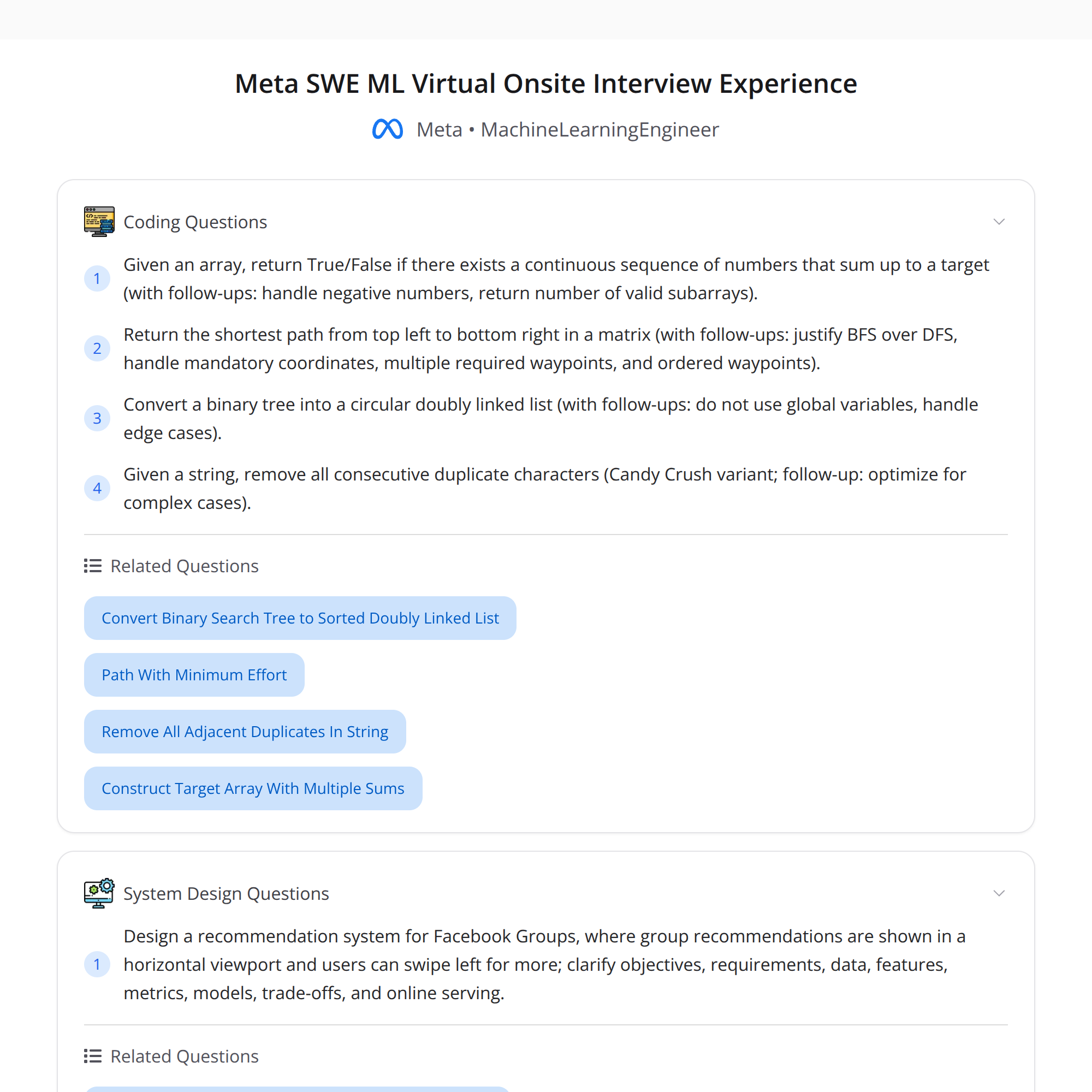
I encountered several advanced algorithmic problems. Here are the types and concise solutions/tips:
Sliding-window & hashmap tricks for subarrays
- Common patterns: variable-length two pointers for sums/unique counts, and hashmaps for frequency tracking.
- Tips: identify whether the window is fixed or variable, keep/update counts incrementally, and derive invariants to move pointers efficiently.
BFS for shortest path with waypoints
- Typical solution: BFS on an extended state (position, visited-waypoints-bitmask) or multi-stage BFS between waypoints and combine with precomputed pairwise distances.
- Tips: compress state (use bitmask for visited set), prune unreachable states early, and compute pairwise shortest paths first if waypoints are few.
Convert binary tree to doubly linked list (in-place)
- Approach: inorder traversal to link nodes sequentially. Maintain previous pointer to connect current node with the previous visited node.
- Tips: implement recursively or iteratively with an explicit stack; be careful with head/tail handling and null pointers.
General coding-round tips:
- Always clarify constraints and examples first.
- Talk through complexity trade-offs and edge cases before coding.
- Write short sanity checks or simple tests if time permits.
Behavioral round — conflict resolution
- Focus area: conflict resolution and collaboration.
- Recommended framework: STAR (Situation, Task, Action, Result).
- Tip: pick a real example that shows ownership, empathy, and measurable outcome. Describe what you learned and how you adjusted your approach.
ML design round — Facebook Groups recommender (two-tower model)
The product prompt was to design a Groups recommender. The interviewer expected both high-level architecture and concrete ML details.
Key components to cover:
Problem framing
- Two stages: candidate generation (retrieval) and ranking (scoring).
- Two-tower (dual-encoder) model: one tower for user embeddings, one for group embeddings.
Features and towers
- User tower: user profile, activity history, membership and join history, social graph signals, embeddings from past interactions.
- Group tower: group metadata (topics, size, activity metrics), text embeddings (description/posts), and latent features from collaborative signals.
Training objective
- Use contrastive losses (e.g., sampled softmax, InfoNCE) or binary cross-entropy with negative sampling to pull relevant user-group pairs closer.
- Consider session-based or time-decayed positives to reflect current interests.
Serving and scalability
- Candidate generation: nearest neighbor search (ANN) over precomputed group embeddings (Faiss, Annoy, ScaNN).
- Re-ranking: a heavier model (e.g., wide & deep / GBDT / transformer) using richer features and interaction signals.
- Freshness: update embeddings periodically and use online features (recent activity) in the ranker.
Evaluation
- Offline metrics: recall@k for retrieval, NDCG/MAP for ranking, AUC for classification tasks.
- Online: A/B test for engagement lifts (joins, DAU/MAU, time-in-group) and safety/quality metrics.
Practical considerations
- Cold-start: use content-based features and social signals for new groups/users.
- Bias & fairness: monitor for echo chambers and moderation constraints.
- Latency trade-offs: tune candidate size vs. ranking complexity.
What the interview tested (and why it matters)
- Algorithmic thinking: efficient, correct solutions under time pressure.
- Systems thinking for ML: balancing model accuracy with latency and scale.
- Communication: clear problem scoping, trade-offs, and incremental solutions.
Concrete preparation tips
- Practice 3–5 medium-hard algorithm problems per day: focus on sliding windows, BFS/DFS variants, bitmask DP, trees, and graph shortest paths.
- Brush up on common in-place tree transformations and pointer manipulations.
- Learn two-tower models end-to-end: training loss choices, negative sampling strategies, evaluation metrics, and ANN tooling (Faiss/ScaNN).
- Mock design interviews: practice outlining components, data flow, read/write patterns, and deployment considerations.
- Behavioral prep: prepare 4–6 STAR stories covering ownership, conflict resolution, impact, and learning.
Final takeaway
Each round pushed a different muscle — from algorithmic precision to product-aware ML design and soft skills. Emphasize clarity, justify trade-offs, and connect ML choices to user-facing metrics. With focused practice on these patterns, you can improve how you reason through and present solutions in top-tech on-sites.
Good luck — and iterate on both your coding and your system design storytelling.
#Tags
#MachineLearning #InterviewExperience #Meta #SoftwareEngineering #Bugfree
About the author
bugfree.ai is an advanced AI-powered platform designed to help software engineers master system design and behavioral interviews. Whether you’re preparing for your first interview or aiming to elevate your skills, bugfree.ai provides a robust toolkit tailored to your needs. Key Features:
150+ system design questions: Master challenges across all difficulty levels and problem types, including 30+ object-oriented design and 20+ machine learning design problems. Targeted practice: Sharpen your skills with focused exercises tailored to real-world interview scenarios. In-depth feedback: Get instant, detailed evaluations to refine your approach and level up your solutions. Expert guidance: Dive deep into walkthroughs of all system design solutions like design Twitter, TinyURL, and task schedulers. Learning materials: Access comprehensive guides, cheat sheets, and tutorials to deepen your understanding of system design concepts, from beginner to advanced. AI-powered mock interview: Practice in a realistic interview setting with AI-driven feedback to identify your strengths and areas for improvement.
bugfree.ai goes beyond traditional interview prep tools by combining a vast question library, detailed feedback, and interactive AI simulations. It’s the perfect platform to build confidence, hone your skills, and stand out in today’s competitive job market. Suitable for:
New graduates looking to crack their first system design interview. Experienced engineers seeking advanced practice and fine-tuning of skills. Career changers transitioning into technical roles with a need for structured learning and preparation.
Comments
Join the discussionNo comments yet. Be the first to comment.