
TL;DR
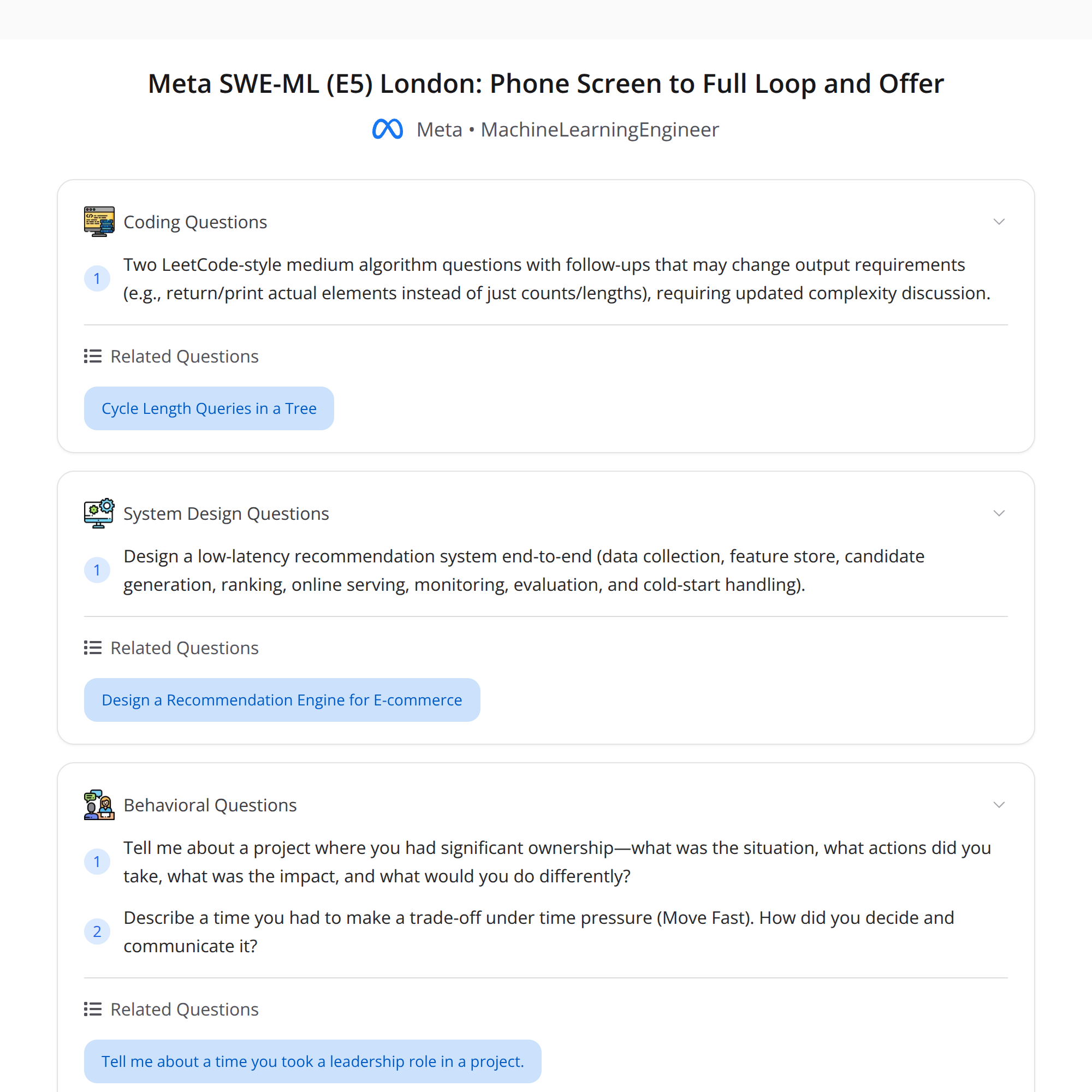
A condensed, high-signal walkthrough of a successful Meta SWE-ML (E5) London interview. Phone screen: 2 medium coding questions + discussion of scope/impact. Onsite/full loop: 2 coding rounds (two medium problems each, with harder follow-ups), 2 ML system-design rounds focused on low-latency recommender systems, and 1 deep behavioral (STAR/CARL). Team matching took ~6 weeks.
Process & Timeline
- Phone screen: 2 medium coding problems (live), plus a conversation about scope and impact.
- Full loop (onsite/virtual):
- 2 coding rounds (each had 2 medium problems; follow-ups could make them notably trickier)
- 2 ML system-design rounds (low-latency RecSys focus)
- 1 behavioral deep-dive (STAR/CARL style)
- Team match / offer window: ~6 weeks after loop.
Coding rounds — practical tactics
- Clarify fast
- Confirm input/output types, constraints, and edge cases immediately.
- Ask about expected complexity and memory limits when ambiguous.
- Brute → Optimize
- State a brute-force approach quickly to show problem understanding.
- Then iteratively optimize; articulate time/space complexity at each step.
- Complexity and trade-offs
- Before coding, say the target complexity (e.g., O(n), O(n log n)).
- Clean code + dry run
- Write clear, modular code. Use meaningful variable names.
- Dry-run with a small example and an edge case aloud.
- Edge cases & follow-ups
- Explicitly test edge cases (empty input, single element, duplicates).
- Watch for "print elements" or output-format follow-ups — interviewers often ask to list or reconstruct elements (e.g., print the sequence, reconstruct indices). Clarify expected ordering and formatting.
Time management tips
- For medium problems, aim to present an approach in 3–6 minutes, implement in 12–20 minutes, and use remaining time for tests and follow-ups.
- If a follow-up pushes complexity, re-state constraints and propose a plan (e.g., using heaps, sliding windows, or hashing).
Recommended problem patterns to rehearse
- Two-pointers, sliding window
- Hash maps and frequency counting
- Heaps for top-k
- DFS/BFS basics and union-find
- Greedy and basic DP patterns
ML system-design rounds (low-latency RecSys)
How to structure your answer (recommended flow for a ~45–50 minute slot):
- Goals & metrics (first 3–5 minutes)
- Define primary objective (e.g., increase CTR, engagement, revenue).
- Define key metrics (precision@k, recall@k, CTR, latency percentiles, SLA).
- State latency and throughput targets early (p99 < X ms, QPS estimates).
- End-to-end sketch (land this in ~30–35 minutes)
- Candidate generation (retrieval/scoring pipeline)
- Feature pipeline: online features, offline features, feature store
- Ranking model → serving layer (model format, batching vs per-request, caching)
- Storage and index choices (ANN, inverted indices)
- Real-time freshness & feature updates
- Offline training and feature computation
- Evaluation & A/B testing hooks
- Trade-offs and deeper dives (remaining time)
- Data: labeling, long-tail users, cold-start strategies
- Freshness: streaming vs batch features, what requires up-to-date state
- Evaluation: offline metrics vs online experiments, counterfactuals
- Monitoring: data drift, model performance, latency, alerting
- Specific optimizations for low latency: feature caching, model quantization, async candidate filtering
Pro tips
- Be explicit about constraints (memory, latency, QPS) and how those shape architecture choices.
- If asked to dive deeper, pick one component (e.g., candidate generation) and walk through concrete data flows, storage types, and complexity.
- Use diagrams verbally: describe components and arrows, indicate sync vs async paths.
Behavioral (STAR/CARL)
- Prepare 4–6 stories that highlight impact, ownership, ambiguity handling, and collaboration.
- Always quantify outcomes (e.g., improved metric by X%, reduced latency by Y ms).
- Be ready to deep-dive on technical ownership and trade-offs you made.
What helped this candidate win
- Rapid, decisive clarifications and a clear problem-solving roadmap.
- Brute-force-first approach that showed correctness, then clean optimizations with stated complexity.
- Dry runs and explicit edge-case checks after coding.
- ML design answers that landed an end-to-end architecture early and then discussed trade-offs (data, freshness, evaluation, cold-start, monitoring).
Quick prep checklist
- Practice 40–60 medium LeetCode problems across patterns listed above.
- Mock interviews with real-time feedback (focus on articulation and complexity analysis).
- Study recommender system design: candidate generation, ranking, feature stores, low-latency serving.
- Prepare measurable behavioral stories using STAR/CARL.
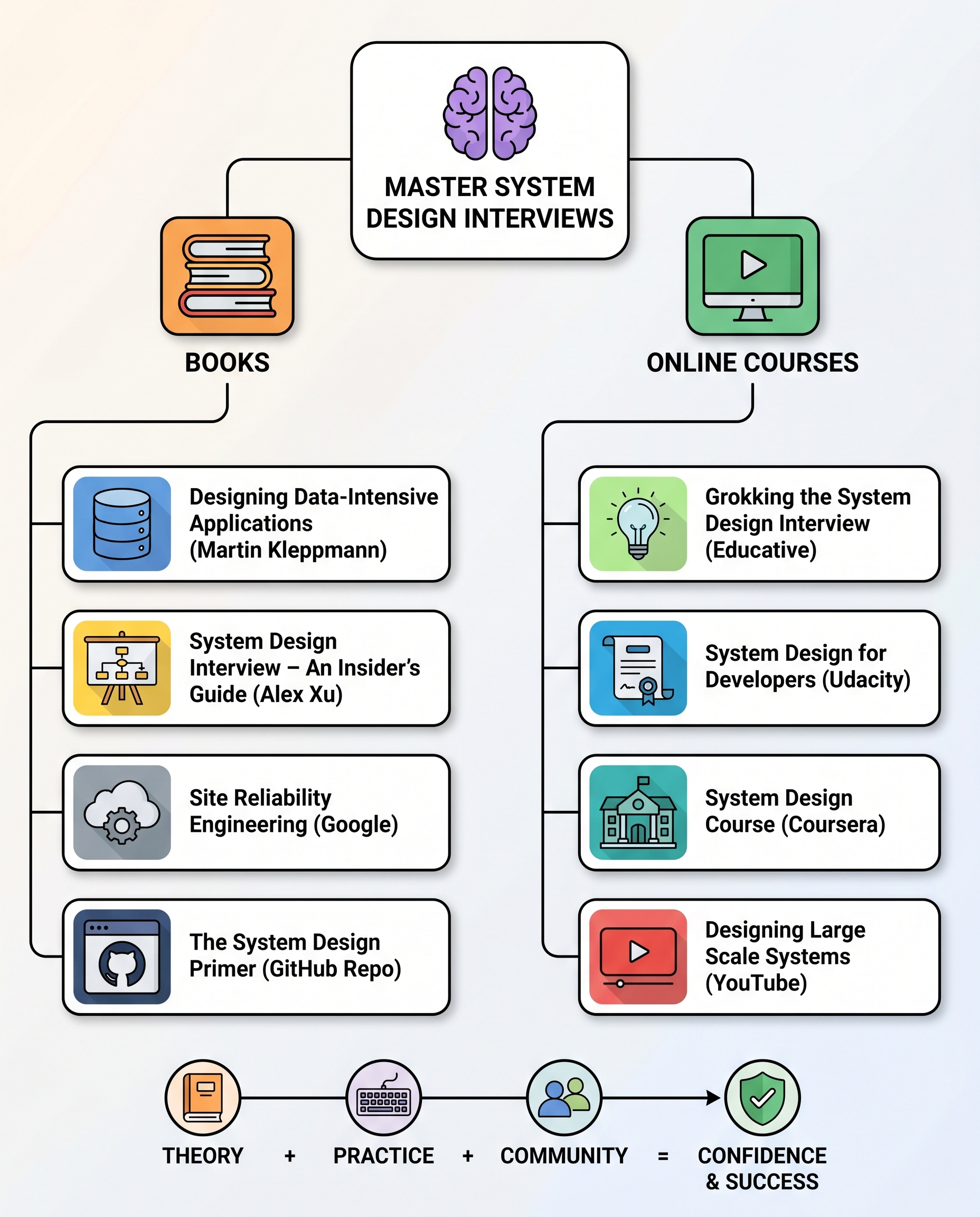
Resources
- LeetCode (medium problems)
- "Designing Data-Intensive Applications" — patterns for data systems
- System Design Primer (GitHub)
- Blogs/videos on scalable recommender systems and low-latency serving
Good luck — focus on clarity first, correctness second, and optimizations third. If you want, I can turn this into a custom 8-week prep plan tailored to your current strengths.
#MachineLearning #SystemDesign #InterviewPrep
About the author
bugfree.ai is an advanced AI-powered platform designed to help software engineers master system design and behavioral interviews. Whether you’re preparing for your first interview or aiming to elevate your skills, bugfree.ai provides a robust toolkit tailored to your needs. Key Features:
150+ system design questions: Master challenges across all difficulty levels and problem types, including 30+ object-oriented design and 20+ machine learning design problems. Targeted practice: Sharpen your skills with focused exercises tailored to real-world interview scenarios. In-depth feedback: Get instant, detailed evaluations to refine your approach and level up your solutions. Expert guidance: Dive deep into walkthroughs of all system design solutions like design Twitter, TinyURL, and task schedulers. Learning materials: Access comprehensive guides, cheat sheets, and tutorials to deepen your understanding of system design concepts, from beginner to advanced. AI-powered mock interview: Practice in a realistic interview setting with AI-driven feedback to identify your strengths and areas for improvement.
bugfree.ai goes beyond traditional interview prep tools by combining a vast question library, detailed feedback, and interactive AI simulations. It’s the perfect platform to build confidence, hone your skills, and stand out in today’s competitive job market. Suitable for:
New graduates looking to crack their first system design interview. Experienced engineers seeking advanced practice and fine-tuning of skills. Career changers transitioning into technical roles with a need for structured learning and preparation.
Comments
Join the discussionNo comments yet. Be the first to comment.