High-Score Meta SWE Interview Experience — VO Timeline & What Actually Helped
A concise, practical breakdown of a high-scoring Software Engineering interview at Meta shared by a Bugfree user. Below are the timeline, what showed up in each loop, and the specific prep strategies that made a difference.
TL;DR
- Meta's process felt structured and professional.
- Behavioral: standard prompts — pre-writing STAR stories and polishing answers built confidence.
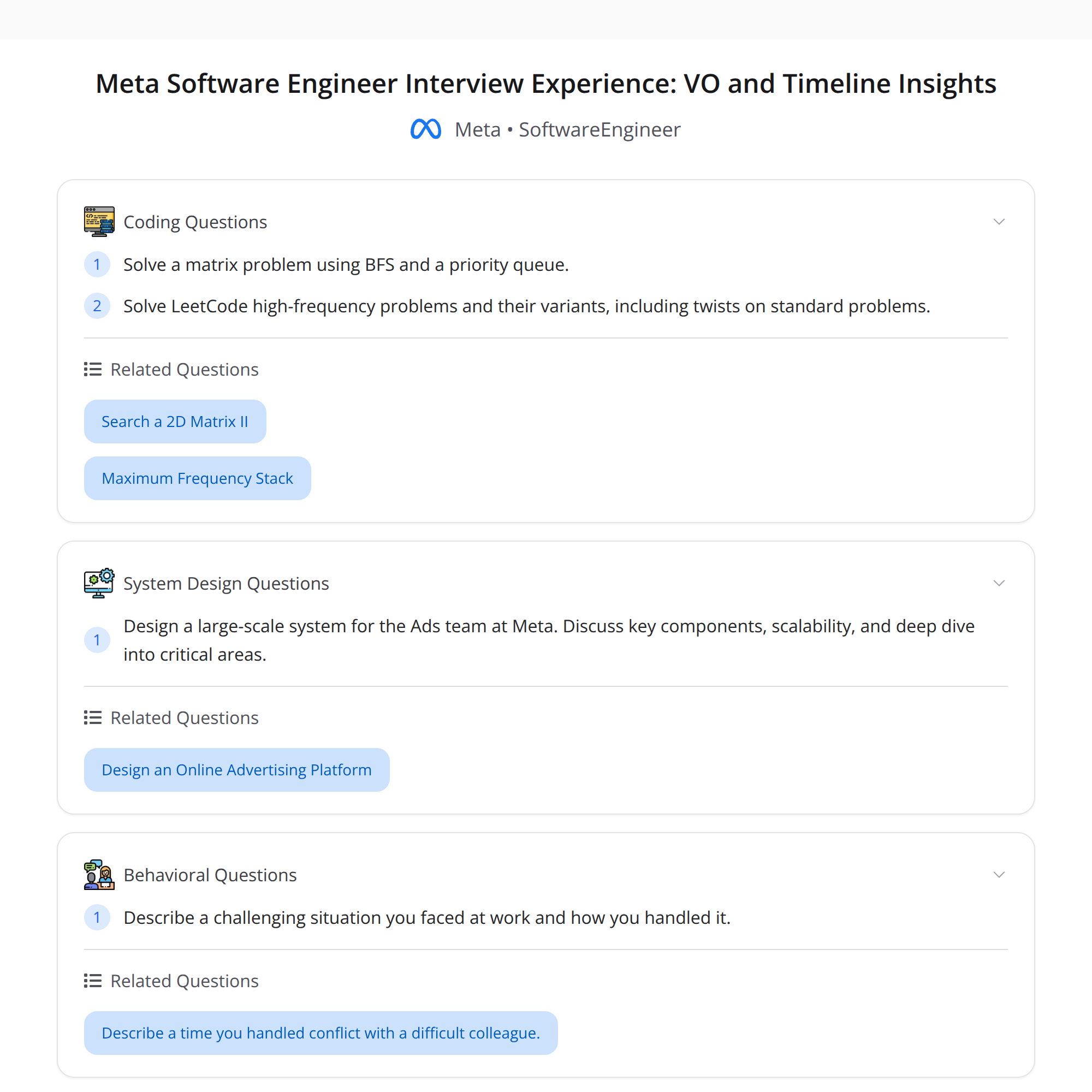
- System design (Ads EM): much larger scale than typical system design prep; 35 minutes felt tight — time-box deep dives and focus on Meta high-frequency topics.
- Coding: four questions, mostly Meta-flavored LeetCode variants; one involved a matrix BFS with a priority queue.
- Timeline: recruiter → phone screen (~1.5 weeks) → onsite (2 weeks later) → HC decision in 4 business days → team match next day.
Timeline (real-world cadence)
- Initial recruiter contact
- Phone screen: ~1.5 weeks after contact
- Onsite interviews: ~2 weeks after the phone screen
- Hiring committee (HC) pass: 4 business days after onsite
- Team match began: the next day
This felt faster and more structured than many other companies — good to plan for multiple touchpoints within a few weeks.
Behavioral / Voice of the Candidate (VO)
- Interview format: standard behavioral prompts. Expect STAR (Situation, Task, Action, Result) style questions.
- Prep tip that helped: pre-write and refine several STAR stories for common themes (leadership, conflict, ambiguous requirements, ownership). Rehearse them until you can adapt them naturally to slightly different prompts.
- Polishing answers: practicing concise intros and clear takeaways boosted confidence during interviews.
System Design (Ads EM — Engineering Manager level focus)
- Scale: questions were at the Ads-level scale — larger and more production-oriented than many typical system design exercises.
- Time pressure: 35 minutes per design felt tight. Prioritize: lay out high-level design, key components, trade-offs, and one deep dive area.
- Prep advice:
- Time-box your design: spend ~5 min on requirements and constraints, ~10 min on high-level architecture, ~15 min on one deep dive, ~5 min on trade-offs and scalability.
- Know Meta high-frequency topics (e.g., ad serving pipeline, caching strategies, data partitioning, rate limiting, consistency trade-offs).
- Prepare a couple of detailed deep-dive areas you can swap in (e.g., storage choice and indexing, real-time bidding pipeline, telemetry/observability).
Coding
- Structure: four coding questions in total.
- Content: mostly Meta-flavored LeetCode variants (think common pattern problems with a Meta twist).
- Notable problem: a matrix BFS combined with a priority queue (so expect algorithmic variations that combine traversal with ordering/prioritization).
- Prep advice:
- Practice medium-to-hard LeetCode problems with focus on pattern recognition (two pointers, BFS/DFS, priority queues, heaps, sliding window, graphs).
- Time yourself and practice talking through trade-offs and complexity.
What Actually Helped (practical checklist)
- Pre-write and refine 6–8 STAR stories for behavioral rounds.
- Mock interviews with focused feedback (coding, system design, behavioral).
- Time-boxed design practice: practice 30–40 minute designs with a forced deep-dive for one component.
- Practice Meta-style questions: work on variants of common patterns rather than one-off puzzles.
- Brush up graph/traversal + heap/priority-queue combos (matrix BFS + PQ came up).
- Keep answers concise, structure your responses, and call out trade-offs explicitly.
Final thoughts
Meta’s process felt polished and predictable. If you prioritize STAR story prep, time-boxed system design practice at scale (especially Ads-related concepts), and Meta-style coding patterns, you’ll be well prepared for the rounds described here.
Good luck — and focus on structured answers and practiced depth, not just breadth.
If you'd like, I can:
- Turn the checklist into a 4-week prep plan
- Generate a list of 20 Meta-style practice problems (coding + systems)
- Mock a 35-minute Ad-system design prompt you can practice with
Which would be most helpful?
About the author
bugfree.ai is an advanced AI-powered platform designed to help software engineers master system design and behavioral interviews. Whether you’re preparing for your first interview or aiming to elevate your skills, bugfree.ai provides a robust toolkit tailored to your needs. Key Features:
150+ system design questions: Master challenges across all difficulty levels and problem types, including 30+ object-oriented design and 20+ machine learning design problems. Targeted practice: Sharpen your skills with focused exercises tailored to real-world interview scenarios. In-depth feedback: Get instant, detailed evaluations to refine your approach and level up your solutions. Expert guidance: Dive deep into walkthroughs of all system design solutions like design Twitter, TinyURL, and task schedulers. Learning materials: Access comprehensive guides, cheat sheets, and tutorials to deepen your understanding of system design concepts, from beginner to advanced. AI-powered mock interview: Practice in a realistic interview setting with AI-driven feedback to identify your strengths and areas for improvement.
bugfree.ai goes beyond traditional interview prep tools by combining a vast question library, detailed feedback, and interactive AI simulations. It’s the perfect platform to build confidence, hone your skills, and stand out in today’s competitive job market. Suitable for:
New graduates looking to crack their first system design interview. Experienced engineers seeking advanced practice and fine-tuning of skills. Career changers transitioning into technical roles with a need for structured learning and preparation.
Comments
Join the discussionNo comments yet. Be the first to comment.