
Posted by Bugfree users — a high-score interview experience.
Quick summary
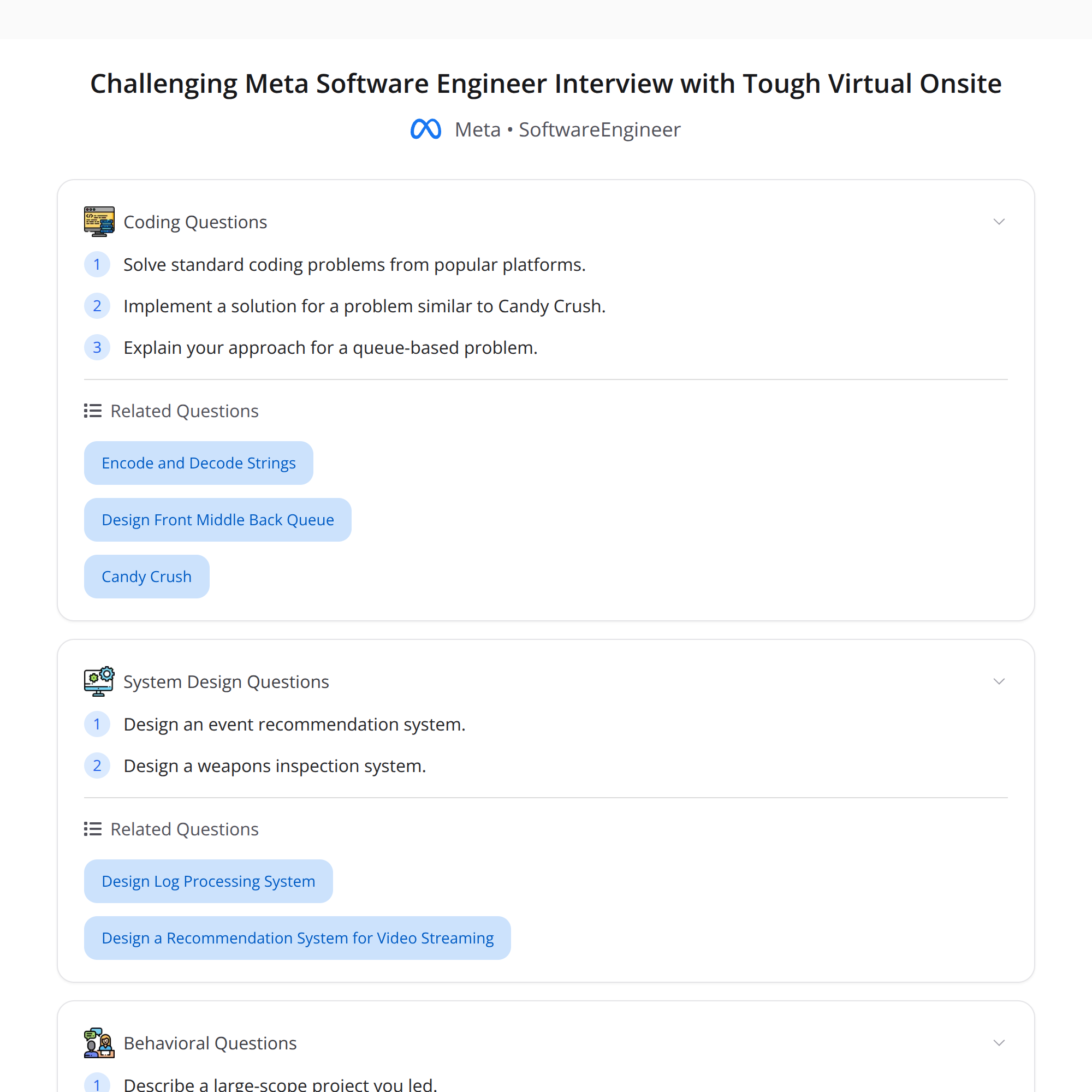
This was a virtual Meta Software Engineering (SWE) onsite consisting of six rounds: three coding, two system design, and one behavioral — though a reschedule turned that behavioral round into two behavioral rounds plus a “shadow” observer. The phone screen beforehand was smooth and included coding and behavioral. Overall — expect a mix of familiar problems and novel, escalating puzzles, plus system design conversations that reward clarity and engagement.
Interview structure (what happened)
- Phone screen: coding + behavioral (smooth).
- Virtual onsite (6 rounds total):
- Coding: 3 rounds (4 problems total — two common patterns, two novel)
- System design: 2 rounds (one on event recommendation — went well; second suffered from low engagement)
- Behavioral: 1 round, expanded to 2 rounds due to reschedule, with a shadow observer in at least one session
Coding rounds — what to expect
Problems: 4 total
- Two were common/pattern-based (dynamic programming, graph, sliding window, etc.).
- Two were novel: one resembled a "Candy Crush"-style elimination puzzle that escalated in complexity across the same problem; another round rewarded a clear explanation of a queue-based approach.
What mattered:
- Problem decomposition: state your plan before coding.
- Communication: explain trade-offs, complexity, and invariants as you go.
- Edge cases & tests: discuss and run through examples, including worst-case inputs.
- Incremental correctness: implement in small, testable steps rather than one long block of code.
Tips for the Candy-Crush style and similar escalations:
- Clarify the exact transformation rules and termination conditions first.
- Work through a small example by hand to validate your model.
- Keep complexity visible: if naive approaches are too slow, propose optimizations and justify them.
Queue-based problems:
- Walk through your queue operations (enqueue/dequeue) and invariants.
- Explain why a queue suits the problem (FIFO semantics, streaming behavior, level-order traversal, etc.).
System design rounds — what went well and what didn’t
Round 1: Event recommendation
- This one went well. The candidate likely covered requirements, high-level architecture, data flow (online vs offline), storage choices, and basic recommendation approaches.
- Important areas to hit: data collection, feature generation, scoring/ranking, serving layer, caching, and metrics (precision, recall, latency).
Round 2: Low engagement
- When interviewers are less engaged, drive the conversation: ask clarifying questions, propose options, and choose one to flesh out.
- Use diagrams: logically explain components and data movement even if the interviewer is quiet — the act of structuring your explanation helps them follow.
General system design tips:
- Clarify scope and constraints early (throughput, latency, data freshness, budget).
- Discuss trade-offs (consistency vs availability, batch vs stream, cost vs complexity).
- Provide concrete capacity/back-of-envelope calculations for traffic, storage, and indices.
- Mention monitoring, instrumentation, and how you’d iterate based on metrics.
Behavioral rounds — focus areas and approach
- Topics covered: leadership, conflict resolution, giving/receiving feedback, and proud projects.
- The reschedule changed format (two behavioral rounds + a shadow observer). Treat every person in the room as an interviewer:
- Be concise and impact-focused using STAR (Situation, Task, Action, Result).
- Quantify impact where possible (numbers, timelines, team size, performance improvements).
- On conflict and feedback: describe the situation, your role, the resolution steps, and the outcome — emphasize learning.
Practical prep checklist
Coding:
- Practice medium-to-hard LeetCode problems; focus on patterns (graphs, DP, two pointers, queues, sliding window).
- Do a few escalation puzzles (games or elimination-style) where the problem grows in complexity.
- Practice explaining queue/stack-based approaches out loud.
System design:
- Study event-driven systems, recommendation pipelines, and trade-offs between batch and streaming.
- Practice designing end-to-end systems with capacity estimates and failure modes.
- Run mock design interviews and get feedback on your presentation flow.
Behavioral:
- Prepare 6–8 STAR stories covering leadership, conflict, failures, feedback, and proud accomplishments.
- Practice concise narration with measurable outcomes.
Final takeaways
- Communication trumps perfect code: explaining your plan and trade-offs often matters as much as getting a full implementation.
- Be proactive in system design interviews; if an interviewer is quiet, lead the conversation with questions and decisions.
- Treat every participant (including shadow observers) as an interviewer.
- Practice escalation-style puzzles and queue-based reasoning to feel comfortable when problems shift in complexity.
Good luck — and remember: clear structure, concrete examples, and measurable impact make the difference in Meta SWE interviews.
#SoftwareEngineering #SystemDesign #InterviewPrep
About the author
bugfree.ai is an advanced AI-powered platform designed to help software engineers master system design and behavioral interviews. Whether you’re preparing for your first interview or aiming to elevate your skills, bugfree.ai provides a robust toolkit tailored to your needs. Key Features:
150+ system design questions: Master challenges across all difficulty levels and problem types, including 30+ object-oriented design and 20+ machine learning design problems. Targeted practice: Sharpen your skills with focused exercises tailored to real-world interview scenarios. In-depth feedback: Get instant, detailed evaluations to refine your approach and level up your solutions. Expert guidance: Dive deep into walkthroughs of all system design solutions like design Twitter, TinyURL, and task schedulers. Learning materials: Access comprehensive guides, cheat sheets, and tutorials to deepen your understanding of system design concepts, from beginner to advanced. AI-powered mock interview: Practice in a realistic interview setting with AI-driven feedback to identify your strengths and areas for improvement.
bugfree.ai goes beyond traditional interview prep tools by combining a vast question library, detailed feedback, and interactive AI simulations. It’s the perfect platform to build confidence, hone your skills, and stand out in today’s competitive job market. Suitable for:
New graduates looking to crack their first system design interview. Experienced engineers seeking advanced practice and fine-tuning of skills. Career changers transitioning into technical roles with a need for structured learning and preparation.
Comments
Join the discussionNo comments yet. Be the first to comment.