High-Scoring Meta Interview Experience: Key Takeaways from Bugfree Users
Bugfree users who cleared Meta's Staff Software Engineer interviews report a consistent pattern: rigorous coding rounds, deep system design conversations, and behavioral questions that probe collaboration and adaptability. Below is a distilled, practical guide to what they faced and how they prepared — useful whether you're interviewing for Staff SWE or aiming for senior technical roles.
Interview structure (what to expect)
- Coding rounds: algorithmic problems that test correctness, efficiency, and trade-offs.
- System design: end-to-end design of scalable services, trade-offs, and detailed component choices.
- Behavioral: STAR-style questions around teamwork, feedback, and adapting to change.
Common coding problems and approaches
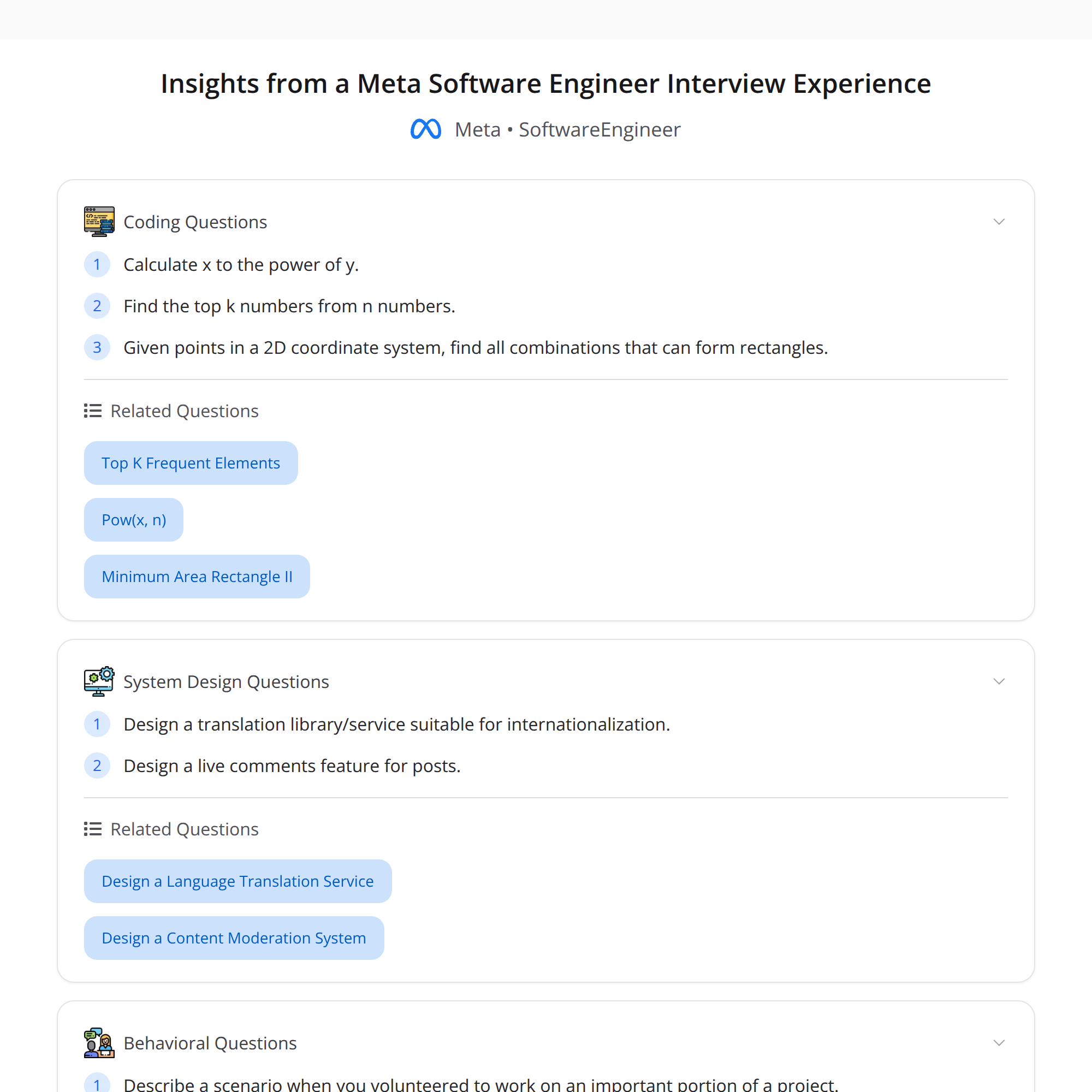
Bugfree candidates reported variations of the following problems. Focus on correctness first, then optimize and explain trade-offs.
Implementing power functions (fast exponentiation)
- Use exponentiation by squaring for O(log n) time and handle negative exponents and overflow cases.
Pseudocode idea:
function pow(x, n):
  if n == 0: return 1
  if n < 0: x = 1/x; n = -n
  result = 1
  while n > 0:
    if n & 1: result *= x
    x *= x
    n >>= 1
  return result
Finding top-k numbers
- Use a min-heap of size k (O(n log k) time) or Quickselect (average O(n)) for in-place selection.
- Discuss stability, memory constraints, and when streaming/online solutions are required.
Identifying rectangles from points
- Put points into a hash set and for each pair of points sharing x or y, check if the complementary corners exist.
- Typical solution uses O(n^2) pair checks but constant-time lookups; discuss optimizations when n is large.
Tips for coding rounds:
- Clarify constraints and input ranges up front.
- Start with a correct, simple solution; then optimize.
- Write clear variable names and walk the interviewer through complexity and edge cases.
System design: what the interviewers probe
Two system-design motifs reported by Bugfree users were:
Translation library for internationalization (i18n)
- Requirements: support many locales, runtime language switching, fallbacks, and pluralization.
- Key design points: centralized vs. distributed translation storage, caching strategies, feature flags to roll out new translations, offline sync for clients, and performance for hot keys.
- Implementation considerations: resource format (JSON/PO), runtime interpolation, A/B test hooks, and tools for translators.
Live comments for posts
- Requirements: low-latency delivery, ordering, moderation, scalability across millions of users.
- Architecture highlights: front-end WebSocket/long-polling, backend pub/sub (Kafka/PubSub) for fan-out, message ordering/causal consistency (or use CRDTs for merging), per-post sharding, read replicas and caches, and moderation pipeline.
For any design question:
- Start with goals and constraints (latency, consistency, availability).
- Propose a high-level architecture diagram and justify choices.
- Drill down on data models, APIs, storage, caching, and failure modes.
- Discuss scaling, monitoring, and incremental rollout.
Behavioral questions: themes and how to answer
Common topics: teamwork, giving/receiving feedback, conflict resolution, and adapting to shifting priorities.
- Use the STAR method (Situation, Task, Action, Result).
- Be specific: quantify impact (throughput improved, latency reduced, X% fewer bugs) and highlight collaboration.
- When discussing feedback, show humility and how you changed behavior.
Example prompt and concise approach:
- "Tell me about a time you changed course based on feedback." — Describe the situation, the feedback, what you implemented, and measurable outcomes.
Preparation strategy and checklist
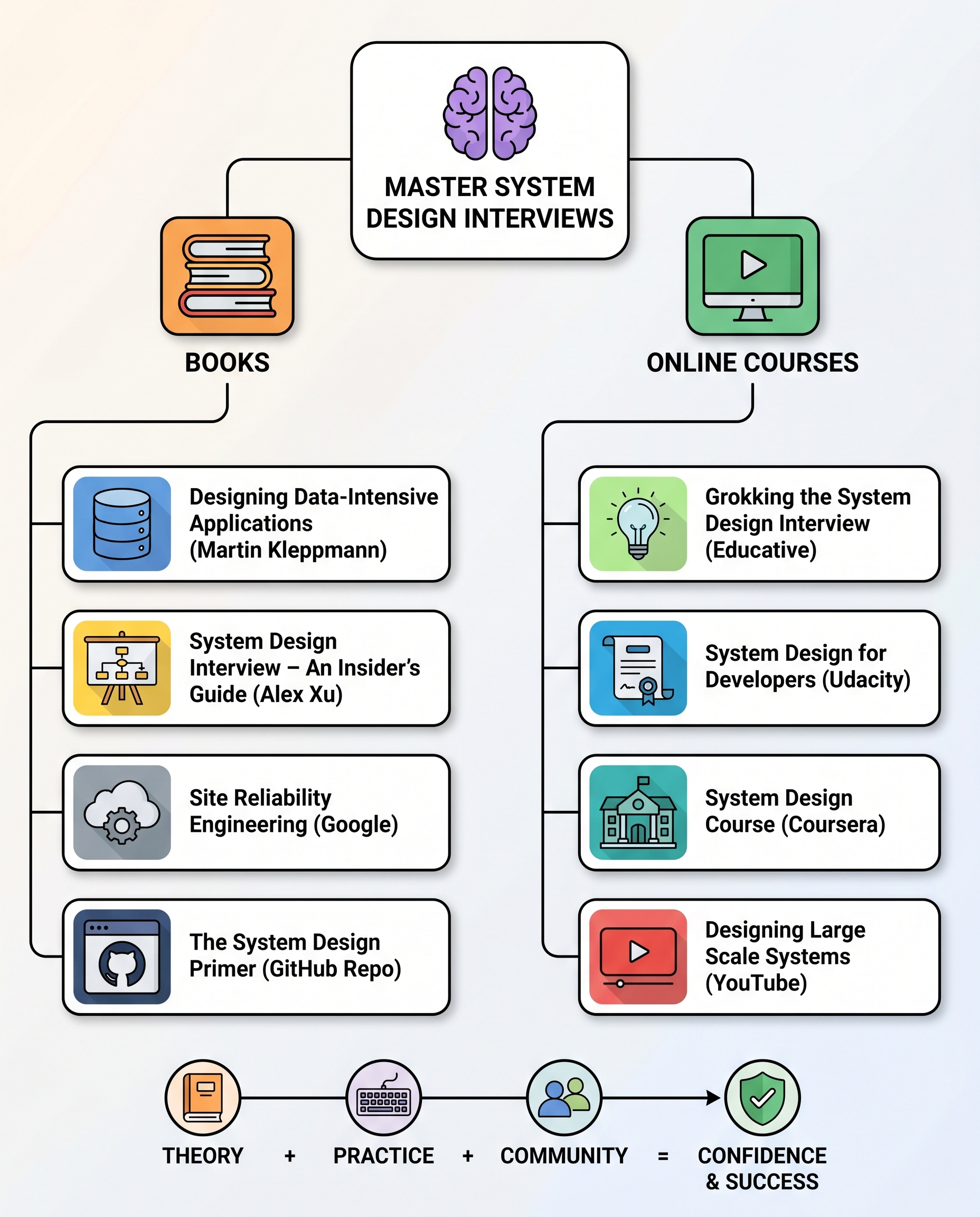
- Practice: LeetCode/Algo problems (focus on arrays, strings, heaps, hashing, recursion, graphs), timed mocks, and whiteboard practice.
- System design: study common patterns (load balancing, caching, partitioning), review real-world architectures, and run mock design interviews.
- Behavioral: prep 6–8 STAR stories that cover leadership, failure, conflict, and cross-team collaboration.
- Interview day: clarify questions, communicate trade-offs, and be flexible to hints from the interviewer.
Quick checklist:
- Understand constraints up front
- Start with a working solution
- Explain complexity and trade-offs
- Ask clarifying questions in design
- Use STAR for behavioral answers
Final takeaways
Preparation + flexibility is the winning combo. Candidates who paired solid algorithm practice with thoughtful system-design study and clear behavioral narratives performed best. Be ready to iterate on your solution during the interview and to justify your choices.
Good luck — and treat each interview as a learning opportunity.
About the author
bugfree.ai is an advanced AI-powered platform designed to help software engineers master system design and behavioral interviews. Whether you’re preparing for your first interview or aiming to elevate your skills, bugfree.ai provides a robust toolkit tailored to your needs. Key Features:
150+ system design questions: Master challenges across all difficulty levels and problem types, including 30+ object-oriented design and 20+ machine learning design problems. Targeted practice: Sharpen your skills with focused exercises tailored to real-world interview scenarios. In-depth feedback: Get instant, detailed evaluations to refine your approach and level up your solutions. Expert guidance: Dive deep into walkthroughs of all system design solutions like design Twitter, TinyURL, and task schedulers. Learning materials: Access comprehensive guides, cheat sheets, and tutorials to deepen your understanding of system design concepts, from beginner to advanced. AI-powered mock interview: Practice in a realistic interview setting with AI-driven feedback to identify your strengths and areas for improvement.
bugfree.ai goes beyond traditional interview prep tools by combining a vast question library, detailed feedback, and interactive AI simulations. It’s the perfect platform to build confidence, hone your skills, and stand out in today’s competitive job market. Suitable for:
New graduates looking to crack their first system design interview. Experienced engineers seeking advanced practice and fine-tuning of skills. Career changers transitioning into technical roles with a need for structured learning and preparation.
Comments
Join the discussionNo comments yet. Be the first to comment.