High Score Meta SDE Interview — Short Recap & Actionable Tips
A bugfree user shared a high-score interview experience for the Meta SDE New Grad role. The loop mixed challenging algorithm problems and behavioral conversations that tested technical depth, edge-case handling, and collaboration under ambiguity. Below is a concise breakdown and practical advice you can use while preparing.
What the interview covered
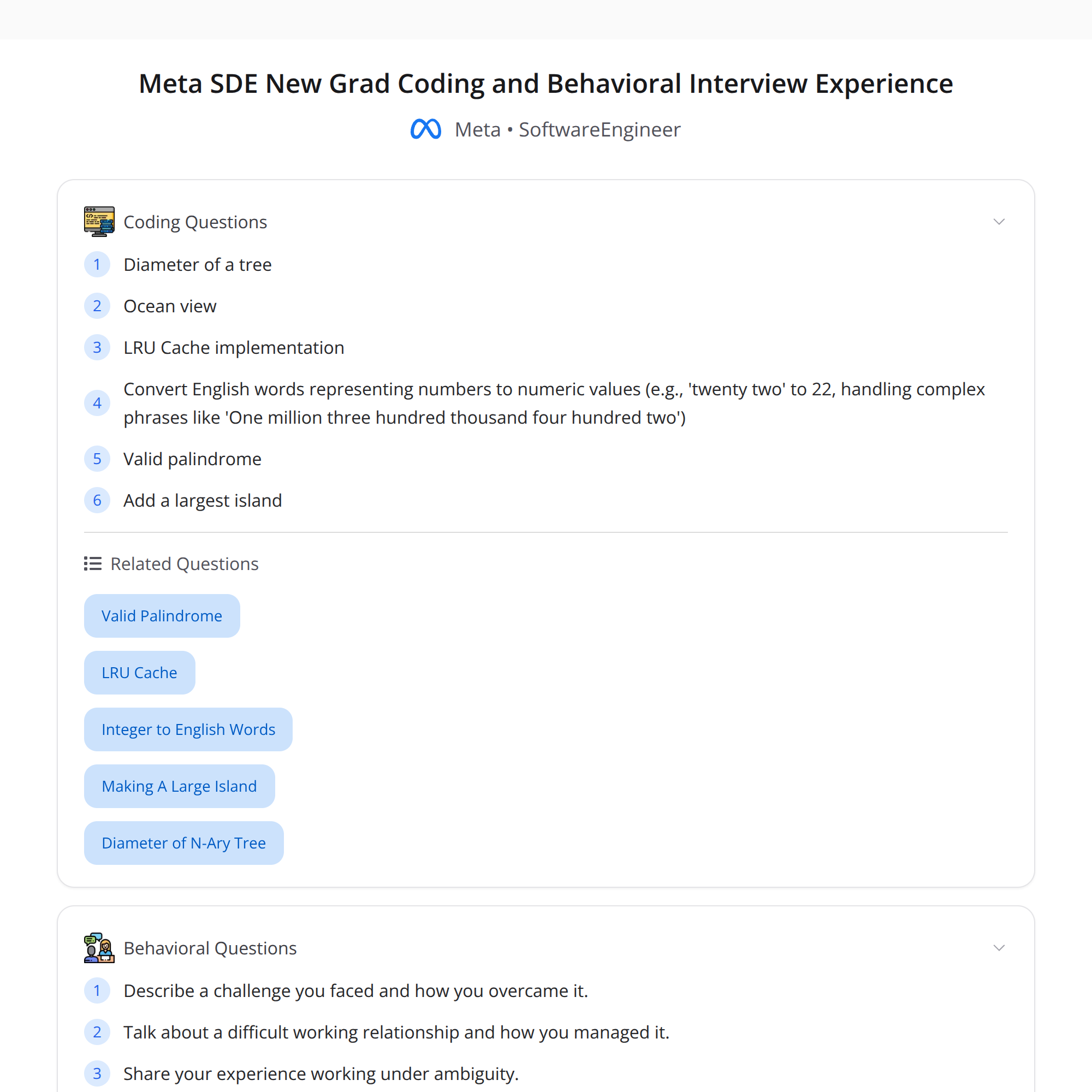
- Multiple coding rounds focused on algorithmic thinking and robust edge-case handling.
- Behavioral rounds exploring problem-solving, difficult relationships, and navigating ambiguity.
Coding rounds — problems and what they tested
Diameter of a Tree: Tests tree traversal techniques (two BFS/DFS passes or dynamic programming) and handling of skewed or single-node trees. Tip: validate small and degenerate cases.
Ocean View (monotonic stack): Checks ability to use stacks or linear scans to maintain monotonic properties. Tip: visualize skyline scenarios and consider time/space trade-offs.
LRU Cache: Classic design + implementation under constraints. Tests use of hash + doubly linked list (or ordered dict). Tip: practice clean, bug-free pointer manipulation and unit-test common sequences (get/put evictions).
Parsing English number phrases: Parsing phrases like “one hundred twenty-three” checks string parsing, mapping words to values, and careful aggregation with multipliers (thousand, million). Tip: handle negatives, extra spaces, and zero explicitly.
Why these matter: interviewers are looking for correct algorithms, clear reasoning, and robust handling of edge cases — not just a working solution for the average case.
Behavioral rounds — focus areas and how to answer
- Topics included overcoming tough challenges, resolving strained working relationships, and working with incomplete requirements.
- Use the STAR method (Situation, Task, Action, Result). Emphasize measurable outcomes, what you learned, and how you adapted.
- When discussing ambiguity, highlight structured approaches: ask clarifying questions, propose hypotheses, iterate quickly, and validate with data.
Prep checklist (practical & prioritized)
- Practice a wide variety of algorithm problems: trees, stacks/queues, hashing, parsing, and design problems.
- Drill edge cases and write quick tests for your solutions.
- Implement classic designs (LRU, LFU) from scratch until they’re second nature.
- Do mock behavioral interviews; prepare 6–8 stories with clear outcomes and learnings.
- Time-box problem solving and practice communicating your thought process aloud.
Key takeaways
- Diversity matters: practice across topic areas, not just your favorites.
- Edge-case handling and clear explanations are as important as a correct approach.
- Reflect on experiences and be ready to explain trade-offs and lessons.
Stay prepared and confident — consistent, focused practice will pay off.
— #MetaInterview #SoftwareEngineering #CodingInterview #CareerTips
About the author
bugfree.ai is an advanced AI-powered platform designed to help software engineers master system design and behavioral interviews. Whether you’re preparing for your first interview or aiming to elevate your skills, bugfree.ai provides a robust toolkit tailored to your needs. Key Features:
150+ system design questions: Master challenges across all difficulty levels and problem types, including 30+ object-oriented design and 20+ machine learning design problems. Targeted practice: Sharpen your skills with focused exercises tailored to real-world interview scenarios. In-depth feedback: Get instant, detailed evaluations to refine your approach and level up your solutions. Expert guidance: Dive deep into walkthroughs of all system design solutions like design Twitter, TinyURL, and task schedulers. Learning materials: Access comprehensive guides, cheat sheets, and tutorials to deepen your understanding of system design concepts, from beginner to advanced. AI-powered mock interview: Practice in a realistic interview setting with AI-driven feedback to identify your strengths and areas for improvement.
bugfree.ai goes beyond traditional interview prep tools by combining a vast question library, detailed feedback, and interactive AI simulations. It’s the perfect platform to build confidence, hone your skills, and stand out in today’s competitive job market. Suitable for:
New graduates looking to crack their first system design interview. Experienced engineers seeking advanced practice and fine-tuning of skills. Career changers transitioning into technical roles with a need for structured learning and preparation.
Comments
Join the discussionNo comments yet. Be the first to comment.