High-Score (Bugfree Users) Meta Production Engineer Interview Experience — Coding, OS & System Design Highlights
A compact, practical breakdown of a Meta Production Engineer loop experienced by Bugfree users. This loop emphasized real-world fundamentals end-to-end and is a great template for focused interview prep.
Summary flow:
- Recruiter reach-out
- Online assessment (20 MCQs)
- Two phone screens
- Virtual onsite (behavioral, coding, system design)
- Outcome: rejected — but a high-value learning loop
Key technical themes that repeatedly showed up:
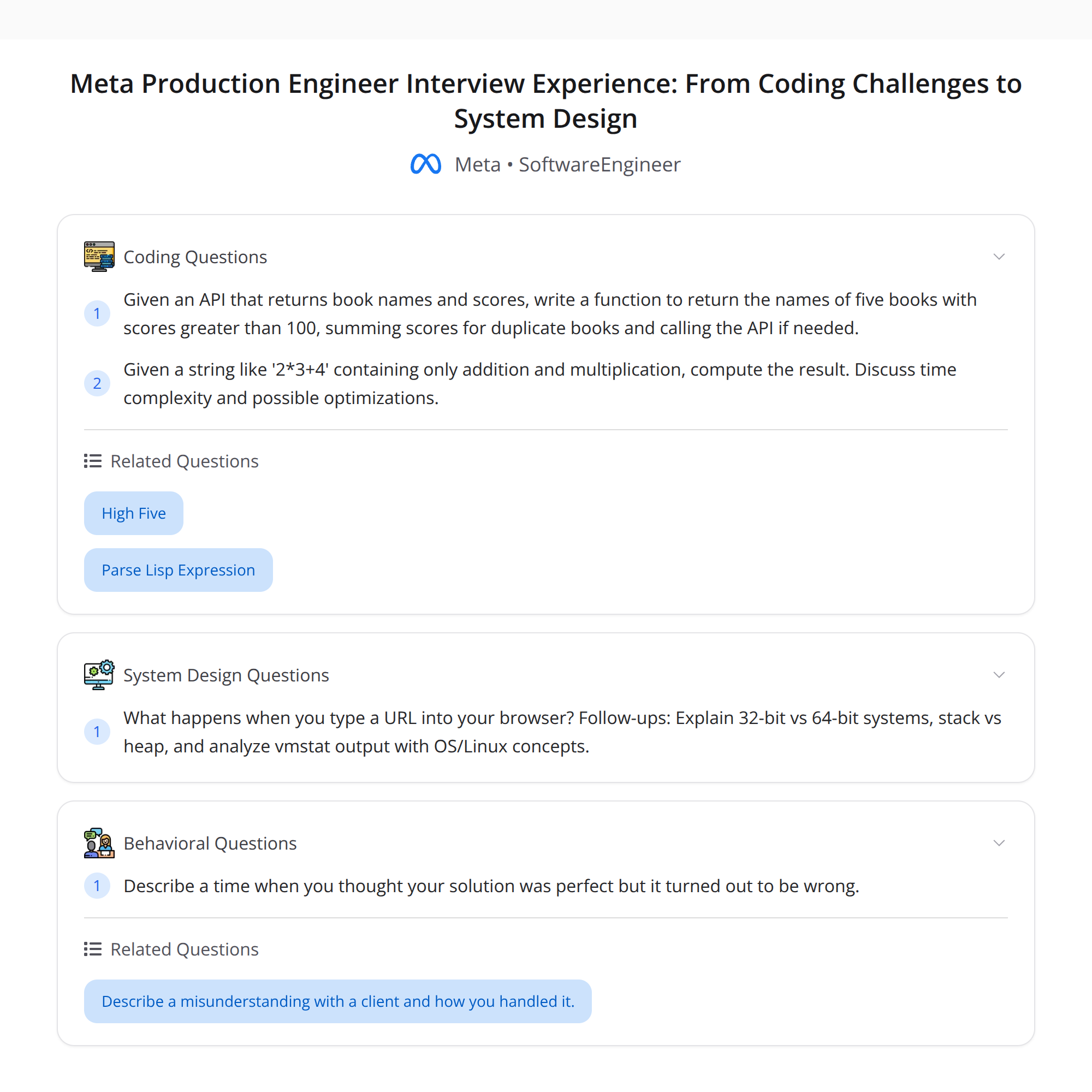
- "What happens when you type a URL?" (end-to-end web request lifecycle)
- 32-bit vs 64-bit differences
- Stack vs heap differences
- Linux / OS fundamentals (vmstat, paging, swapping)
- Shell/globbing patterns (e.g., ls -l foo*)
Below I expand each area, give concise answers you can adapt in an interview, and provide sample code and strategies for the coding problems.
Interview flow and expectations
- OA: short multiple-choice covering OS, networking, basic algorithms.
- Phone screens: behavioral + quick technical questions to validate fundamentals.
- Virtual onsite: deeper behavioral, one or two coding problems, a system-design or production engineering discussion, plus OS/Linux troubleshooting questions.
Focus your prep on clear, verbalizable fundamentals and fast, correct solutions for short-coded tasks.
"What happens when you type a URL?" — a succinct answer to deliver in interviews
- Browser parses the URL and checks cache (DNS/HTTP cache).
- DNS lookup (local cache → resolver → authoritative) to get the IP.
- TCP handshake (SYN, SYN-ACK, ACK) to establish connection; if HTTPS, TLS handshake follows.
- Browser constructs and sends an HTTP request to the server (with Host header, cookies, etc.).
- Network elements: CDNs, load balancers, reverse proxies may intercept/route the request.
- Server receives request, web server forwards to application process, which executes logic and queries DB or caches as needed.
- Application constructs an HTTP response and returns it.
- Browser receives response, parses headers and body, and starts rendering (HTML → DOM; CSS → style; JS execution).
- Additional resource fetches (images, scripts, fonts) follow, possibly parallelized.
- Connection may be kept alive (HTTP persistent connection) or closed.
Mention caching, CDNs, security (TLS), and observability (logs, metrics, traces) as follow-up talking points.
32-bit vs 64-bit (talking points)
- Addressable memory: 32-bit ≈ 4GiB address space; 64-bit vastly larger.
- Pointer size doubles (8 bytes on 64-bit), affecting memory footprint and alignment.
- Performance: 64-bit can enable faster integer arithmetic and more registers, but increases memory usage.
- ABI/syscall differences and implications for cross-platform builds.
Keep answers concrete: why it matters (memory limits, pointer arithmetic, data structure sizing), and trade-offs for systems design.
Stack vs Heap
- Stack: automatic storage, LIFO, fast allocation/deallocation, limited size, function-local lifetimes, risk of stack overflow.
- Heap: manual/dynamic allocation, larger but can fragment, requires explicit free/GC, suitable for variable-sized data and longer lifetimes.
Explain when to use each and how they affect performance/debugging.
Linux / OS basics and vmstat
- Key vmstat fields to know (typical output columns):
- r: runnable processes (CPU demand)
- b: blocked processes
- swpd: amount of virtual memory used (swap)
- free: idle memory
- buff/cache: kernel buffers and page cache
- si / so: swap in / swap out (KB/s)
- wa: IO wait
- Paging vs swapping: paging moves pages between RAM and page cache; swapping moves whole process pages to swap. High si/so indicates swapping, which causes high latency.
- Causes: memory pressure, misconfigured OOM parameters, memory leaks.
When given vmstat data in an interview, narrate what each hot metric means and suggest concrete mitigations (e.g., add memory, reduce working set, tune caching, change swappiness).
Shell patterns: ls -l foo*
- Glob foo* matches files starting with "foo" (zero or more characters after).
- Examples: foo, foobar, foo.txt match; barfoo does not.
- Discuss quoting, escaping, and that the shell expands globs before the command executes.
Coding problem 1: API returns (book, score) — collect 5 books with score > 100
Problem summary: an API returns items like (book, score). Items may repeat across pages/calls. Keep calling the API until you have 5 unique books with score > 100, aggregating duplicates properly.
Approach:
- Maintain a map/dictionary keyed by book id/title storing the best/highest score seen for that book.
- Each API response: for each (book, score): update map[book] = max(map.get(book, 0), score).
- After processing a page, count how many books have score > 100. If >= 5, stop and return the top 5 (or the qualifying set, as required).
- Continue paging until you either reach the threshold or the API has no more results. Handle rate limits and backoff.
Pseudocode:
map = {}
while more_pages:
    page = call_api()
    for (book, score) in page.items:
        map[book] = max(map.get(book, 0), score)
    qualified = [b for b, s in map.items() if s > 100]
    if len(qualified) >= 5:
        return select_top_5(qualified, map)
    backoff_if_rate_limited()
return qualified   # or error if not enough items
Notes and trade-offs:
- Memory: if the dataset is huge, use an LRU or streaming approach and/or a threshold to prune low-scoring books.
- Duplicate handling: store max or aggregate depending on semantics (best score, average, count).
- Robustness: handle transient failures, idempotency, and consistent dedup keys (use stable IDs).
Coding problem 2: Evaluate a simple expression like "23+4" (only + and )
Constraints: only non-negative integers, operators + and , standard precedence ( before +), no parentheses.
Simple, fast approach:
- Split by '+' to get terms; each term may include '*' multipliers.
- For each term, split by '*' and multiply the factors; sum the term results.
Python example:
def eval_expr(s):
    terms = s.split('+')
    total = 0
    for t in terms:
        factors = t.split('*')
        prod = 1
        for f in factors:
            prod *= int(f)
        total += prod
    return total

# Examples:
# "2*3+4" -> (2*3) + 4 = 10
# "2+3*4+1" -> 2 + (3*4) + 1 = 15
This is O(n) in the length of the string and easy to explain in an interview. For more operators or parentheses, implement the shunting-yard algorithm or write a recursive-descent parser.
System design / production engineering topics covered in the onsite
Typical focuses for a Production Engineer role:
- High availability and failover strategies (load balancing, health checks, replicas)
- Observability: metrics, logs, distributed tracing, alerting (SLOs, SLIs, error budgets)
- Incident response and mitigations
- Capacity planning and performance tuning
- Data flow and backpressure handling for aggregator APIs
If asked to design a service that aggregates book scores across sources, discuss: API contracts, idempotency, deduplication keys, pagination/streaming, rate limiting, caching (TTL, invalidation), monitoring, and graceful degradation.
Practical tips and takeaways
- Nail the fundamentals: be ready to walk through "type a URL" and explain OS metrics (vmstat) quickly and clearly.
- For short coding problems, prefer simple, provably-correct solutions (and mention edge cases).
- Practice small parsers and string manipulation problems—these come up often.
- For system-design/production questions, focus on trade-offs, observability, and failure modes.
- Treat rejections as feedback: log gaps in your answers and prioritize those topics in the next loop.
Outcome: the candidate was rejected, but the loop provided a focused, practical checklist of fundamentals to practice next time. If you want, I can expand any section (full sample solutions, more vmstat examples, or a mock Q&A for the behavioral round).
About the author
bugfree.ai is an advanced AI-powered platform designed to help software engineers master system design and behavioral interviews. Whether you’re preparing for your first interview or aiming to elevate your skills, bugfree.ai provides a robust toolkit tailored to your needs. Key Features:
150+ system design questions: Master challenges across all difficulty levels and problem types, including 30+ object-oriented design and 20+ machine learning design problems. Targeted practice: Sharpen your skills with focused exercises tailored to real-world interview scenarios. In-depth feedback: Get instant, detailed evaluations to refine your approach and level up your solutions. Expert guidance: Dive deep into walkthroughs of all system design solutions like design Twitter, TinyURL, and task schedulers. Learning materials: Access comprehensive guides, cheat sheets, and tutorials to deepen your understanding of system design concepts, from beginner to advanced. AI-powered mock interview: Practice in a realistic interview setting with AI-driven feedback to identify your strengths and areas for improvement.
bugfree.ai goes beyond traditional interview prep tools by combining a vast question library, detailed feedback, and interactive AI simulations. It’s the perfect platform to build confidence, hone your skills, and stand out in today’s competitive job market. Suitable for:
New graduates looking to crack their first system design interview. Experienced engineers seeking advanced practice and fine-tuning of skills. Career changers transitioning into technical roles with a need for structured learning and preparation.
Comments
Join the discussionNo comments yet. Be the first to comment.