High-Score Interview Experience: Meta MLE (PhD New Grad) — What Actually Got Tested
Posted by a Bugfree user — a concise, practical breakdown of what was actually evaluated in a successful Meta Machine Learning Engineer (PhD new grad) loop.
TL;DR
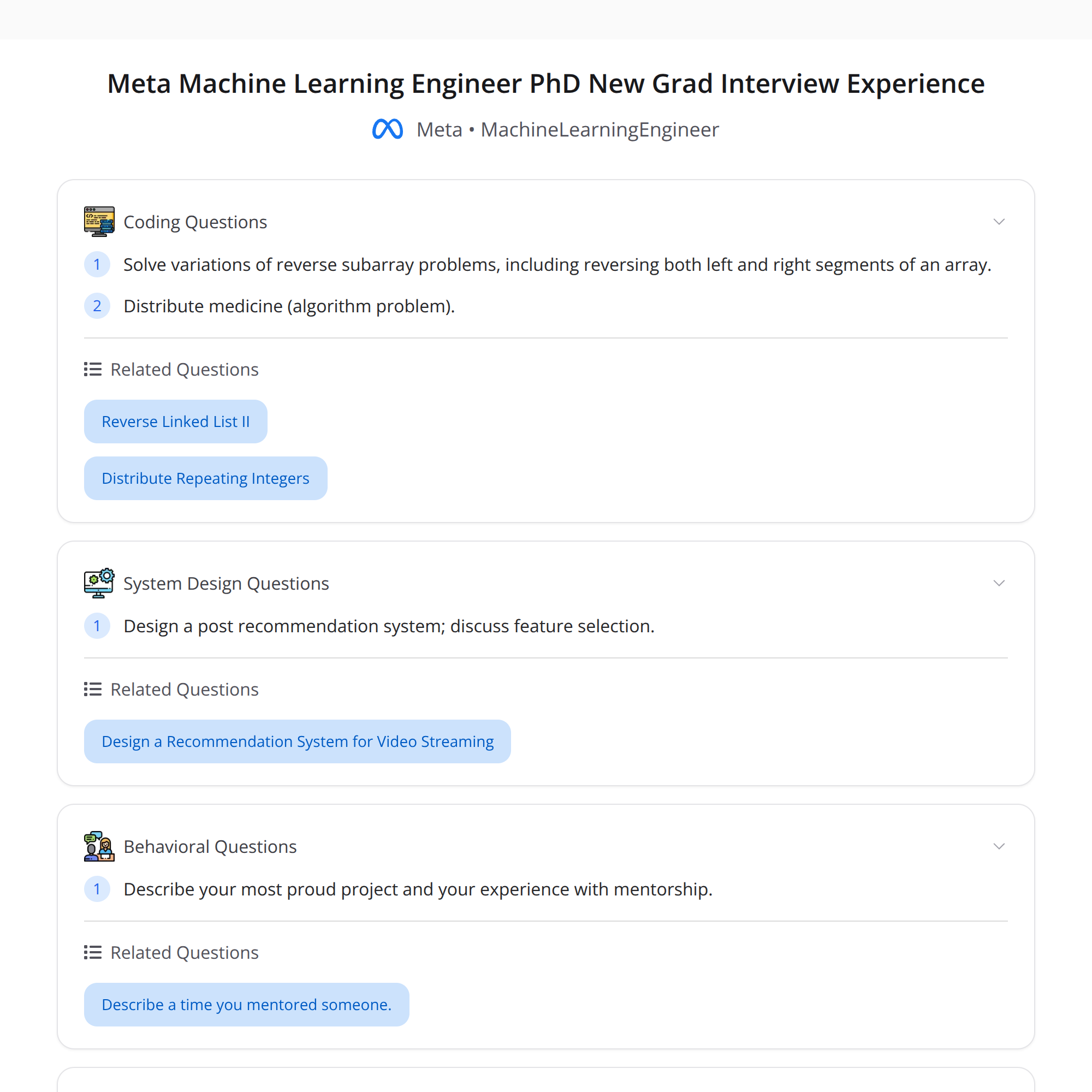
- Phone screen: 2 straightforward algorithm questions (logistics + tree traversal). Same-day pass.
- Virtual onsite system design: post recommendation system (Alex Xu–style). Heavy emphasis on feature selection and structured trade-offs.
- Coding rounds: classic patterns — reverse-subarray variations and a “distributing medicine” style problem (pattern recognition + careful invariants).
- Behavioral: proudest project + mentorship experience; relaxed and conversational.
- Final round: rescheduled but again tested an array segment reversal.
Main takeaway: master core DS&A patterns and recommender-system design fundamentals.
Timeline & Format (what happened)
- HR outreach → phone screen
- Two algo problems: one logistics-style (scheduling/greedy) and one tree-traversal.
- Passed same day.
- Virtual onsite — multi-round
- System design (recommender / post recommendation)
- Two coding interviews (pattern-based array problems)
- Behavioral (project + mentorship)
- Final round (rescheduled): similar array reversal theme
System Design (virtual onsite)
- Prompt: design a post recommendation system (Alex Xu-style).
- Focus areas tested:
- Feature selection: what user/item/context features to include and why.
- Ranking pipeline: candidate generation → ranking → re-ranking.
- Metrics and evaluation: offline metrics, A/B testing considerations, feedback loops.
- Trade-offs: latency vs. model complexity, freshness vs. personalization, offline vs. online training.
- Tip: use a structured framework (requirements → capacity/scale → high-level components → deep dives into one or two components). Be explicit about assumptions and metrics.
Coding Rounds
- Problems fell into well-known patterns rather than novel algorithms:
- Reverse-subarray variations: think transformations on array segments, edge cases, in-place vs. extra-space, and how multiple operations compose.
- "Distributing medicine" style problem: a distribution/greedy or prefix-sum-style reasoning problem that required maintaining invariants.
- How they were evaluated:
- Problem recognition and pattern mapping.
- Correctness and handling edge cases.
- Clean, testable implementation and stepwise optimization.
- Tip: practice the common families (sliding window, two pointers, prefix sums, segment reversals) and be ready to explain time/space trade-offs clearly.
Behavioral
- Format: conversational. Questions included proudest project and mentorship experience.
- Evaluation criteria: communication clarity, impact quantification, collaboration and mentorship style.
- Tip: prepare one or two concise STAR stories focused on impact, trade-offs, and what you learned.
Notable Patterns & Observations
- Repeated theme: array segment reversal appeared multiple times. Interviewers often test small variations of the same core idea.
- System design emphasized feature engineering and evaluation more than low-level ML math.
- Behavioral round was relaxed — strong communication and concrete impact examples go a long way.
Concrete Preparation Checklist
- Master core DS&A patterns: two pointers, sliding window, prefix/suffix sums, segment manipulations.
- Practice problem variations, not just canonical problems — e.g., many reverse-subarray twists.
- Study recommender-system fundamentals: candidate generation, ranking/reranking, metrics, online/offline evaluation.
- Use a structured design approach (requirements → high level → deep dive → trade-offs → metrics).
- Prepare 2–3 STAR behavioral stories emphasizing impact and mentorship.
Final Takeaway
This loop rewarded strong fundamentals: pattern recognition in coding, structured thinking in system design, and clear communication in behavioral rounds. Focus your prep on core DS&A families and recommender-system design basics to maximize chances.
#MachineLearning #SystemDesign #InterviewPrep
About the author
bugfree.ai is an advanced AI-powered platform designed to help software engineers master system design and behavioral interviews. Whether you’re preparing for your first interview or aiming to elevate your skills, bugfree.ai provides a robust toolkit tailored to your needs. Key Features:
150+ system design questions: Master challenges across all difficulty levels and problem types, including 30+ object-oriented design and 20+ machine learning design problems. Targeted practice: Sharpen your skills with focused exercises tailored to real-world interview scenarios. In-depth feedback: Get instant, detailed evaluations to refine your approach and level up your solutions. Expert guidance: Dive deep into walkthroughs of all system design solutions like design Twitter, TinyURL, and task schedulers. Learning materials: Access comprehensive guides, cheat sheets, and tutorials to deepen your understanding of system design concepts, from beginner to advanced. AI-powered mock interview: Practice in a realistic interview setting with AI-driven feedback to identify your strengths and areas for improvement.
bugfree.ai goes beyond traditional interview prep tools by combining a vast question library, detailed feedback, and interactive AI simulations. It’s the perfect platform to build confidence, hone your skills, and stand out in today’s competitive job market. Suitable for:
New graduates looking to crack their first system design interview. Experienced engineers seeking advanced practice and fine-tuning of skills. Career changers transitioning into technical roles with a need for structured learning and preparation.
Comments
Join the discussionNo comments yet. Be the first to comment.