
High-Scoring Meta MLE E6 Interview Experience — Key Takeaways
I recently completed a high-scoring onsite interview for Meta MLE (E6) after being laid off. Preparation was minimal, but the process was challenging and ultimately rewarding. Below I share the structure of the interview, the problems I encountered, and actionable advice to help you prepare.
Interview overview
- Context: Onsite interview for Meta Machine Learning Engineer (E6)
- Preparation: Limited, but focused on core areas
- Outcome: Strong performance across rounds
Rounds and sample problems
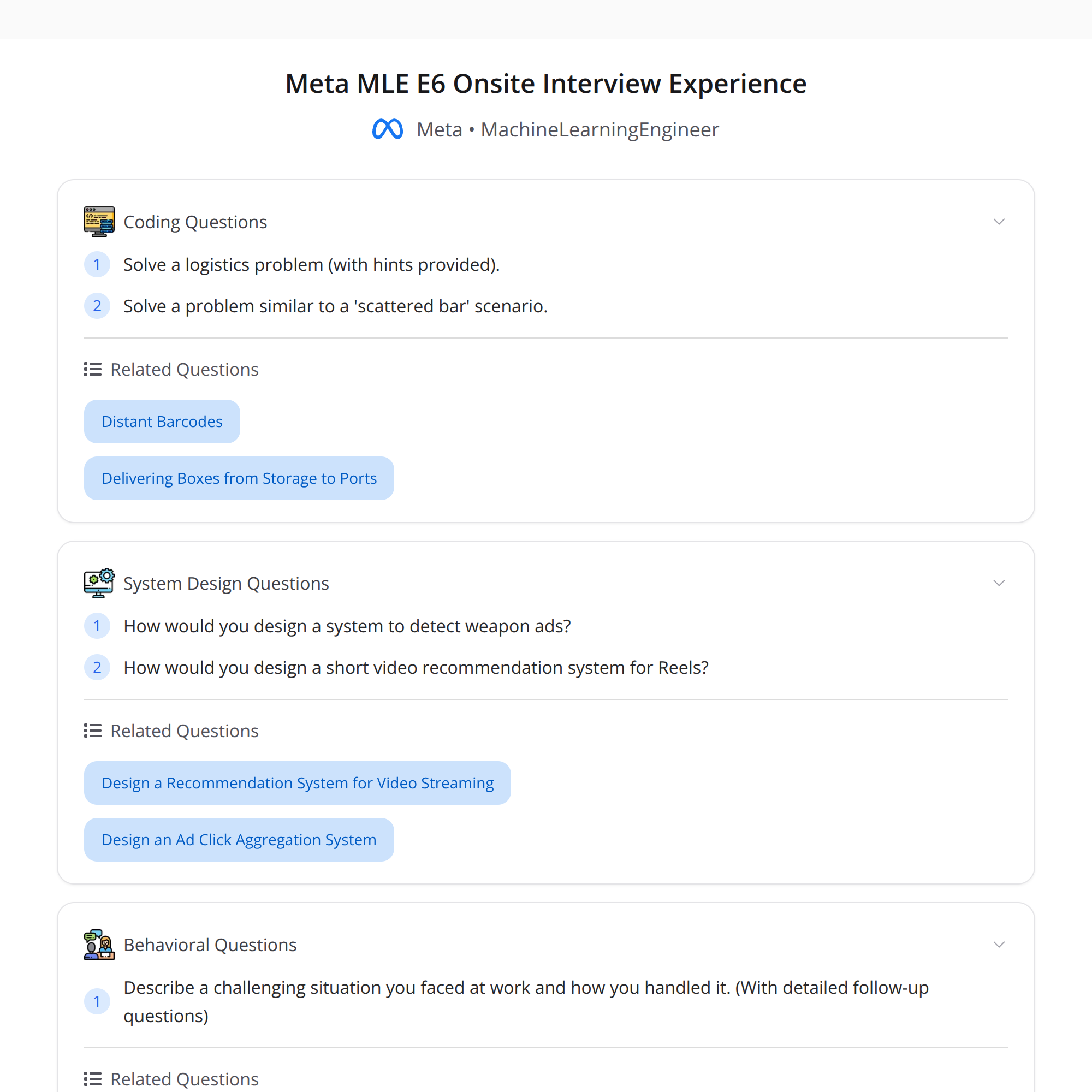
1) Coding rounds
The coding portion included algorithmic and application-oriented problems. Two notable problems:
Logistics-style problem:
- Typical constraints: scheduling, capacity, route planning, or resource allocation.
- Focus on correctness, complexity analysis, and clear explanation of trade-offs.
"Scattered bar" problem:
- A unique, possibly combinatorics/greedy or dynamic programming challenge with a narrative twist.
- Emphasize clarifying assumptions, writing clean pseudocode, and iterating toward an optimal approach.
Tips for coding rounds:
- Ask clarifying questions early (input sizes, edge cases, memory limits).
- Start with a brute-force solution, then optimize with clear reasoning.
- Talk through complexity (time and space) and potential pitfalls.
2) ML System & Model Design
Two concrete prompts I faced:
Weapon ad detection:
- Consider data labeling, class imbalance, false positive vs false negative costs, and moderation policies.
- Discuss model choices (CNNs, vision transformers, transfer learning), pre-processing, and explainability.
- Address deployment concerns: inference latency, content moderation flows, and safety monitoring.
Reels recommendation system:
- Focus on candidate ranking pipeline (candidate generation -> re-ranking -> personalization).
- Cover features (user signals, content signals, contextual signals), cold start strategies, and feedback loops.
- Bring up offline and online evaluation metrics (CTR, watch time, long-term engagement), A/B testing, and causal analysis.
ML design tips:
- Define the objective and success metrics upfront.
- Clarify data availability and labeling strategies.
- Discuss model lifecycle: training, validation, deployment, monitoring, and retraining.
- Talk trade-offs: accuracy vs latency, personalization vs privacy.
3) Behavioral / Leadership
Behavioral questions were intense with deep follow-ups on past experiences. Interviewers probed for ownership, impact, ambiguity resolution, and collaboration.
Behavioral tips:
- Use STAR (Situation, Task, Action, Result) but be ready to dive into any step.
- Quantify impact (metrics improved, time saved, users affected).
- Be honest about failures and emphasize lessons learned.
- Prepare stories around cross-functional partnerships, technical trade-offs, and situations where you influenced outcomes.
General advice & preparation checklist
- Balance technical and soft-skill prep: both are critical for E6.
- Practice system/ML design regularly; sketch diagrams and end-to-end pipelines.
- Do mock interviews that include follow-up depth similar to onsite rounds.
- Study evaluation metrics and experiment design (A/B testing, causality).
- Work on communication: clearly explain assumptions, trade-offs, and next steps.
- Prepare for surprises: interviewers often introduce twists or probe edge cases.
Final thoughts
Coming from a layoff, I found the interview experience energizing and validating. A strong showing requires both technical depth and the ability to tell compelling, impact-oriented stories. Expect the unexpected, practice iteratively, and sharpen both your algorithms and system design muscles.
Good luck — and remember: interviews test thoughtfulness and communication as much as raw knowledge.
#MachineLearning #Meta #InterviewExperience #CareerGrowth
About the author
bugfree.ai is an advanced AI-powered platform designed to help software engineers master system design and behavioral interviews. Whether you’re preparing for your first interview or aiming to elevate your skills, bugfree.ai provides a robust toolkit tailored to your needs. Key Features:
150+ system design questions: Master challenges across all difficulty levels and problem types, including 30+ object-oriented design and 20+ machine learning design problems. Targeted practice: Sharpen your skills with focused exercises tailored to real-world interview scenarios. In-depth feedback: Get instant, detailed evaluations to refine your approach and level up your solutions. Expert guidance: Dive deep into walkthroughs of all system design solutions like design Twitter, TinyURL, and task schedulers. Learning materials: Access comprehensive guides, cheat sheets, and tutorials to deepen your understanding of system design concepts, from beginner to advanced. AI-powered mock interview: Practice in a realistic interview setting with AI-driven feedback to identify your strengths and areas for improvement.
bugfree.ai goes beyond traditional interview prep tools by combining a vast question library, detailed feedback, and interactive AI simulations. It’s the perfect platform to build confidence, hone your skills, and stand out in today’s competitive job market. Suitable for:
New graduates looking to crack their first system design interview. Experienced engineers seeking advanced practice and fine-tuning of skills. Career changers transitioning into technical roles with a need for structured learning and preparation.
Comments
Join the discussionNo comments yet. Be the first to comment.