High-Score Meta Infra IC4 Interview Experience (Bugfree Users)
TL;DR: Meta Infra IC4 moves fast and is heavily LeetCode-patterned. Expect a recruiter call to set logistics, a short tech screen with 2 problems, multiple 45-min coding rounds onsite, and a search/infra-flavored system design. Behavioral questions map to Meta values. No fluff — be calm, structured, and consistent.
Quick overview
- Recruiter call: logistics, expectations, timeline.
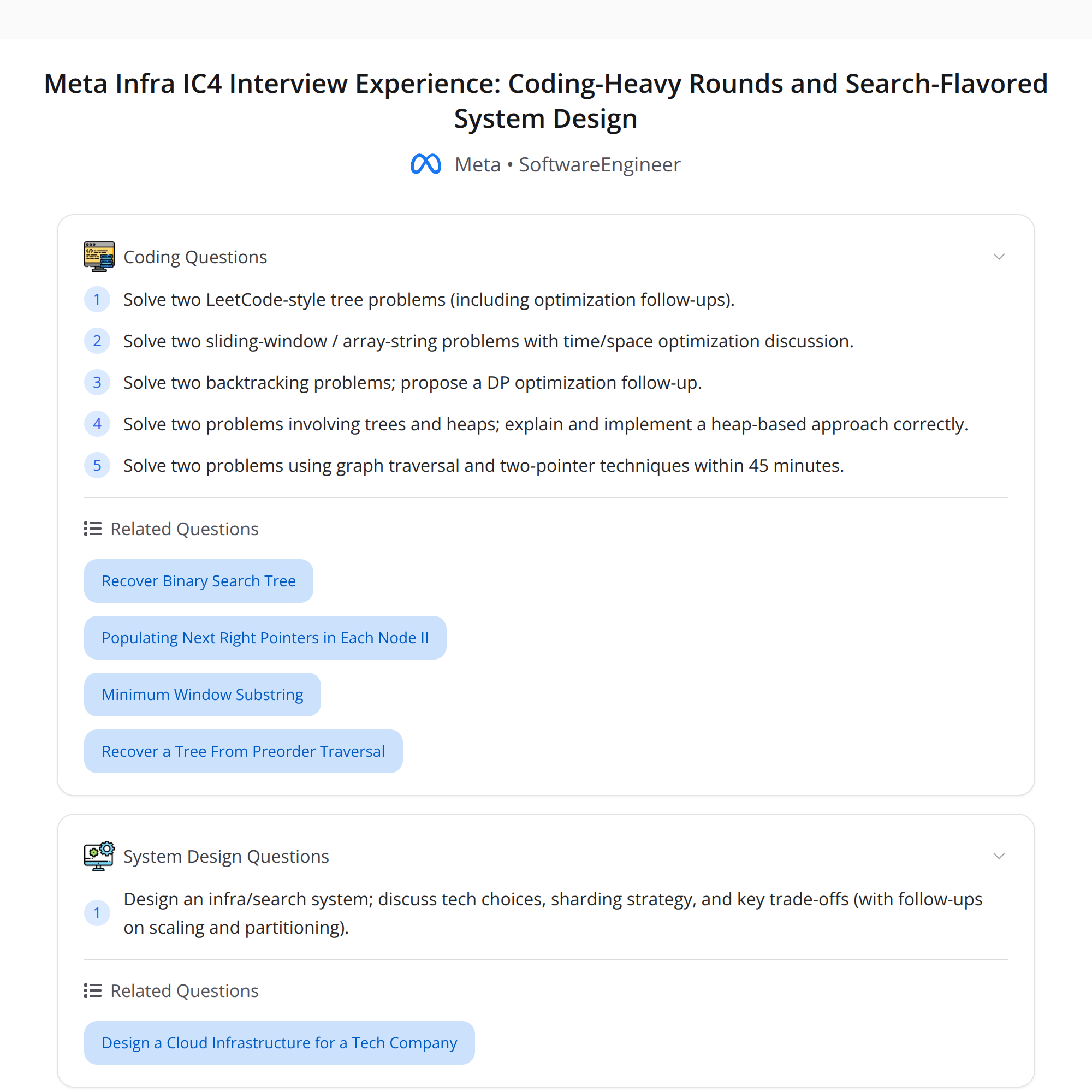
- Tech screen: 2 problems (tree + sliding window), discussion on optimizations.
- Onsite: several 45-minute coding rounds (backtracking, trees/heaps). A describe-vs-implement mismatch caused an extra follow-up round (graphs, two-pointers).
- System design: infra/search-focused. Used the "Hello Interview" structure and emphasized tech choices and sharding.
- Behavioral: aligned to Meta values (feedback, learning, results).
Interview timeline & format
- Recruiter screen — scheduling, role expectations, and logistics.
- Technical phone screen — 2 problems; both were LeetCode-style with optimization-talk.
- Onsite (or virtual onsite) — several 45-minute coding interviews covering:
- Backtracking
- Trees and heaps
- (Follow-up) Graphs and two-pointers
- System design — infra/search flavor, clarified goals, trade-offs, sharding, scaling, SLOs.
- Behavioral — stories aligned to Meta values.
What the coding rounds focused on
- Pattern-first problems: expect classical LeetCode patterns (trees, sliding windows, two-pointers, backtracking).
- Emphasis on clarity: explain approach, write correct baseline solution, then optimize.
- Follow-ups: space/time trade-offs, edge cases, iterative improvement.
Sample pattern mapping and tips:
- Trees: practice recursion, iterative traversals, divide-and-conquer and heap usage for top-k problems.
- Sliding window & two-pointers: master invariant maintenance, window shrinking/expanding logic.
- Backtracking: pruning and early exits; explain branching factor and complexity.
- Graphs: BFS/DFS variants, shortest paths, connectivity; be explicit about visited states and complexity.
The describe-vs-implement mismatch (what happened)
One interviewer wanted a design/description-level approach while another expected a full implementation. This mismatch resulted in an extra follow-up round focusing on coding (graphs, two-pointers). Lesson: clarify the interviewer’s expectations early — ask if they want a high-level design, pseudo, or full implementation.
System design: infra + search flavor
- Structure used: Hello Interview (goal → constraints → high-level → components → trade-offs) worked well.
- What to cover for search/infra roles:
- Query flow and indexing pipeline (indexing latency vs query freshness).
- Sharding and partitioning strategy (by doc ID, by term, or by semantic shard) and rebalancing.
- Replication, fault tolerance, and consistency semantics.
- Caching: per-node query cache, result cache, and invalidation policies.
- Ranking and relevance: offline features vs online signals, feature freshness.
- SLOs and monitoring: latency targets, p95/p99, and fallbacks.
- Storage choices: inverted index, column store, or custom on-disk formats; trade-offs among RocksDB, Lucene, or custom-built indexes.
- Emphasize concrete tech choices and trade-offs rather than abstract wishlists.
Behavioral/values mapping
Meta likes explicit alignment to its values. Prepare short STAR-format stories that show:
- Giving and receiving feedback
- Learning from failure and iterating quickly
- Delivering measurable results and impact
Prep checklist (practical)
- LeetCode: practice medium-hard problems across trees, sliding-window, two-pointers, backtracking, graphs.
- Mock interviews: 45-minute sessions to get comfortable with pacing.
- System design: practice Hello Interview structure; design search services and think about sharding, indexing, and ranking.
- Behavioral: prep 6–8 STAR stories mapped to feedback, learning, and results.
Final tips
- Start by clarifying the problem and constraints. Repeat requirements and edge cases.
- Solve incrementally: naive → correct → optimize. Verbally justify optimizations.
- Always state complexity (time/space) and trade-offs.
- For system design, pick concrete tech and give reasons (latency, throughput, operational complexity).
- If you sense a describe-vs-implement mismatch, ask: "Would you like a high-level design, pseudocode, or a full implementation?"
Key takeaway
Meta Infra interviews are fast, pattern-oriented, and expect concise, structured thinking. Be calm, systematic, and consistent — avoid fluff and focus on clear trade-offs and correctness.
Hashtags: #SoftwareEngineering #InterviewPrep #SystemDesign
About the author
bugfree.ai is an advanced AI-powered platform designed to help software engineers master system design and behavioral interviews. Whether you’re preparing for your first interview or aiming to elevate your skills, bugfree.ai provides a robust toolkit tailored to your needs. Key Features:
150+ system design questions: Master challenges across all difficulty levels and problem types, including 30+ object-oriented design and 20+ machine learning design problems. Targeted practice: Sharpen your skills with focused exercises tailored to real-world interview scenarios. In-depth feedback: Get instant, detailed evaluations to refine your approach and level up your solutions. Expert guidance: Dive deep into walkthroughs of all system design solutions like design Twitter, TinyURL, and task schedulers. Learning materials: Access comprehensive guides, cheat sheets, and tutorials to deepen your understanding of system design concepts, from beginner to advanced. AI-powered mock interview: Practice in a realistic interview setting with AI-driven feedback to identify your strengths and areas for improvement.
bugfree.ai goes beyond traditional interview prep tools by combining a vast question library, detailed feedback, and interactive AI simulations. It’s the perfect platform to build confidence, hone your skills, and stand out in today’s competitive job market. Suitable for:
New graduates looking to crack their first system design interview. Experienced engineers seeking advanced practice and fine-tuning of skills. Career changers transitioning into technical roles with a need for structured learning and preparation.
Comments
Join the discussionNo comments yet. Be the first to comment.