High-score interview experience — Meta E4 Machine Learning Engineer (final round)
A Bugfree user shared their onsite experience for a Meta E4 Machine Learning Engineer final round. The loop consisted of:
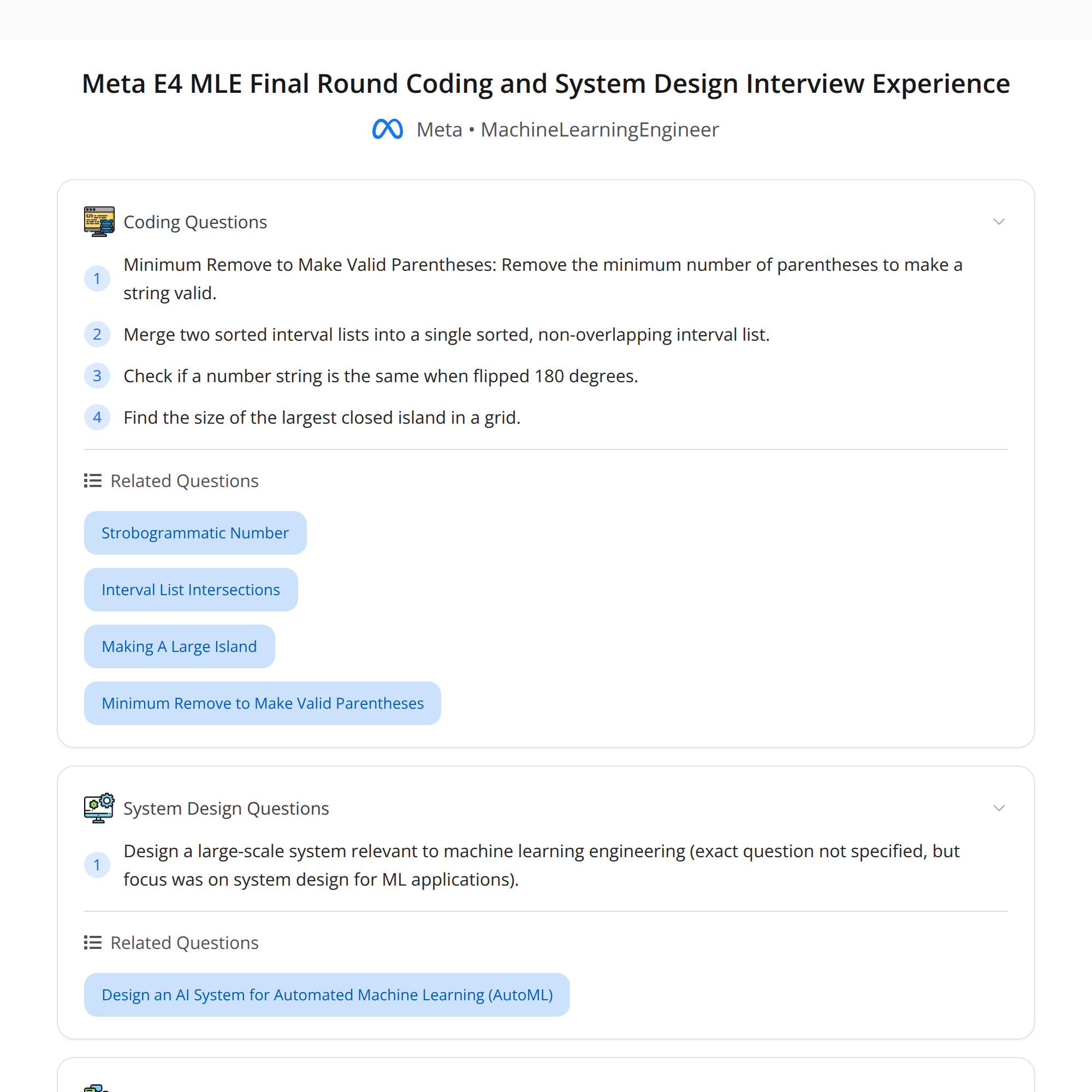
- 2 coding rounds
- 1 behavioral interview
- 1 system design interview (the toughest)
Below I rephrase and expand the highlights, add focused tips, and give a prep plan for the system-design portion which needs deeper work beyond campus-style practice.
Quick summary of the four coding problems
1) Minimize removals to make parentheses valid
- Idea: Use a stack (or two-pass count method) to identify and remove unmatched parentheses. Keep indices of unmatched characters or build the result on the fly.
- Time: O(n), Space: O(n) for index storage (or O(1) extra if you modify in-place with two-pass techniques).
- Key tips: Clarify whether you should remove minimum number of parentheses to make the string valid or return any valid string. Discuss edge cases (empty string, only opens or closes).
2) Merge two sorted interval lists into a non-overlapping output
- Idea: Two pointers through both sorted lists, append and merge overlapping intervals into a result list. Equivalent to merging sorted lists but with interval coalescing.
- Time: O(m + n), Space: O(m + n) for output.
- Key tips: Confirm invariants (are intervals already non-overlapping within each list?). Handle boundary touching vs overlapping (e.g., [1,2] and [2,3] — do they merge?).
3) Strobogrammatic (180° flip) check
- Idea: Check characters pairwise from ends toward center using a mapping: 0↔0, 1↔1, 8↔8, 6↔9, 9↔6. Compare s[i] with mapped s[j].
- Time: O(n), Space: O(1) extra.
- Key tips: Ask if leading zeros or single-digit rules matter. Consider odd length center character allowed only if it maps to itself (0,1,8).
4) Largest closed island in a grid
- Idea: Treat the grid as land/water. A "closed island" is a connected region of land cells not touching the border. Run DFS/BFS from unvisited land cells, track whether the region touches the border and measure size; only count regions that do not touch the border. Return the maximum size.
- Time: O(rows cols), Space: O(rows cols) worst-case recursion/queue.
- Key tips: Mark visited cells to avoid repeats. Edge cases: all border land, no closed islands, tiny grids.
Behavioral interview: what worked
- Strong communication and teamwork stories stood out. Use STAR: Situation, Task, Action, Result.
- Be explicit about your impact (quantify when possible), decisions you owned, trade-offs, and how you collaborated with engineers, product managers, or researchers.
- Prepare stories covering: technical leadership, cross-team friction, a time you failed and what you learned, and a high-impact project you led.
System design: the wake-up call (how to prepare and what to expect)
The candidate reported the system-design interview as the toughest round. Campus-style practice (short, textbook designs) is often not enough for senior ML roles. For Meta E4 MLE, expect questions that probe both large-scale systems thinking and ML-specific concerns.
Focus areas to prepare:
Core components for ML systems:
- Data ingestion and pipelines (batch vs. streaming)
- Data validation, labeling flows, and feature stores
- Model training, versioning, and orchestration (Airflow/Kubeflow concepts)
- Model serving (online vs. batch), latency, and scalability
- Monitoring: performance, data drift, concept drift, and alerting
- A/B testing, canary deployments, and rollback strategies
Non-functional requirements and trade-offs:
- Throughput vs. latency vs. cost
- Consistency of features between training and serving
- Storage choices: feature store, OLAP/warehouse vs. online key-value store
- Fault tolerance, retries, and backpressure
ML-specific considerations:
- Label freshness and labeling pipelines
- Batch scoring vs. streaming inference
- Model explainability, fairness, and reproducibility
- Retraining cadence, automated pipelines, and metrics for triggering retrain
Practical tasks for interview prep:
- Design end-to-end systems: recommender, fraud detection, real-time personalization, or ML feature store
- Sketch clear components on a whiteboard, explain data flow and API contracts
- Practice capacity estimation (QPS, data volume, storage needs)
- Discuss monitoring, alerting, and operational playbooks
- Role-play trade-off discussions—be ready to pick and justify options
Resources to use:
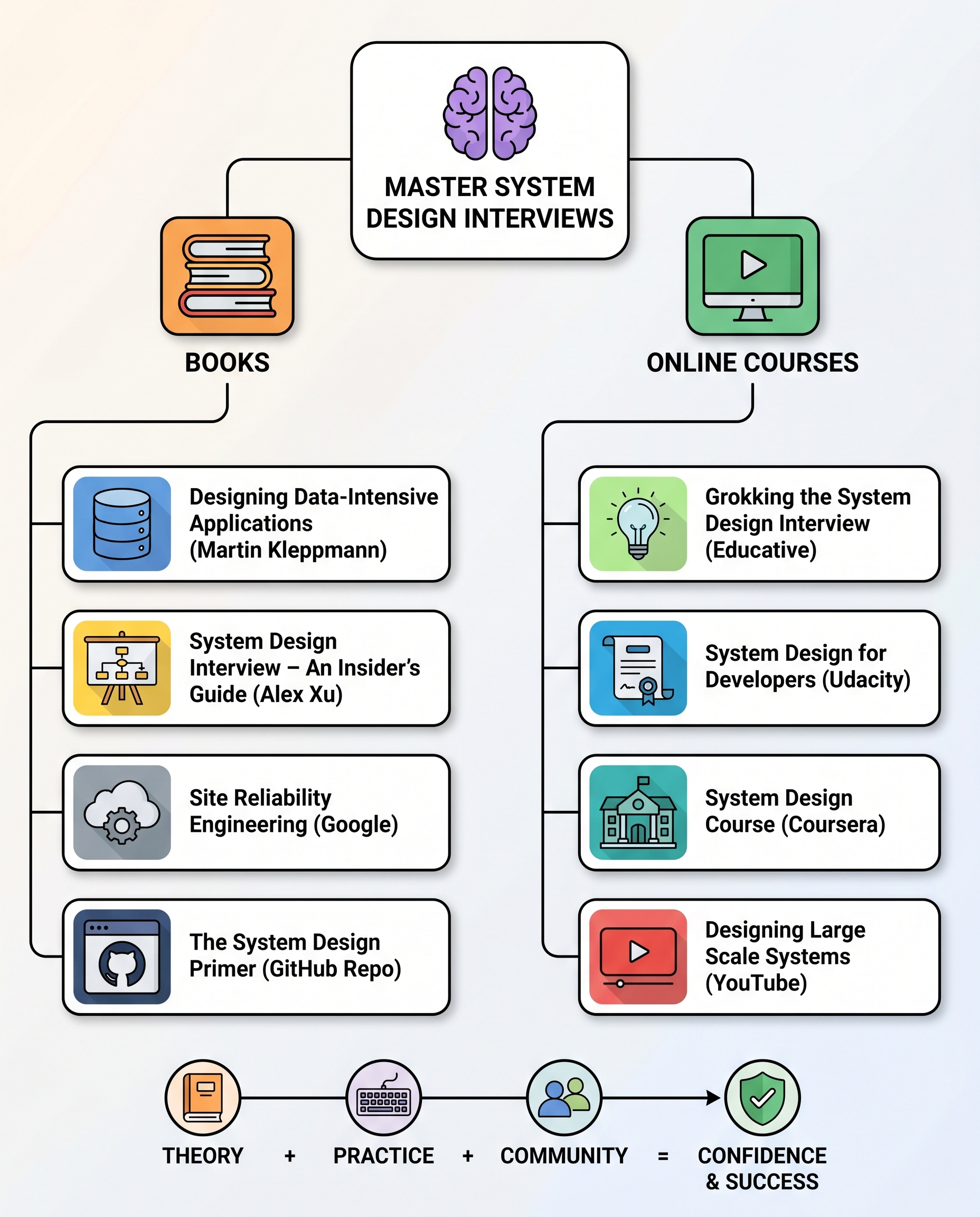
- System design primers focused on ML (articles, YouTube, and design templates)
- Design mock interviews and feedback from senior MLEs or SREs
- Implement or prototype a small end-to-end pipeline (data ingestion → feature store → training → serving)
Practical interview-day tips
- Clarify assumptions early (data size, SLAs, traffic patterns).
- For coding: verbalize the approach, discuss complexity, and handle edge cases before coding.
- For system design: draw components, explain data contracts, and discuss failures and mitigations.
- For behavioral: structure answers (STAR) and quantify outcomes.
- After each interview: reflect and note one improvement area for the next round.
Final takeaways
- Coding rounds rewarded common patterns: stacks, two pointers, DFS/BFS, and careful index handling.
- Behavioral success = clear communication + measurable impact stories.
- System design for senior ML roles requires deeper, practice-driven preparation: focus on end-to-end ML pipelines, operational concerns, and trade-offs.
Good luck — prioritize system design practice early, and keep a repository of strong behavioral stories and coding patterns handy.
#MachineLearning #SystemDesign #InterviewPrep
About the author
bugfree.ai is an advanced AI-powered platform designed to help software engineers master system design and behavioral interviews. Whether you’re preparing for your first interview or aiming to elevate your skills, bugfree.ai provides a robust toolkit tailored to your needs. Key Features:
150+ system design questions: Master challenges across all difficulty levels and problem types, including 30+ object-oriented design and 20+ machine learning design problems. Targeted practice: Sharpen your skills with focused exercises tailored to real-world interview scenarios. In-depth feedback: Get instant, detailed evaluations to refine your approach and level up your solutions. Expert guidance: Dive deep into walkthroughs of all system design solutions like design Twitter, TinyURL, and task schedulers. Learning materials: Access comprehensive guides, cheat sheets, and tutorials to deepen your understanding of system design concepts, from beginner to advanced. AI-powered mock interview: Practice in a realistic interview setting with AI-driven feedback to identify your strengths and areas for improvement.
bugfree.ai goes beyond traditional interview prep tools by combining a vast question library, detailed feedback, and interactive AI simulations. It’s the perfect platform to build confidence, hone your skills, and stand out in today’s competitive job market. Suitable for:
New graduates looking to crack their first system design interview. Experienced engineers seeking advanced practice and fine-tuning of skills. Career changers transitioning into technical roles with a need for structured learning and preparation.
Comments
Join the discussionNo comments yet. Be the first to comment.