High-Score Meta E4 Interview Experience — Phone Screen & Onsite Highlights
Posted by Bugfree Users — High-Score Interview Experience
This post summarizes a recent Meta (E4) interview experience: what the phone screen looked like, what showed up onsite, how points were earned, and the mindset that helped. If you're prepping, this is a concise, practical checklist and set of takeaways.
Quick overview
- Phone screen: fast LeetCode-style problems where speed and clear narration mattered.
- Onsite: multiple coding rounds, a system design session, and a behavioral interview.
- Themes that scored: structured problem-solving, trade-off discussion, crisp communication, and solid CS fundamentals.
Phone screen — structure & tips
What happened
- Problems were LeetCode-like and timed.
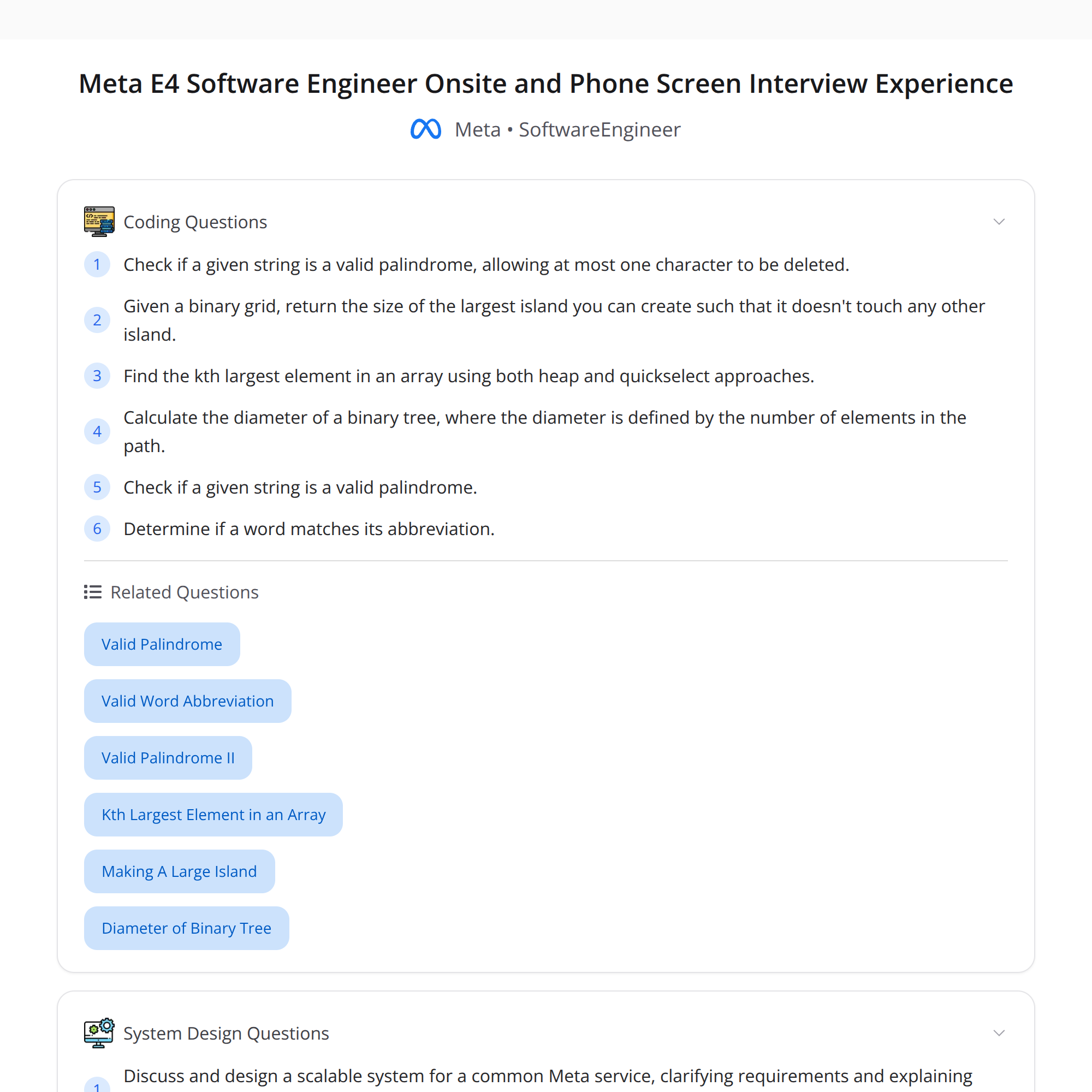
- Typical prompts: palindrome variants (e.g., alphanumeric palindrome, ignoring cases/punctuation) and variants of "number of islands" (grid DFS/BFS variants).
What helped
- Start with clarifying questions immediately (input size, allowed characters, edge cases).
- Outline the approach before coding: explain algorithm idea and time/space complexity up front.
- Narrate as you code: say what each block is doing and why (keeps the interviewer aligned and demonstrates thought process).
- Run quick dry-runs on small examples and handle edge cases.
Why this matters
- Speed matters, but a clear narration often matters more than finishing every edge-case perfectly. Interviewers want to see how you reason under time constraints.
Onsite — coding rounds
Round highlights
- Kth largest element: discussed both heap and quickselect solutions. Calling out trade-offs earned points.
- Binary tree diameter: implemented a DFS-based solution that computes height and diameter in one traversal.
Kth largest — trade-off summary
- Min-heap of size k: O(n log k) time, O(k) space. Simple, predictable, good for streaming data.
- Quickselect: average O(n) time, O(1) extra space, but worst-case O(n^2) unless randomized/median-of-medians used. Faster average-case but riskier without randomization.
- Saying when you'd pick each approach (memory constraints, streaming vs random-access) demonstrates practical judgement.
Binary tree diameter — approach
- Use a single DFS that returns subtree height while updating a global max diameter: O(n) time, O(h) recursion space.
- Explain correctness and prove by reasoning about longest path passing through a node = left height + right height.
Scoring tips
- When you choose an algorithm, explicitly discuss complexity and memory trade-offs.
- If you change approach, explain why you pivot.
- Test on small examples and cover edge cases (empty tree, single node, duplicates in arrays).
System design — expectations & approach
What they looked for
- Clarifying requirements first (functional vs non-functional requirements, scale targets, success metrics).
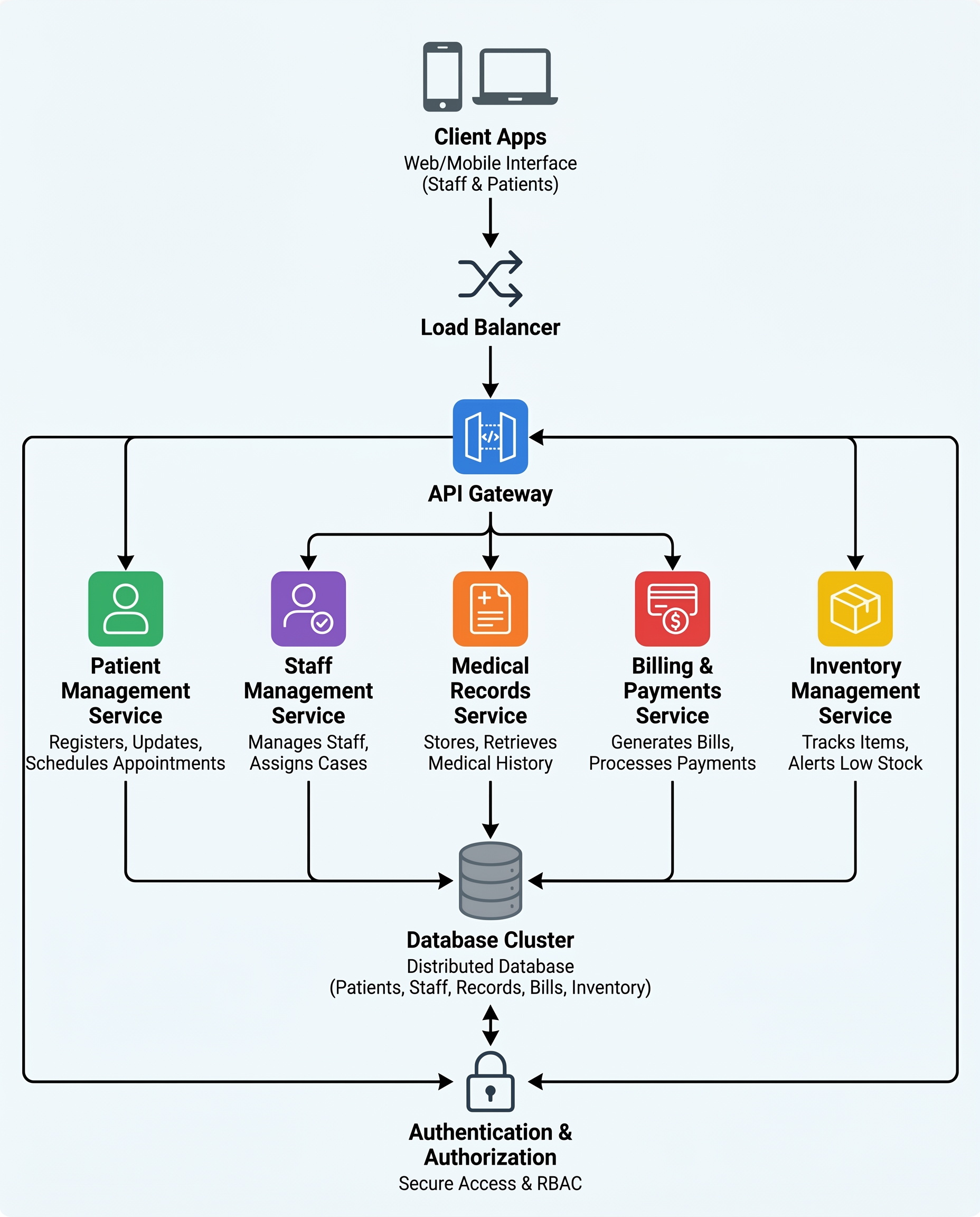
- Breaking the system into components (API, data storage, caching, load balancing, background processing).
- Communicating trade-offs (consistency vs availability, sharding keys, cache invalidation strategies).
A concise approach to follow
- Clarify scope and constraints (traffic, read/write ratio, latency, storage limits).
- Sketch high-level components and data flow.
- Dive into key components (data model, API design, caching, partitioning, failure modes).
- Discuss scaling strategies and bottlenecks (CDN, caching tier, database partitioning, async processing).
- Surface open questions and trade-offs rather than pretending to know every micro-detail.
What scores well
- Asking the right clarifying questions early.
- Prioritizing components (what matters at target scale) and identifying bottlenecks.
- Communicating trade-offs in plain language and justifying choices with real constraints.
Behavioral — prep tips
What to prepare
- Several STAR stories (Situation, Task, Action, Result) that show leadership, problem solving, conflict resolution, and ownership.
- Honest reflection on failures and what you learned — interviewers appreciate self-awareness.
How to present
- Keep answers structured and concise. Start with a one-line summary, then give details, and end with the outcome and lessons.
Key takeaways
- Structured problem-solving + crisp communication = big wins.
- Explain trade-offs when proposing solutions — interviewers are evaluating judgment as much as correctness.
- Demonstrate core CS fundamentals (algorithms, data structures, complexity analysis).
- For system design, clarify requirements first, then focus on the biggest bottlenecks and scaling strategies.
- Behavioral interviews reward honest, specific stories with clear impact.
Quick interview checklist
- Before coding: ask clarifying questions, state approach, mention complexity.
- While coding: narrate, write clean code, and handle edge cases.
- After coding: run through examples, explain runtime/memory, and mention optimizations.
- System design: clarify scope, sketch architecture, discuss trade-offs, and identify bottlenecks.
- Behavioral: use STAR; be concise and reflective.
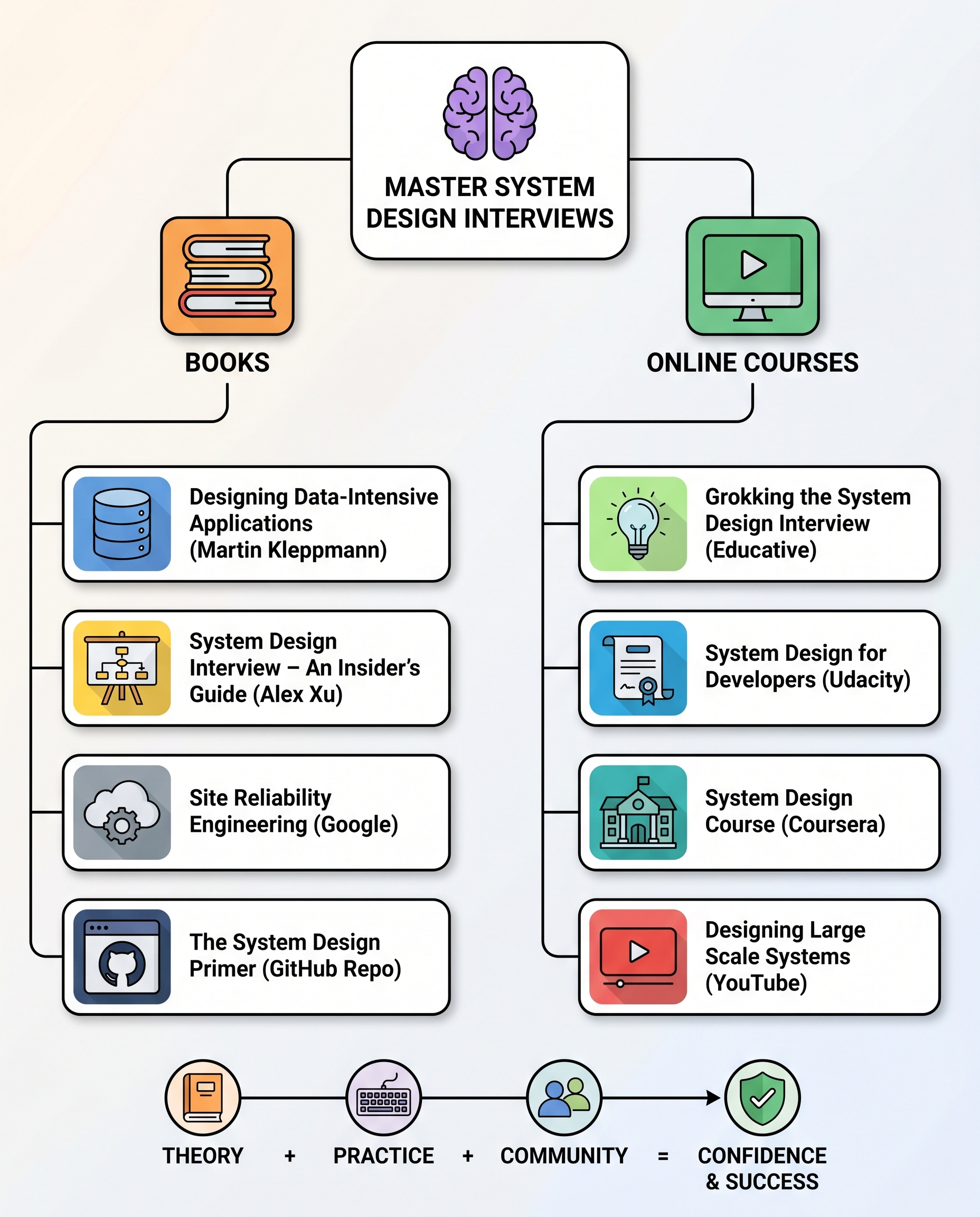
Practice resources
- LeetCode — practice timed problems and common patterns (DFS/BFS, two pointers, heaps, quickselect).
- System Design Primer (GitHub) — for structured design walkthroughs.
- "Cracking the Coding Interview" — for fundamentals and common behavioral prompts.
Final thoughts
This Meta E4 experience reinforced that interview success is a mix of speed, clarity, and judgement. Practice writing out explanations as you code, rehearse STAR stories, and regularly review trade-offs in algorithms and system design. Good luck!
#SoftwareEngineering #SystemDesign #InterviewPrep
About the author
bugfree.ai is an advanced AI-powered platform designed to help software engineers master system design and behavioral interviews. Whether you’re preparing for your first interview or aiming to elevate your skills, bugfree.ai provides a robust toolkit tailored to your needs. Key Features:
150+ system design questions: Master challenges across all difficulty levels and problem types, including 30+ object-oriented design and 20+ machine learning design problems. Targeted practice: Sharpen your skills with focused exercises tailored to real-world interview scenarios. In-depth feedback: Get instant, detailed evaluations to refine your approach and level up your solutions. Expert guidance: Dive deep into walkthroughs of all system design solutions like design Twitter, TinyURL, and task schedulers. Learning materials: Access comprehensive guides, cheat sheets, and tutorials to deepen your understanding of system design concepts, from beginner to advanced. AI-powered mock interview: Practice in a realistic interview setting with AI-driven feedback to identify your strengths and areas for improvement.
bugfree.ai goes beyond traditional interview prep tools by combining a vast question library, detailed feedback, and interactive AI simulations. It’s the perfect platform to build confidence, hone your skills, and stand out in today’s competitive job market. Suitable for:
New graduates looking to crack their first system design interview. Experienced engineers seeking advanced practice and fine-tuning of skills. Career changers transitioning into technical roles with a need for structured learning and preparation.
Comments
Join the discussionNo comments yet. Be the first to comment.