High Score Meta E4 Interview Experience: Insights from a Bugfree User
I just finished the full-loop Meta E4 Software Engineer interview — and walked away with a high score. The process was intense but highly structured: two coding rounds, a system design interview, and a behavioral discussion focused on Meta’s core values. Below are the highlights, lessons learned, and practical tips to help other engineers prepare.
Quick overview
- Interview type: Meta E4 (full loop)
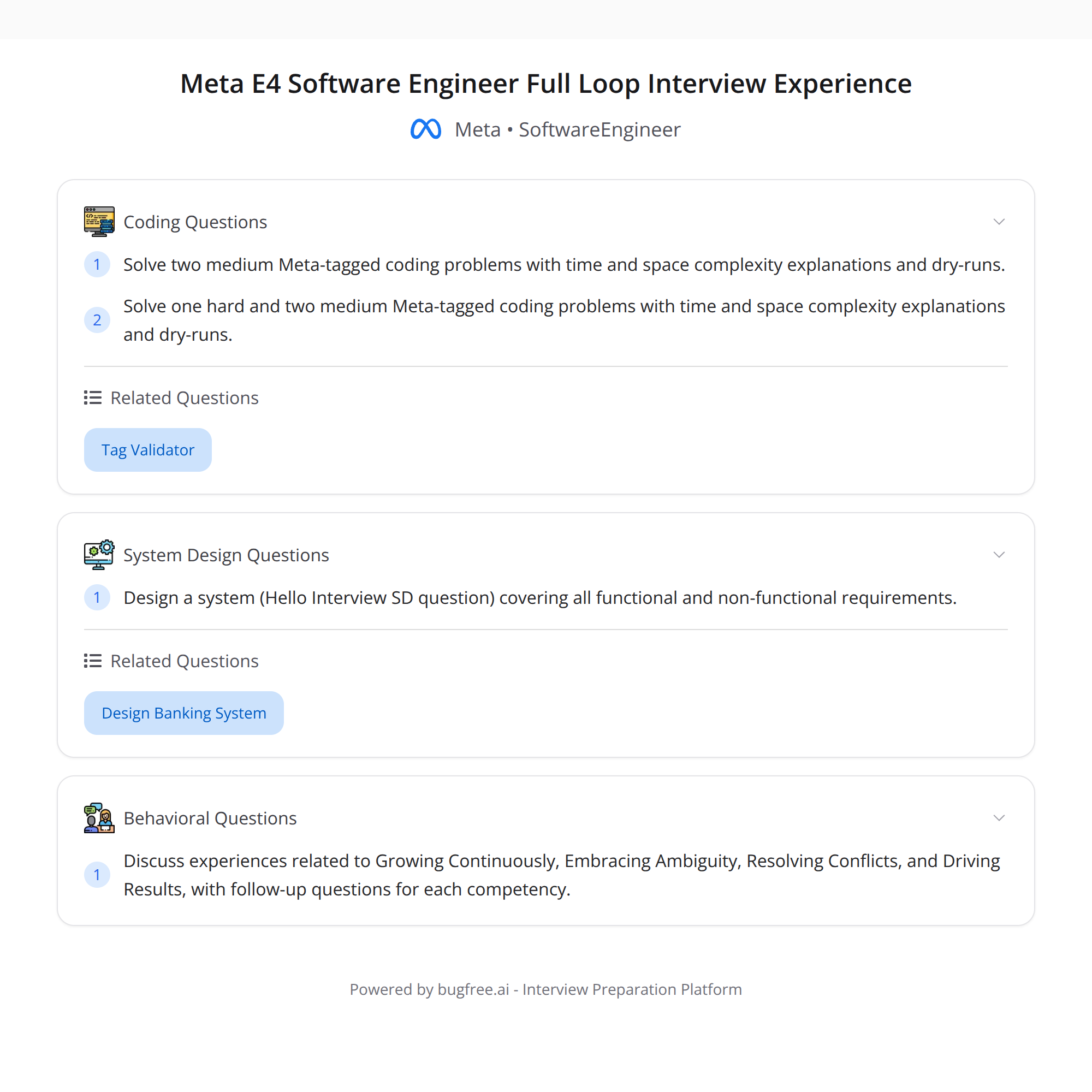
- Rounds: 2 coding interviews, 1 system design, 1 behavioral
- Outcome: Solved all coding problems, covered design requirements and scalability, and completed the behavioral round with clear alignment to Meta values
What each round looked like
Coding rounds
- Two rigorous algorithmic problems.
- I solved both and explained my thought process, trade-offs, and complexity analysis.
- Emphasis was on correctness, clarity, and communicating decisions.
System design
- Covered requirements, high-level architecture, components, data flow, and scalability.
- Discussed bottlenecks, databases, caching, data partitioning, and how to evolve the system over time.
Behavioral
- Focused on Meta’s core values and leadership principles.
- Expect questions that probe impact, ownership, collaboration, and conflict resolution.
What helped me perform well
- Communication: Narrate your thinking. Talk through failure cases and why you choose one approach over another.
- Time management: For coding rounds, quickly outline your plan before implementing. For design, structure the conversation: requirements → constraints → components → trade-offs.
- Clarity on trade-offs: Explain choices (e.g., SQL vs NoSQL, consistency vs availability, caching layer) and when you'd change them.
- Examples in behavioral: Use specific, impact-oriented stories with clear context, action, and measurable results.
Practical tips to prepare
Coding practice
- Solve medium-to-hard problems on LeetCode and practice explaining solutions out loud.
- Focus on common patterns: two pointers, sliding window, DFS/BFS, dynamic programming, heaps, and hash maps.
System design
- Practice designing end-to-end systems (e.g., feed systems, messaging, URL shortener) with emphasis on scalability.
- Study bottlenecks: load balancing, sharding, replication, caching, eventual consistency.
Behavioral
- Prepare 6–8 STAR-format stories showing ownership, impact, and collaboration.
- Tie examples to metrics when possible (e.g., reduced latency by X%, increased throughput by Y%).
Mock interviews
- Do timed mocks with peers or interview platforms to simulate pressure and improve communication.
Common pitfalls to avoid
- Rushing to code without a clear plan.
- Ignoring edge cases or not writing complexity analysis.
- Overdesigning in system design without prioritizing core requirements.
- Vague behavioral answers lacking concrete outcomes.
Final thoughts
This interview loop is challenging but fair. If you can communicate clearly, reason about trade-offs, and support your answers with concrete examples, you’ll be in a strong position. Good luck — hope these notes help you prepare and feel more confident going into a Meta interview!
#MetaInterview #SoftwareEngineering #InterviewTips #BugfreeExperience
About the author
bugfree.ai is an advanced AI-powered platform designed to help software engineers master system design and behavioral interviews. Whether you’re preparing for your first interview or aiming to elevate your skills, bugfree.ai provides a robust toolkit tailored to your needs. Key Features:
150+ system design questions: Master challenges across all difficulty levels and problem types, including 30+ object-oriented design and 20+ machine learning design problems. Targeted practice: Sharpen your skills with focused exercises tailored to real-world interview scenarios. In-depth feedback: Get instant, detailed evaluations to refine your approach and level up your solutions. Expert guidance: Dive deep into walkthroughs of all system design solutions like design Twitter, TinyURL, and task schedulers. Learning materials: Access comprehensive guides, cheat sheets, and tutorials to deepen your understanding of system design concepts, from beginner to advanced. AI-powered mock interview: Practice in a realistic interview setting with AI-driven feedback to identify your strengths and areas for improvement.
bugfree.ai goes beyond traditional interview prep tools by combining a vast question library, detailed feedback, and interactive AI simulations. It’s the perfect platform to build confidence, hone your skills, and stand out in today’s competitive job market. Suitable for:
New graduates looking to crack their first system design interview. Experienced engineers seeking advanced practice and fine-tuning of skills. Career changers transitioning into technical roles with a need for structured learning and preparation.
Comments
Join the discussionNo comments yet. Be the first to comment.