High-Score Meta Data Engineer Interview (Bugfree Users): SQL + Python + Behavioral Wins
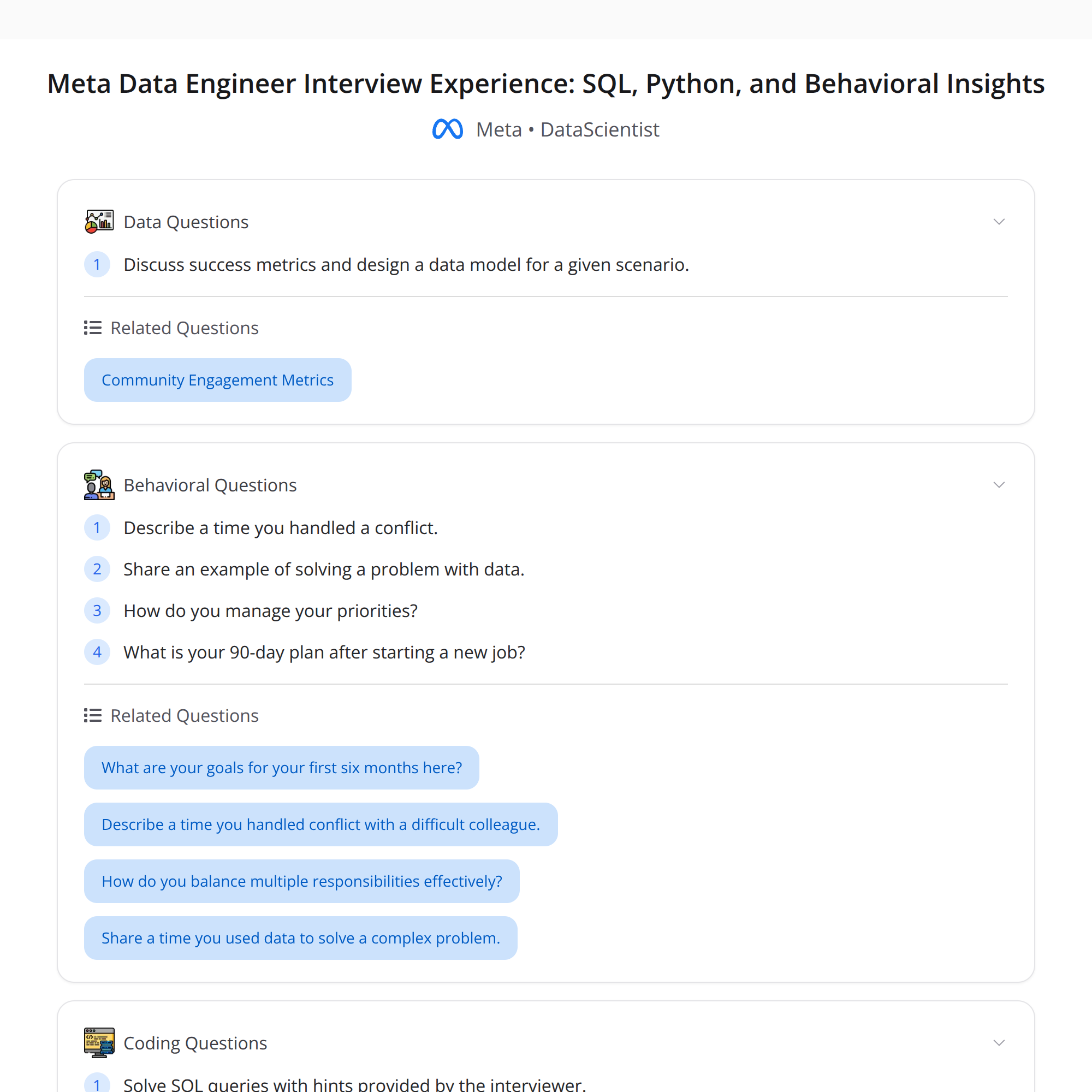
I just finished a high-score Meta Data Engineer loop (shared by Bugfree users). The loop was 3 technical rounds followed by 1 behavioral — here’s a concise, practical recap so you can prep efficiently.
Quick summary
- 3 technical rounds (SQL, Python, metrics/modeling) + 1 behavioral
- Expect ~2 problems per section
- SQL and Python dominate; modeling and metrics are checked but lighter
- Interviewers range from fast-paced managers to detail-oriented senior engineers
Round-by-round breakdown
Round 1 — "Netflix-style" (fast-paced manager)
- Format: quick, high-energy; interviewer gives hints and nudges.
- Focus: SQL + Python, split into two parts; they expect you to clarify ambiguities fast.
- Tips:
- Ask clarifying questions immediately (data types, null semantics, expected output format).
- Verbalize your approach before coding.
- If given partial results/hints, incorporate them and explain why.
Round 2 — "Uber-style" (metrics + light data modeling)
- Format: calm, allows quiet thinking time; one or two metric-design or modeling questions.
- Focus: define metrics, edge cases, and small data model decisions.
- Tips:
- Start by defining the metric precisely (time windows, dedup rules, joins).
- Sketch a minimal schema or aggregate plan before computing.
- Expect straightforward execution — correctness and clarity > cleverness.
Round 3 — "Reels" (senior, detail-oriented)
- Format: deep, detail-focused; expects fully correct SQL/Python and catches small mistakes.
- Focus: correctness, edge cases, performance considerations.
- Tips:
- Double-check joins, group-bys, handling of NULLs, and boundary conditions.
- Explain complexity and possible optimizations (indexes, partitioning).
- Run through small examples to validate logic.
Behavioral round
- Topics: conflict resolution, prioritization, data-driven problem solving, and a 90-day plan.
- Tips:
- Structure answers with STAR (Situation, Task, Action, Result).
- For prioritization questions, show frameworks (impact vs. effort, stakeholder alignment).
- For the 90-day plan, present a clear, realistic sequence: learn the stack → identify quick wins → propose improvements.
What to expect (common patterns)
- SQL + Python are the core — most interviewers will ask multiple problems in each.
- Data modeling and metric design are typically lighter checks.
- Interviewers often expect 2 questions per section or two subproblems in one prompt.
- Small mistakes (missing a join condition, off-by-one) can be caught — be methodical.
Example question types & how to approach them
SQL examples:
- Aggregation with edge cases: "Compute daily active users (DAU) from event logs, dedupe by user_id per day."
- Approach: clarify timezone, dedupe rule, what counts as active; show query with GROUP BY and window or distinct count.
- Funnel or retention: "Given events with timestamps, compute 7-day retention."
- Approach: define cohorts, time windows, show JOIN logic or windowed aggregation.
Python examples:
- Data munging: "Given CSVs, join, filter, and compute a metric; handle missing values."
- Approach: outline steps (read → validate → join → aggregate), write clear idiomatic code, handle edge cases.
- Algorithmic/data-structure small tasks: simple sliding windows or parsing tasks; optimize for clarity and correctness.
Modeling/metrics:
- Define the metric precisely (e.g., active user definition, sessionization rules).
- Explain schema choices and what trade-offs you made.
Behavioral prompts (examples):
- "Describe a time you disagreed with a stakeholder. How did you resolve it?"
- "How would you prioritize five data quality issues?"
- "What would you do in the first 90 days on the team?"
Practical prep checklist
- Brush up core SQL: window functions, joins, GROUP BY, DISTINCT, CTEs, handling NULLs.
- Practice Python for data tasks: pandas basics, reading/writing, groupby, apply, defensive checks.
- Review metrics & data modeling basics: cohort definitions, dedupe rules, event/session logic.
- Mock interviews: run 2-problem sessions under time pressure.
- Prepare 3-4 behavioral stories using STAR and a concise 90-day plan.
Final takeaways
- SQL and Python are the gates — be confident, clear, and methodical.
- Clarify ambiguities early; interviewers reward good questions.
- Practice small examples and verify edge cases; tiny mistakes can be decisive.
- Keep behavioral answers structured and measurable.
If you'd like, I can:
- Turn this into a 2-week study plan
- Generate 6 practice problems (SQL + Python) with solutions
- Help you craft STAR-format behavioral answers and a 90-day plan
Good luck — you’ve got this!
#DataEngineering #SQL #InterviewPrep
About the author
bugfree.ai is an advanced AI-powered platform designed to help software engineers master system design and behavioral interviews. Whether you’re preparing for your first interview or aiming to elevate your skills, bugfree.ai provides a robust toolkit tailored to your needs. Key Features:
150+ system design questions: Master challenges across all difficulty levels and problem types, including 30+ object-oriented design and 20+ machine learning design problems. Targeted practice: Sharpen your skills with focused exercises tailored to real-world interview scenarios. In-depth feedback: Get instant, detailed evaluations to refine your approach and level up your solutions. Expert guidance: Dive deep into walkthroughs of all system design solutions like design Twitter, TinyURL, and task schedulers. Learning materials: Access comprehensive guides, cheat sheets, and tutorials to deepen your understanding of system design concepts, from beginner to advanced. AI-powered mock interview: Practice in a realistic interview setting with AI-driven feedback to identify your strengths and areas for improvement.
bugfree.ai goes beyond traditional interview prep tools by combining a vast question library, detailed feedback, and interactive AI simulations. It’s the perfect platform to build confidence, hone your skills, and stand out in today’s competitive job market. Suitable for:
New graduates looking to crack their first system design interview. Experienced engineers seeking advanced practice and fine-tuning of skills. Career changers transitioning into technical roles with a need for structured learning and preparation.
Comments
Join the discussionNo comments yet. Be the first to comment.