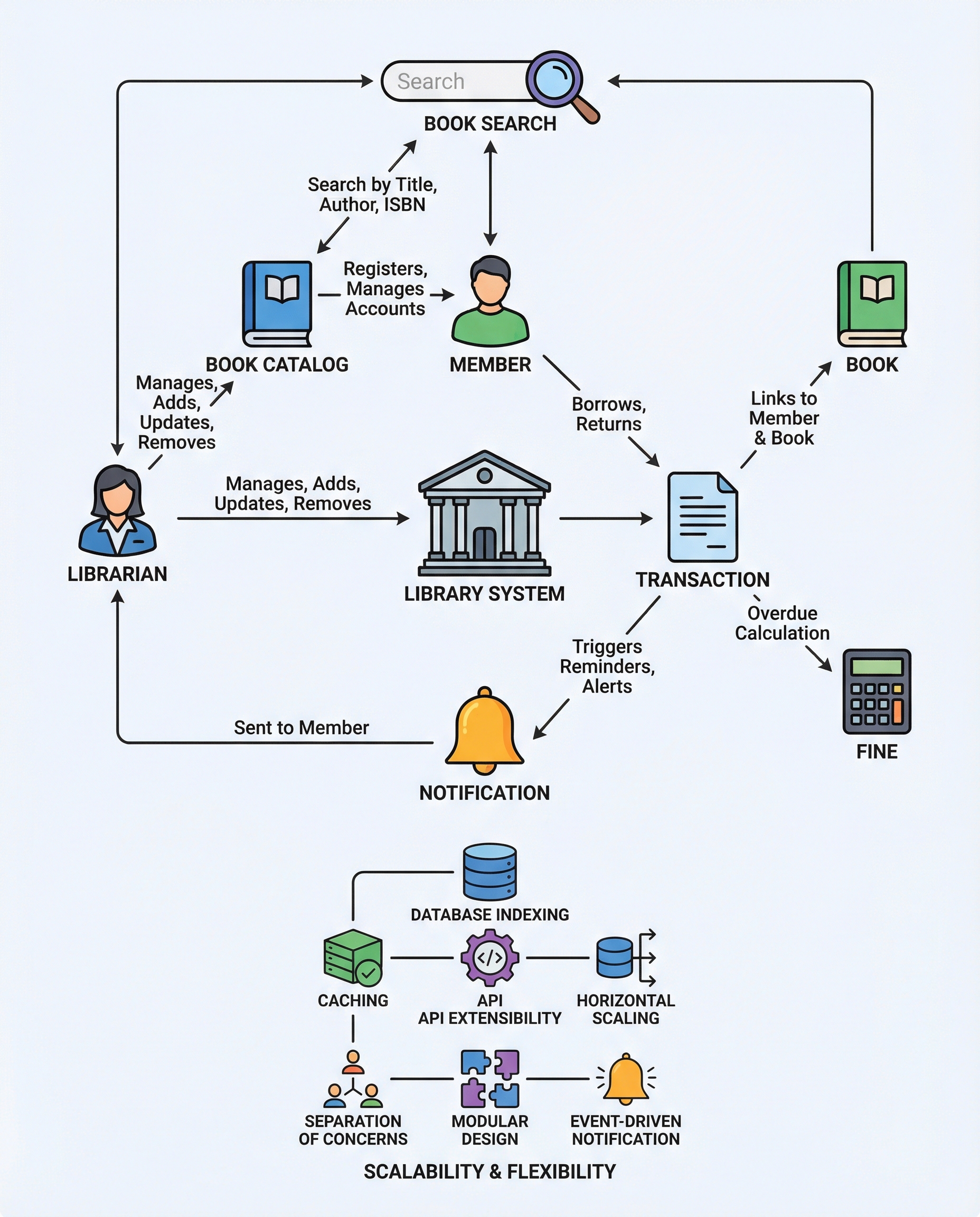
In a Library Management System design, one decision separates a thoughtful OOD answer from a guess: model borrowing as a Transaction object — not as a boolean "available" flag on Book.
The core idea
The Book's availability should be derived, not stored. The single source of truth is a Transaction that links Member ↔ Book and records borrowDate, dueDate, returnDate, and fine (if any). That Transaction object:
- Provides auditability: who borrowed what and when.
- Answers runtime questions: "Who has this book now?" or "What is this member currently holding?".
- Enables overdue and fine logic cleanly (compute based on dueDate and returnDate).
- Prevents inconsistent state when failures happen during return/checkout, because state changes happen inside a single transaction object rather than scattered flags.
If you can't clearly explain why Transaction is the core, you're designing by guessing — not by modeling the domain.
Why not a Book.available flag?
- Derived state: availability is a result of active Transactions, not an independent truth.
- Race and failure conditions: toggling a flag during checkout/return can leave the system inconsistent if the process fails mid-way.
- No history: flags don't tell you who had the book previously or when it was returned.
- Complex queries become harder: answering "which member currently has book X?" is direct with Transactions but requires joins/extra bookkeeping with flags.
What a Transaction typically contains
- transactionId
- bookId (or Book reference)
- memberId (or Member reference)
- borrowDate
- dueDate
- returnDate (nullable)
- fine (computed or stored)
- status (CHECKED_OUT, RETURNED, LOST, etc.)
Example (pseudo-code):
class Transaction {
  UUID id;
  Member member;
  Book book;
  LocalDate borrowDate;
  LocalDate dueDate;
  LocalDate returnDate; // null until returned
  Money fine;
  TransactionStatus status; // CHECKED_OUT, RETURNED, LOST
}

// Derived availability
boolean isBookAvailable(Book book) {
  return !exists(Transaction t where t.book == book && t.status == CHECKED_OUT);
}
How to explain this in an interview (quick script)
- State the thesis: "Borrowing should be modeled as a Transaction object, not a flag on Book."
- Explain the source-of-truth reasoning: "Availability is derived from active transactions."
- List benefits briefly: auditability, consistent state, simpler overdue/fine logic, easier queries.
- Optionally sketch the Transaction fields and how availability is derived.
That concise line — plus a quick example — demonstrates domain thinking and shows you understand consistency, auditability, and failure modes.
Bottom line
Treat borrowing as a first-class Transaction. It's the relationship interviewers actually test: can you model domain state correctly and reason about derived state, consistency, and failures?
#SystemDesign #OOP #SoftwareEngineering
About the author
bugfree.ai is an advanced AI-powered platform designed to help software engineers master system design and behavioral interviews. Whether you’re preparing for your first interview or aiming to elevate your skills, bugfree.ai provides a robust toolkit tailored to your needs. Key Features:
150+ system design questions: Master challenges across all difficulty levels and problem types, including 30+ object-oriented design and 20+ machine learning design problems. Targeted practice: Sharpen your skills with focused exercises tailored to real-world interview scenarios. In-depth feedback: Get instant, detailed evaluations to refine your approach and level up your solutions. Expert guidance: Dive deep into walkthroughs of all system design solutions like design Twitter, TinyURL, and task schedulers. Learning materials: Access comprehensive guides, cheat sheets, and tutorials to deepen your understanding of system design concepts, from beginner to advanced. AI-powered mock interview: Practice in a realistic interview setting with AI-driven feedback to identify your strengths and areas for improvement.
bugfree.ai goes beyond traditional interview prep tools by combining a vast question library, detailed feedback, and interactive AI simulations. It’s the perfect platform to build confidence, hone your skills, and stand out in today’s competitive job market. Suitable for:
New graduates looking to crack their first system design interview. Experienced engineers seeking advanced practice and fine-tuning of skills. Career changers transitioning into technical roles with a need for structured learning and preparation.
Comments
Join the discussionNo comments yet. Be the first to comment.