Java OOD Interviews: Stop Memorizing—Start Designing
Memorizing code snippets won't get you far in Java object-oriented design (OOD) interviews. Interviewers are evaluating how you think about design: how you identify responsibilities, choose abstractions, and defend trade-offs. Focus on principles, apply Java's tools correctly, and communicate clearly.
Think in Principles, Not Snippets
Start from the fundamentals. The four pillars of OOP should guide your decisions:
- Encapsulation — keep state private and expose behaviour through well-defined methods.
- Abstraction — hide implementation details behind interfaces or abstract classes.
- Inheritance — use only when there's a clear "is-a" relationship; prefer composition otherwise.
- Polymorphism — design systems that operate on abstractions, not concrete classes.
When you answer, explicitly mention which principles you’re using and why.
Use Java Tools the Right Way
Know the practical differences and when to use them:
Interfaces vs Abstract Classes
- Interface: use for capabilities and when multiple inheritance of type is needed (default/static methods are available in modern Java).
- Abstract class: use when you want to share common state or partial implementation.
- Trade-off: Interfaces maximize flexibility; abstract classes simplify shared behavior.
Access Modifiers
- public, protected, package-private, private — pick the narrowest scope that still allows required access.
- Prefer composition and package-private helpers over public utility methods to reduce coupling.
Collections & Concurrency
- Choose the right collection (List vs Set vs Map) based on uniqueness and ordering.
- Know thread-safe collections or synchronization strategies if the system is concurrent.
Always justify your choices (readability, testability, performance, extensibility).
Core Patterns to Practice (and How to Explain Them)
Singleton
- Use when one and only one instance must exist (e.g., configuration manager).
- Trade-offs: global state and testing complexity; consider dependency injection instead.
Factory (Factory Method / Abstract Factory)
- Use to centralize object creation, hide concrete types, and support easy extension.
- Trade-offs: more indirection but better decoupling and testability.
Observer
- Good for event-driven systems where many components need to react to changes.
- Trade-offs: potential memory leaks if listeners are not removed; harder to trace control flow.
When naming a pattern, also describe why it fits the problem and what you’d watch out for.
System Design Approach — Step by Step
A repeatable interview workflow helps clarity:
- Clarify requirements and constraints (functional + non-functional).
- Identify primary entities and their responsibilities.
- Define relationships and cardinality.
- Sketch a high-level UML or class diagram.
- Design public APIs (core methods) for main classes.
- Discuss data storage, scaling, threading, and failure modes if relevant.
- Explain trade-offs and possible alternatives.
Keep each step short and verbalize assumptions.
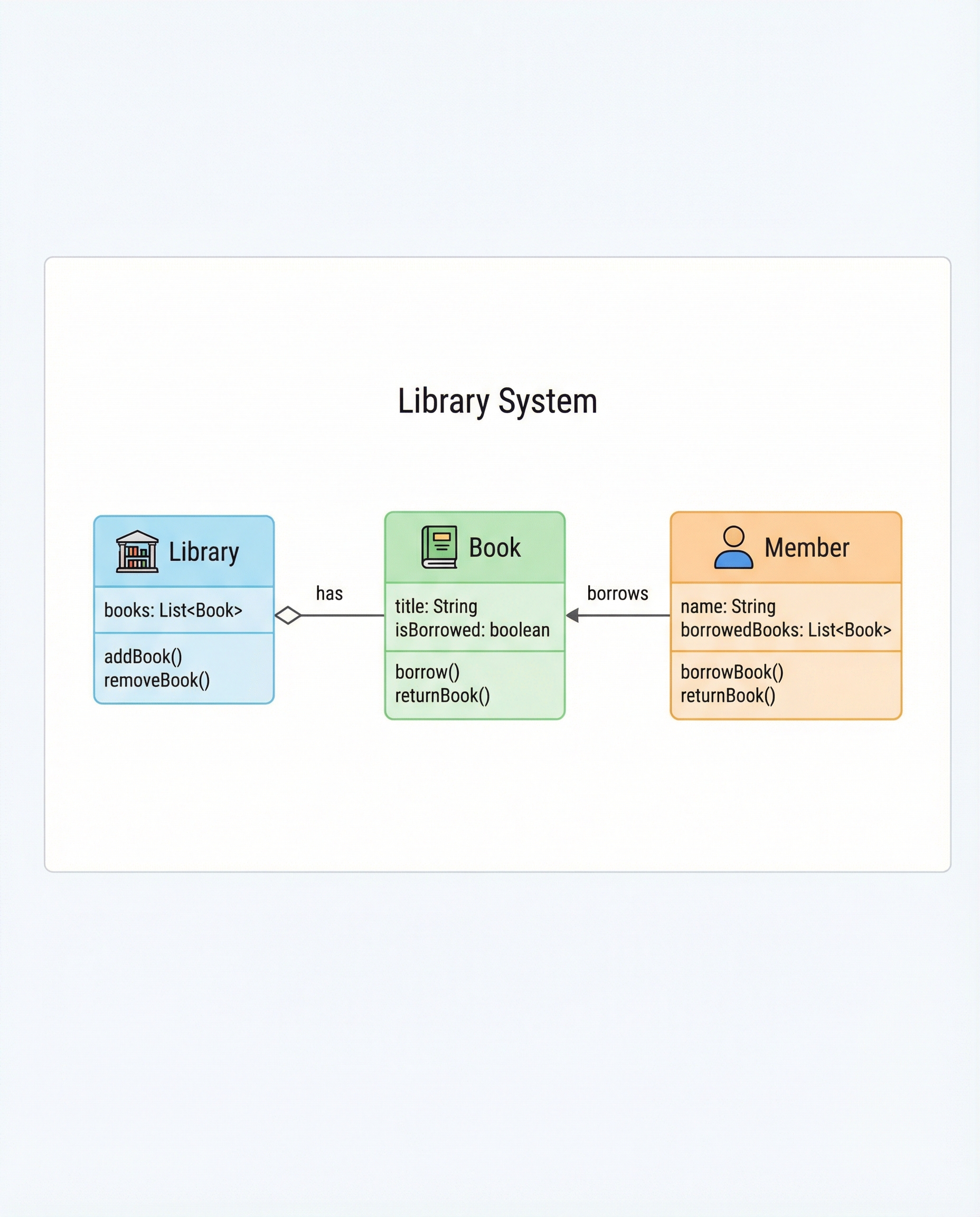
Example: Library System (quick walkthrough)
- Clarify: core features — add/remove books, borrow/return, search, membership.
- Entities: Library, Book, Catalog, Member, Loan (or BorrowRecord).
- Relationships:
- Library has Catalog and Members.
- Catalog contains Books (or BookCopies).
- Member can have multiple Loans; Loan references BookCopy and Member.
Simple class sketch (informal UML):
Library
 - catalog: Catalog
 - members: Map<MemberId, Member>
 + addBook(book)
 + registerMember(member)

Catalog
 - books: Map<ISBN, List<BookCopy>>
 + search(query): List<BookCopy>

BookCopy
 - id: String
 - isbn: String
 - status: AVAILABLE | LOANED

Member
 - id: String
 - loans: List<Loan>
 + borrow(bookCopy)
 + return(bookCopy)

Loan
 - bookCopyId
 - memberId
 - loanDate
 - dueDate
APIs to show during interview:
- Library.borrowBook(memberId, isbn)
- Library.returnBook(memberId, bookCopyId)
- Catalog.searchByTitle(title)
Trade-offs to mention:
- Track physical copies vs only metadata (consistency vs storage cost).
- Synchronous vs asynchronous notifications for overdue books.
- Concurrency control for borrow/return (optimistic lock vs synchronized access).
How to Present Answers in an Interview
- Start with a short summary of your approach and assumptions.
- Show entities and responsibilities quickly (1–2 min sketch).
- Drill into one or two classes and show method signatures—don’t write full code.
- Explain trade-offs and alternatives.
- If time permits, mention testing strategy and edge cases.
Practice Tips
- Whiteboard or paper: practice sketching designs under time.
- Talk out loud: interviewers listen to your reasoning, not just the final diagram.
- Do mock interviews and review common OOD problems.
- Build small projects emphasizing OOD (e.g., reservation system, chat room).
Final Checklist for Java OOD Interviews
- Describe which OOP principles you’re using.
- Pick Java constructs deliberately (interface vs abstract class, access level).
- Use simple, named patterns and state their trade-offs.
- Sketch a clear UML and present concise APIs.
- Explain concurrency, persistence, and scaling if relevant.
Focus on design thinking. Memorized snippets won't substitute for a clear, principled approach that you can explain under pressure.
#SoftwareEngineering #Java #SystemDesign
About the author
bugfree.ai is an advanced AI-powered platform designed to help software engineers master system design and behavioral interviews. Whether you’re preparing for your first interview or aiming to elevate your skills, bugfree.ai provides a robust toolkit tailored to your needs. Key Features:
150+ system design questions: Master challenges across all difficulty levels and problem types, including 30+ object-oriented design and 20+ machine learning design problems. Targeted practice: Sharpen your skills with focused exercises tailored to real-world interview scenarios. In-depth feedback: Get instant, detailed evaluations to refine your approach and level up your solutions. Expert guidance: Dive deep into walkthroughs of all system design solutions like design Twitter, TinyURL, and task schedulers. Learning materials: Access comprehensive guides, cheat sheets, and tutorials to deepen your understanding of system design concepts, from beginner to advanced. AI-powered mock interview: Practice in a realistic interview setting with AI-driven feedback to identify your strengths and areas for improvement.
bugfree.ai goes beyond traditional interview prep tools by combining a vast question library, detailed feedback, and interactive AI simulations. It’s the perfect platform to build confidence, hone your skills, and stand out in today’s competitive job market. Suitable for:
New graduates looking to crack their first system design interview. Experienced engineers seeking advanced practice and fine-tuning of skills. Career changers transitioning into technical roles with a need for structured learning and preparation.
Comments
Join the discussionNo comments yet. Be the first to comment.