Inventory Design Interview: Stop Storing Stock as a Simple Number
In e-commerce inventory design, treat the inventory ledger — not a single numeric field — as the source of truth. Instead of relying on a mutable stockLevel field, model every change as an immutable InventoryTransaction (Add / Remove / Return / Reserve). Derive the current stock from the transaction ledger. This simple mental shift gives you auditability, safer debugging, and robust handling of returns, cancellations, and edge cases.
Why this matters
- Auditability: an append-only ledger records who changed inventory, why, and when. You can answer: "When was the stock adjusted? By whom? For which order?"
- Reproducibility: you can rebuild stock state from the ledger at any time — useful after bugs, migrations, or for analytics.
- Safer debugging: instead of guessing what mutated
stockLevel, you inspect transactions to trace the cause. - Correct business semantics: returns, cancellations, reservations, and compensations are explicit transactions, not ad-hoc decrements/increments.
- Concurrency & consistency: when designed correctly, the pattern makes reasoning about races and compensating actions clearer.
Core model
Store immutable transactions with fields similar to:
InventoryTransaction {
  id            : uuid,
  product_id    : uuid,
  delta         : integer,   -- + for add/return, - for remove/sale
  type          : enum(ADD, REMOVE, RETURN, RESERVE, RELEASE),
  reason        : string,     -- e.g. orderId or returnId
  created_by    : uuid,       -- user/service id
  created_at    : timestamp
}
The current stock can be derived as:
stock = SUM(delta) WHERE product_id = X
Caching for performance
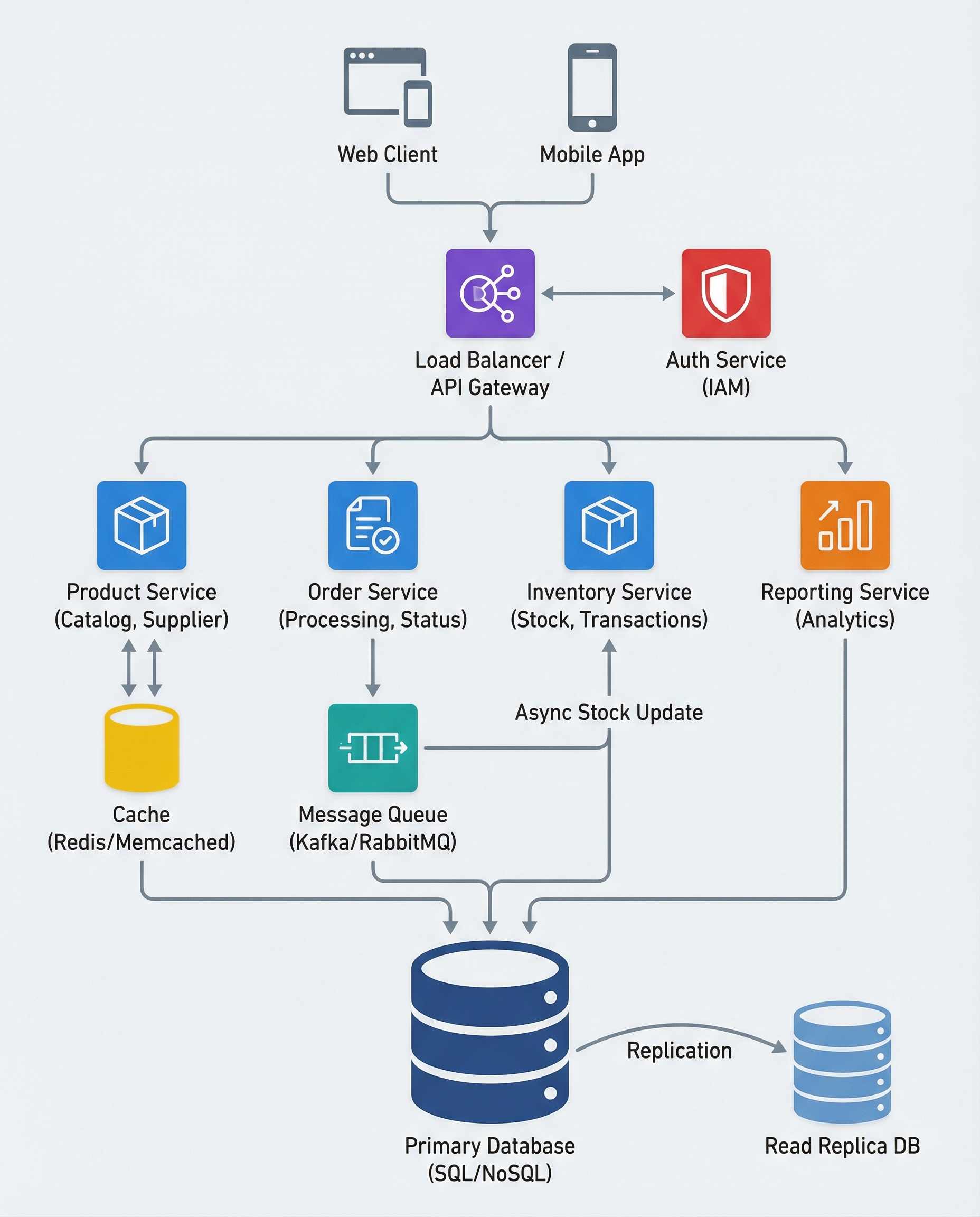
Computing SUM(delta) on the fly can be expensive. Keep a stockLevel as a cache for fast reads, but do not treat it as the authoritative source. Always append an InventoryTransaction first and update the cached stockLevel in the same atomic operation.
Recommended approaches:
- Database transaction: append the transaction row and update the stock cache in a single DB transaction so they stay in sync.
- Optimistic concurrency: store a version number on the cached row and use CAS/optimistic locking when updating, retrying on conflict.
- Event-sourcing / CQRS: emit an immutable inventory event to an event log, then materialize read models; provide reconciliation jobs to repair divergence.
Reservations vs. committed stock
Don’t conflate reservation (holding stock for a pending checkout) with committed sale. Model reservations explicitly as transactions (RESERVE/RELEASE) or as a separate ledger. This avoids accidental overselling and makes TTL or expiration handling explicit.
Handling idempotency and retries
Make transaction creation idempotent by using stable request IDs (e.g. order id + line id) or unique constraints so duplicate requests don’t create duplicate deltas. This is crucial for network retries and webhook replays.
Concurrency patterns
- Single DB row locking (SELECT ... FOR UPDATE) can be simple and correct for moderate scale.
- Optimistic updates with retries scale better in high-concurrency scenarios.
- Partitioning by product (or product shard) and routing requests avoids cross-shard contention.
What to say in an interview
Keep the message clear and concise. Example phrasing:
"I treat inventory as an append-only ledger of immutable InventoryTransactions. The ledger is the source of truth; stockLevel is a cached read model updated atomically alongside each transaction. This gives us a full audit trail, easier debugging, explicit handling of returns/reservations, and the ability to rebuild state if needed. For correctness I either update the transaction and cache in a DB transaction, or use an event-sourced pattern with reconciliation and idempotency guarantees."
Quick checklist to mention if asked follow-ups:
- Show the transaction schema and examples (ADD, REMOVE, RETURN, RESERVE).
- Explain atomic update strategy (DB transaction, optimistic lock, or event sourcing + materializer).
- Discuss reservations vs committed stock and TTL for holds.
- Describe idempotency keys to avoid duplicate deltas.
- Mention reconciliation jobs to repair any divergence between ledger and cached read model.
Summary
Stop treating stockLevel as the source of truth. Model every inventory change as a transaction in an append-only ledger, derive current quantities from that ledger, and maintain stockLevel only as a cached, performant read model updated atomically. This approach improves auditability, correctness, and maintainability — and it's a strong, interview-ready design decision.
#SystemDesign #OOP #SoftwareEngineering
About the author
bugfree.ai is an advanced AI-powered platform designed to help software engineers master system design and behavioral interviews. Whether you’re preparing for your first interview or aiming to elevate your skills, bugfree.ai provides a robust toolkit tailored to your needs. Key Features:
150+ system design questions: Master challenges across all difficulty levels and problem types, including 30+ object-oriented design and 20+ machine learning design problems. Targeted practice: Sharpen your skills with focused exercises tailored to real-world interview scenarios. In-depth feedback: Get instant, detailed evaluations to refine your approach and level up your solutions. Expert guidance: Dive deep into walkthroughs of all system design solutions like design Twitter, TinyURL, and task schedulers. Learning materials: Access comprehensive guides, cheat sheets, and tutorials to deepen your understanding of system design concepts, from beginner to advanced. AI-powered mock interview: Practice in a realistic interview setting with AI-driven feedback to identify your strengths and areas for improvement.
bugfree.ai goes beyond traditional interview prep tools by combining a vast question library, detailed feedback, and interactive AI simulations. It’s the perfect platform to build confidence, hone your skills, and stand out in today’s competitive job market. Suitable for:
New graduates looking to crack their first system design interview. Experienced engineers seeking advanced practice and fine-tuning of skills. Career changers transitioning into technical roles with a need for structured learning and preparation.
Comments
Join the discussionNo comments yet. Be the first to comment.